Here you can find details on the unique capabilities of the Acoustic Pipeline’s ultrasonic classifiers for detecting and identifying bats, which includes the identification of all European bat species, and other species groups that produce high-frequency sound.

Features, capabilities and performance
The species identification algorithms in the BTO Acoustic Pipeline deliver unique and unrivalled performance for bats and other wildlife.
The Acoustic Pipeline’s ultrasonic classifiers give higher quality performance than many other systems:
Identification of multiple species per file
The Pipeline classifiers don’t just focus on the species with the strongest signal. This means they can detect multiple simultaneous signals, including quieter species such as Barbastelle and Plecotus bats.
Separate identification of bat echolocation calls, social calls and feeding buzzes
Identifying social calls can be useful for distinguishing some bat species, where the echolocation calls are very similar. Depending on the species, social calls can also provide useful information on the proximity to a roost, and / or mating behaviour.
Identifying feeding buzzes may be useful for some bat species in providing quantitative information on feeding activity. Species identification based on feeding buzzes can also be useful for distinguishing some bat species, where the echolocation calls alone are very similar.
Identification of small terrestrial mammals
This is valuable for identifying species of conservation interest like Hazel Dormouse, and avoids confusion between small terrestrial mammals and bat species with similar calls.
Identification of bush-crickets
These may be of interest in their own right, or as a means to flag recordings that are only likely to include bush-crickets.
Warnings to identify where species are rare or unexpected
Region-specific warnings facilitate checking of high-profile records and cases where confidence in the identification is low.
Accuracy
As long as good practice is followed when deploying bat detectors, classifier performance for most commonly occurring species is very high.
For example, for European bats, manual verification of over 86,000 independent recordings shows that the true positive rate is in the range of 93–100%.
Speed
Speed depends on the size of the task.
- The speed of upload depends on your broadband capacity.
- Once uploaded, the average processing time is 15 minutes per GB.
The Support Hub details the technical requirements for using Acoustic Pipeline ultrasonic classifiers.
Geographic coverage and species scope
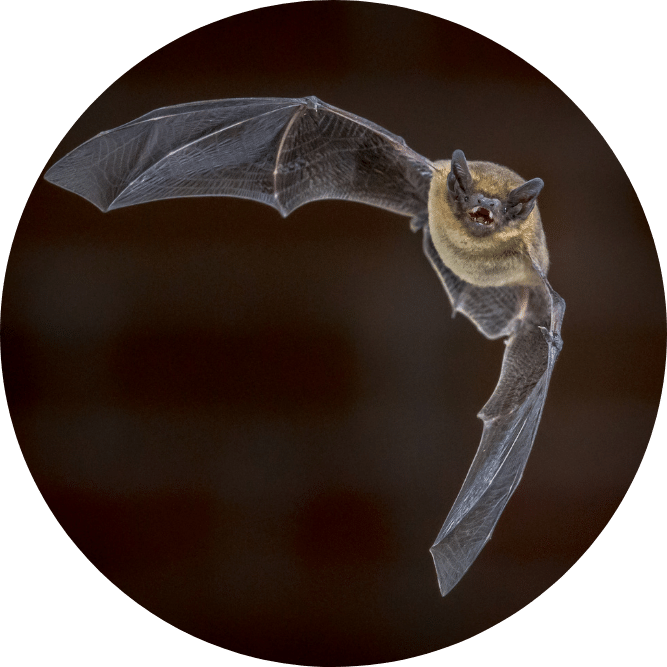 The BTO Acoustic Pipeline’s ultrasonic classifiers cover all European bat species, including important regional and island variation.
We provide different classifiers for the countries and regions of Europe to reflect the different communities of bats and other species present across the continent. The Pipeline will automatically choose the right classifier for your recording location.
Collectively, the classifiers can identify all European bat species and most bat species in North Africa (69 bat species). They also identify over 26 small terrestrial mammal species and over 25 bush-cricket species.
- Identification support for European bat species (online app). This free app provides detailed species-level identification information and may be useful when verifying identifications made by the Pipeline.
If you have ultrasonic recordings of species the classifier doesn’t currently cover please do get in touch – we are always keen to further extend our classifiers’ capabilities.
Quality assurance
This dataset has been collected and collated by Stuart Newson through almost two decades of focused work on acoustic identification, covering bats as well as other species groups commonly recorded as by-catch during bat surveys.
A key strength of the BTO Acoustic Pipeline is the quality and provenance of the data used to train its classifiers. Recordings have been selected through highly targeted fieldwork and expert review to ensure that species identifications are robust before they are used in model development. This emphasis on carefully validated reference material is central to the reliability of the system.
This approach distinguishes the BTO Acoustic Pipeline from many newer AI-based platforms that rely heavily on crowd-sourced field recordings. Although such datasets can be large, they may include uncertain, inconsistent or incorrectly labelled examples, particularly for species groups that are difficult to separate acoustically. These limitations are often most apparent in the performance for more challenging groups such as Myotis and Plecotus, where expert knowledge and carefully validated training data are especially important.
Stuart’s work has also contributed to a wider suite of resources that support acoustic identification across multiple species groups, including bats, bush-crickets and small mammals. These resources help improve confidence in species identification and support the wider use of acoustic monitoring in ecological research and conservation.
Pioneering work
This includes pioneering work on sound identification of small mammals in Britain and Ireland, which was published in British Wildlife.
- This work is covered in more detail in Stuart’s book, coauthored with Neil Middleton and Huma Pearce: Sound Identification of Terrestrial Mammals of Britain and Ireland, available from Pelagic Publishing.
Case studies and testimonials
 Providing baseline data, improving data for planning decisions, and opportunities for citizen science: the BTO Acoustic Pipeline is used in a range of projects across the world.
- Read more about its use on our case studies page.
The Acoustic Pipeline has allowed us to interpret huge amounts of data to gain some really interesting results on our local bat populations. It is the first time we have been able to gain this kind of data on a taxa throughout the whole Bailiwick. The friendly user interface has made our citizen science project so much easier to coordinate and the almost instant interpretation has engaged the community with bats in a way we never expected.Emily Coule, Agriculture, Countryside and Land Management Services, States of Guernsey
Get in touch
Interested in a Pipeline Project?
We’d love to hear from you.
You can reach us at acoustic.pipeline@bto.org
