Planting fruiting shrubs, trees, climbers or herbaceous plants in your garden is a great way to provide a natural food source for birds, from late summer through to winter time. Find out why fruiting plants are so beneficial for birds, use our list of fruiting garden plants for birds to help you decide which plants might be appropriate for your garden and which are native, introduced and invasive.
Why fruiting plants are so beneficial for birds
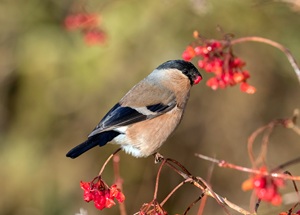
Many birds rely on berries and fruits in autumn and winter, when other sources of food such as insects are scarce. However, changes to the wider countryside - like agricultural intensification, biodiversity loss and habitat destruction - have reduced the amount of scrub and woodland habitat where berries naturally occur. Without enough high-energy food, birds are less likely to survive winter, and may start the breeding season in poor condition.
Growing berry plants in your garden ensures that birds can find the vital energy and nutrients they need to live through the colder months and start the breeding season in good health.
Examples of fruiting trees for birds
These four fruiting trees are popular choices for gardens, and are suitable for smaller spaces too. They are native to the UK, which means they are likely to support more wildlife than introduced plant species.
Guelder-rose (Viburnum opulus)

Guelder-rose is a small tree or shrub that can be found across most of Britain and Ireland. It is most suitable for lowland neutral or calcareous soils, often on damp ground, but it is also widely planted in gardens and amenity parkland. The cultivar ‘Compactum’ is ideal for small gardens and can even be grown in a container.
The white flowers of Guelder-rose are followed by clusters of bright red, slightly translucent fruits from September or early October. These autumn fruits are particularly popular with Bullfinches and Mistle Thrushes.
The fruits are of low toxicity to humans, but may cause vomiting if eaten raw.
Hawthorn (Crataegus monogyna) and Midland Hawthorn (Crataegus laevigata)
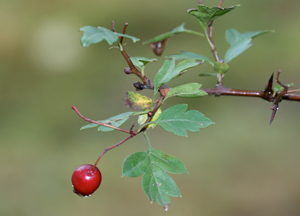 Hawthorn and Midland Hawthorn are very similar in appearance, although Midland Hawthorn has a much more restricted distribution. Both species tolerate a wide range of conditions but prefer dry to moist, not waterlogged, soils.
Hawthorn is found across Britain and Ireland, although it is absent from parts of northern Scotland. It is mainly associated with scrub, open woodland and hedgerows, and its frothy white flowers are a familiar sight in spring.
Midland Hawthorn grows mainly in lowland England, associated with ancient woodland and old hedgerows on clay soils. Records of Midland Hawthorn from outside this core range (including a scatter of records from Scotland and Ireland) mostly refer to planted populations.
The fruits of both species are known as haws. They are usually scarlet and shiny when first ripe in early August, darkening to crimson and losing their shine with age, although yellow-fruiting forms of Hawthorn have been recorded. Although some haws ripen by late summer, they often persist on the tree well into winter (unless they have been eaten!), providing a valuable source of food in the coldest months.
Hawthorn is strongly associated with migrating winter thrushes, such as Redwings, Fieldfares, Blackbirds and Mistle Thrushes. Hedgerows, scrub patches and gardens containing hawthorn are often visited by large flocks of these birds during winter.
Spindle (Euonymous europaeus)
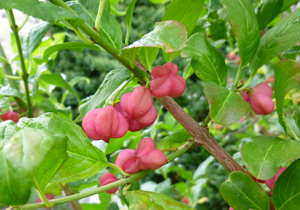
Spindle grows wild in the UK on free-draining soils, particularly those overlying chalk and limestone. It is most commonly encountered in the southern part of Britain and across Ireland, with a few records from Scotland presumed to be introductions via planted stock.
Spindle trees have unusual fruits that are coral-pink and deeply lobed. They ripen in autumn, usually from September to November, each lobe splitting open to reveal a single seed, with a bright orange seed covering. The fruits are eaten during early winter by a range of birds, including Starlings and thrushes.
The fruits are toxic to humans and have a strong laxative effect.
Yew (Taxus baccatus)
 Yew is widely distributed across Britain and Ireland, found most often on well-drained calcareous soils. It has been widely established in larger gardens, churchyards and amenity parkland, sometimes used as a hedge. Its evergreen nature makes it useful for nesting and sheltering birds.
Yew fruits, which ripen in September or October, are eaten by a range of species, with trees being visited by ‘falls’ of migrating birds such as Redwings and Fieldfares in the autumn months. The birds make use of the high-energy fruit, while the highly toxic seeds pass through their digestive tract. Like the seeds, the leaves and other parts of the plant are also poisonous, and can be lethal if ingested by humans or pets.
Dig deeper into gardening for birds
Visit the BTO Shop to browse our selection of expert books about garden birds, garden wildlife and wildlife gardening.
List of fruiting garden plants for birds
The lists below include fruiting plants commonly available in local garden centres, that have been associated with seed dispersal by birds in the UK and may be good food sources for birds during the fruiting period. We have included the status of each species to help you decide which plants are right for your garden. You can also find out more about each plant on the RHS Plant Finder.
Native plants for berries and fruit
Native plants are those which have been growing in the UK for many thousands of years, without human assistance. They are usually considered to be of higher value to UK wildlife than introduced species and are well-adapted to growing conditions in the UK. Many native species have become established outside their natural range by “escaping” from gardens and surviving in the wild; not all UK native species will be native to your local area.
These lists include a mixture of trees, shrubs, herbaceous plants and climbers, some of which are suited to smaller gardens or even containers.
Trees and large shrubs | |
|---|---|
| English name | Scientific name |
| Alder Buckthorn | Frangula alnus |
| Barberry | Berberis vulgaris |
| Blackthorn | Prunus spinosa |
| Buckthorn (Purging Buckthorn) | Rhamnus cathartica |
| Cherry, Bird | Prunus padus |
| Cherry, Wild | Prunus avium |
| Crab-apple | Malus sylvestris |
| Dogwood | Cornus sanguinea |
| Elder | Sambucus nigra |
| Guelder-rose | Viburnum opulus |
| Hawthorn | Crataegus monogyna |
| Hawthorn, Midland | Crataegus laevigata |
| Holly | Ilex aquifolium |
| Juniper | Juniperus communis |
| Privet, Wild | Ligustrum vulgare |
| Rowan | Sorbus aucuparia |
| Sea-buckthorn (in England and Wales only) | Hippophae rhamnoides |
| Spindle | Euonymus europaeus |
| Strawberry-tree | Arbutus unedo |
| Wayfaring Tree | Viburnum lantana |
| Whitebeam | Sorbus aria |
| Wild Service-tree | Sorbus torminalis |
| Yew | Taxus baccata |
Native | Introduced | Invasive
Small shrubs and herbaceous plants | |
|---|---|
| English name | Scientific name |
| Iris, Gladwyn (Stinking) | Iris foetidissima |
| Lily-of-the-valley | Convallaria majalis |
| Lords-and-Ladies | Arum maculatum |
| Rose, Burnet | Rosa pimpinellifolia |
| Rose, Field | Rosa arvensis |
| Rose, Dog | Rosa canina agg. |
| Rose, Small-flowered Sweet-briar | Rosa micrantha |
| Rose, Sweet-briar | Rosa rubiginosa |
| Solomon's-seal, Angular | Polygonatum odoratum |
Native | Introduced | Invasive
Climbers | |
|---|---|
| English name | Scientific name |
| Bittersweet | Solanum dulcamara |
| White Bryony | Bryonia dioica |
| Common Honeysuckle | Lonicera periclymenum |
| Ivy | Hedera helix |
| Mistletoe | Viscum album |
Native | Introduced | Invasive
Introduced garden plants for fruit and berries
Many plants grown in gardens are not native. These are known as introduced plants. They started growing in the UK because humans brought them here (either accidentally or deliberately), and are sometimes referred to as non-native. Introduced plants can spread into the wild from cultivated areas like parks and gardens, and are often referred to as garden escapes or naturalised plant species.
Trees and large shrubs | |
|---|---|
| English name | Scientific name |
| Apple | Malus domestica |
| Berberis (Barberry) | Berberis |
| Blackcurrant | Ribes nigrum |
| Cherry, Dwarf | Prunus cerasus |
| Cotoneaster, Franchet’s | Cotoneaster franchetii |
| Cotoneaster, Late | Cotoneaster lacteus |
| Cotoneaster, Willow-leaved | Cotoneaster salicifolius |
| Dogwood, Red-osier | Cornus sericea |
| Duke of Argyll’s Tea-plant | Lycium barbarum |
| Firethorn | Pyracantha coccinea |
| Gooseberry | Ribes uva-crispa |
| Juneberry (Serviceberry) | Amelanchier lamarckii |
| Laurel, Cherry | Prunus laurocerasus |
| Laurel, Portugal | Prunus lusitanica |
| Laurustinus | Viburnum tinus |
| Medlar | Mespilus germanica |
| Oregon-grape | Mahonia aquifolium |
| Pear | Pyrus communis |
| Plum, Cherry | Prunus cerasifera |
| Plum, Wild | Prunus domestica |
| Privet, Garden | Ligustrum ovalifolium |
| Solomon’s-seal, Garden | Polygonatum multiflorum x P. odoratum |
| Spurge Laurel | Daphne laureola |
Native | Introduced | Invasive
Invasive fruit-producing plants
When introduced plants spread and out-compete native species, causing significant damage to habitats and ecosystems, they are referred to as invasive. Some fruiting plants are legally recognised as invasive due to the scale of their impact; these are listed on Schedule 9 of the Wildlife and Countryside Act.
We have included the Schedule 9 plants in this list because many are still available to buy from garden centres. However, for each of these species, it is an offence to plant them in the wild (in Scotland) or to cause them to grow in the wild (in England, Wales and Northern Ireland).
| English name | Scientific name |
|---|---|
| Cotoneaster, Himalayan - Schedule 9 | Cotoneaster simonsii |
| Cotoneaster, Hollyberry - Schedule 9 | Cotoneaster bullatus |
| Cotoneaster, Small-leaved - Schedule 9 | Cotoneaster microphyllus agg. |
| Cotoneaster, Wall - Schedule 9 | Cotoneaster horizontalis |
| Rose, Japanese | Rosa rugosa |
| Salmonberry | Rubus spectabilis |
| Sea-buckthorn (in Northern Ireland and Scotland only) | Hippophae rhamnoides |
Native | Introduced | Invasive
Get involved
Join our citizen science projects and deepen your understanding of birds and wildlife around you. Collecting data about the birds you see in your garden, as well as other locations and habitats, is vital for BTO because it helps improve our understanding of bird populations and migration behaviour across the UK.
Two projects in particular that might be of interest are Garden BirdWatch, which involves recording the birds you see in your garden – even five or ten minutes a day is helpful. You might also like to take part in the Winter Bird Survey which involves identifying the birds that are likely to be encountered in autumn and winter in your survey square, and recording some simple information about the surrounding habitat.