Short-toed Treecreeper
Introduction
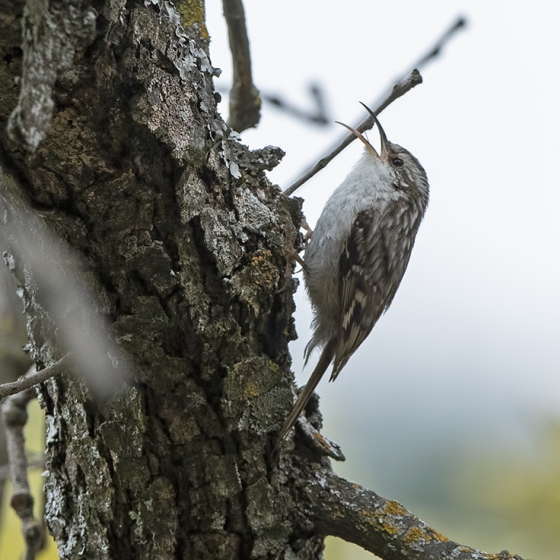
Although widely distributed in Europe (including the Channel Islands), the Short-toed Treecreeper is a very rare visitor to Britain (and hasn't been recorded in Ireland).
It looks extremely similar to the more familiar Treecreeper and is best distinguished by its song.
Key Stats







Status and Trends
Conservation Status
Population Size
Population Change
Short-toed Treecreeper is a fairly common breeding bird on Jersey and Guernsey [Young et al. 2019] but an extremely rare bird elsewhere in the UK, with only about two records received each year [Bacon et al. 2024]. The species is thought to have increased moderately across Europe since 1982 [PECBMS: PECBMS 2020a].
Distribution
Within the region covered by th Britain & Ireland atlases the Short-toed Treecreeper is restricted to the Channel Islands. Occasional vagrants are identified on the south and east coasts of Britain, including one record during the Atlas period, but none have yet shown signs of breeding.
Occupied 10-km squares in UK
2007/08–10/11
or view it on Bird Atlas Mapstore.
2008–11
or view it on Bird Atlas Mapstore.
European Distribution Map
Distribution Change
Change in occupied 10-km squares in the UK
from 1981–84 to 2007–11
or view it on Bird Atlas Mapstore.
from 1968–72 to 2008–11
or view it on Bird Atlas Mapstore.
Seasonality
This species has been too rarely reported to BirdTrack during 2011–22 to properly assess seasonality.
Movement
Britain & Ireland movement
Foreign locations of birds ringed or recovered in Britain & Ireland
Dots show the foreign destinations of birds ringed in Britain & Ireland, and the origins of birds ringed overseas that were subsequently recaptured, resighted or found dead in Britain & Ireland. Dot colours indicate the time of year that the species was present at the location.
- Winter (Nov-Feb)
- Spring (Mar-Apr)
- Summer (May-Jul)
- Autumn (Aug-Oct)

European movements
EuroBirdPortal uses birdwatcher's records, such as those logged in BirdTrack to map the flows of birds as they arrive and depart Europe. See maps for this species here.
The Eurasian-African Migration Atlas shows movements of individual birds ringed or recovered in Europe. See maps for this species here.
Biology
Survival and Longevity
Survival is shown as the proportion of birds surviving from one year to the next and is derived from bird ringing data. It can also be used to estimate how long birds typically live.
View number ringed each year in the Online Ringing Report.
Classification, names and codes
Classification and Codes
- Order: Passeriformes
- Family: Certhiidae
- Scientific name: Certhia brachydactyla
- Authority: CL Brehm, 1820
- BTO 2-letter code: TH
- BTO 5-letter code: SHTTR
- Euring code number: 14870
Alternate species names
- Catalan: raspinell comú
- Czech: šoupálek krátkoprstý
- Danish: Korttået Træløber / Parktræløber
- Dutch: Boomkruiper
- Estonian: aedporr
- Finnish: etelänpuukiipijä
- French: Grimpereau des jardins
- German: Gartenbaumläufer
- Hungarian: rövidkarmú fakusz
- Icelandic: Garðfeti
- Italian: Rampichino comune
- Latvian: ispirkstu mizložna
- Lithuanian: sodinis liputis
- Norwegian: Kortklotrekryper
- Polish: pelzacz ogrodowy
- Portuguese: trepadeira
- Slovak: kôrovník krátkoprstý
- Slovenian: kratkoprsti plezalcek
- Spanish: Agateador europeo
- Swedish: trädgårdsträdkrypare
- Welsh: Dringwr Bach Bodiau-cwta
Research
Publications (1)
A method to evaluate the combined effect of tree species composition and woodland structure on indicator birds
Author:
Published: 2015
Providing quantitative management guidelines is essential for an effective conservation of forest-dependent animal communities. Traditional forest practices at the stand scale simultaneously alter both physical and floristic features with a negative effect on ecosystem processes. Thus, we tested and proposed a method to define forestry prescriptions taking into account the combined effect of woodland structure and tree species composition on the presence of four bird indicator species (Marsh Tit Poecile palustris, European Nuthatch Sitta europaea, Short-toed Tree-creeper Certhya brachydactyla and Blue Tit Cyanistes caeruleus). The study was carried out in Lombardy (Northern Italy), from 2002 to 2005. By using a stratified cluster sampling design, we recorded Basal Area, one hundred tree trunk diameters at breast height (DBH) and tree species in 160 sampling plots, grouped in 23 sampling areas. In each plot we also performed a bird survey using the point count method. We analyzed data using Multimodel Inference and Model Averaging on Generalized Linear Mixed Models, with species presence/absence as the response variable, sampling area as a random factor and forest covariates as fixed factors. In order to test our method, we compared it with other two traditional approaches, which consider structural and tree floristic variables separately. Model comparison showed that our method performed better than traditional ones, in both the evaluation and validation processes. Based on our main results, in deciduous mixed forest where the exploitation demand is limited, we recommend maintaining at least 65 trees/ha with DBH>45cm. In particular, we advise keeping 70 trees/ha with DBH>50cm in chestnut forests and 300 trees/ha with DBH 20–30cm in oak forests. Conversely, in more exploited oak forests, we advise maintaining at least 670 trees/ha with DBH 15–30cm in chestnut forests and 100 trees/ha with DBH 10–15cm. Providing quantitative management guidelines is essential for an effective conservation of forest-dependent animal communities. Traditional forest practices at the stand scale simultaneously alter both physical and floristic features with a negative effect on ecosystem processes. Thus, we tested and proposed a method to define forestry prescriptions taking into account the combined effect of woodland structure and tree species composition on the presence of four bird indicator species (Marsh Tit Poecile palustris, European Nuthatch Sitta europaea, Short-toed Tree-creeper Certhya brachydactyla and Blue Tit Cyanistes caeruleus). The study was carried out in Lombardy (Northern Italy), from 2002 to 2005. By using a stratified cluster sampling design, we recorded Basal Area, one hundred tree trunk diameters at breast height (DBH) and tree species in 160 sampling plots, grouped in 23 sampling areas. In each plot we also performed a bird survey using the point count method. We analyzed data using Multimodel Inference and Model Averaging on Generalized Linear Mixed Models, with species presence/absence as the response variable, sampling area as a random factor and forest covariates as fixed factors. In order to test our method, we compared it with other two traditional approaches, which consider structural and tree floristic variables separately. Model comparison showed that our method performed better than traditional ones, in both the evaluation and validation processes. Based on our main results, in deciduous mixed forest where the exploitation demand is limited, we recommend maintaining at least 65 trees/ha with DBH>45cm. In particular, we advise keeping 70 trees/ha with DBH>50cm in chestnut forests and 300 trees/ha with DBH 20–30cm in oak forests. Conversely, in more exploited oak forests, we advise maintaining at least 670 trees/ha with DBH 15–30cm in chestnut forests and 100 trees/ha with DBH 10–15cm.
01.04.15
Papers
More Evidence
More evidence from Conservation Evidence.com
Partners




Citing BirdFacts
If you wish to cite particular content in this page (e.g. a specific value) it is best to use the original sources as linked in the page. For a more general citation of the whole page please use: BTO (20XX) BirdFacts Species: profiles of birds occurring in the United Kingdom. BTO, Thetford (www.bto.org/birdfacts, accessed on xx/xx/xxxx).