Pied Flycatcher
Introduction
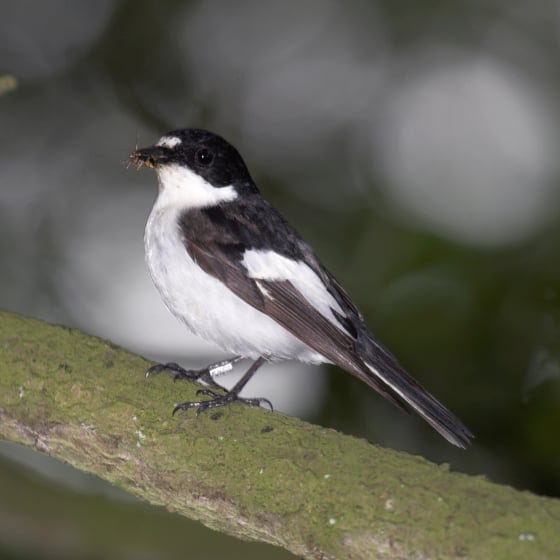
The black and white male, sporting two white spots on the forehead, and the subtle brown and white female are scarce breeders in Britain and rare breeders in Ireland.
Wales's Oak woodlands are very much the breeding stronghold for this summer visitor but breeding populations can also be found in Scotland, and northern, central and south-west England. The Pied Flycatcher leaves its breeding territories in August and can be seen on migration during September and into October as it makes its way to its trans-Saharan winter quarters.
Pied Flycatchers begin arriving back during April and can be spotted at coastal migration watchpoints and they head back to their breeding locations. The UK population declined around the turn of the millennium, but this decrease has since levelled off.
- Our Trends Explorer gives you the latest insight into how this species' population is changing.
Key Stats










Identification
Songs and Calls
Song:
Call:
Status and Trends
Conservation Status
Population Change
Pied Flycatchers are restricted to upland deciduous woods in parts of western and northern Britain. The proportions of CBC plots occupied rose during the 1980s, but the species was never numerous enough for trends to be estimated (Marchant et al. 1990). The 1988-91 breeding atlas revealed a small expansion in range from 1968-72, aided by the provision of nest boxes in new areas (Gibbons et al. 1993). BBS indicates that a decrease in abundance has occurred since 1995, prompting the species to be moved from the green to the amber list in 2009 and subsequently from amber to the UK red list at the latest review in 2015 (Eaton et al. 2015). This decrease occurred mainly in the late-1990s and early 2000s and the subsequent trend has been broadly stable. Nest-box occupancy rates have also fallen over a similar period at a number of sites monitored as RAS projects. There has been a across Europe since 1980 (PECBMS: PECBMS 2020a>).
Distribution
Breeding Pied Flycatchers are associated with the mature upland woodlands of western and northern Britain. They are widely distributed across most of Wales, parts of Shropshire and Herefordshire, and in northwest England from West Yorkshire through Cumbria to Northumberland, but are more patchily distributed in western Scotland.
Occupied 10-km squares in UK
2007/08–10/11
or view it on Bird Atlas Mapstore.
2008–11
or view it on Bird Atlas Mapstore.
European Distribution Map
Distribution Change
Marked range changes have occurred over the last 40 years or so. Pied Flycatcher breeding range expanded by 35% between 1968–72 and 1988–91 but there was a subsequent 27% range contraction from 1988–91 to 2008–11. Together these changes hint at a subtle westerly and northerly shift in distribution, with most of the recent losses involving thinning of the range along its eastern fringe and in southwest England. There has been a concurrent reduction in relative abundance almost everywhere since 1988–91.
Change in occupied 10-km squares in the UK
from 1981–84 to 2007–11
or view it on Bird Atlas Mapstore.
from 1968–72 to 2008–11
or view it on Bird Atlas Mapstore.
Seasonality
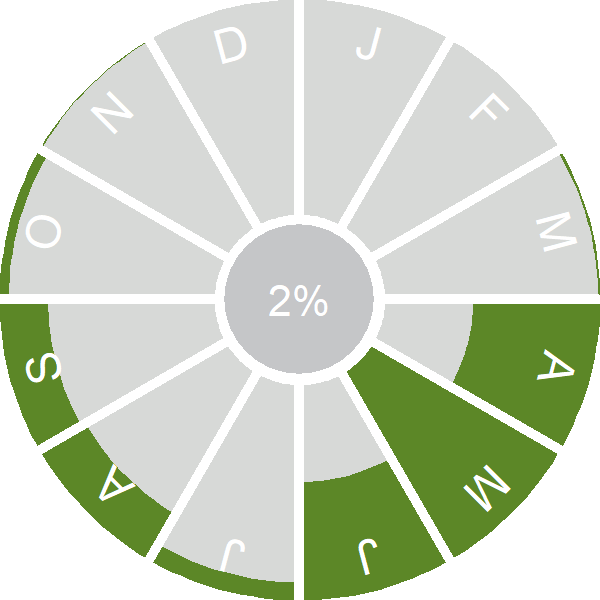
Pied Flycatcher is a localised summer migrant, arriving from mid April; autumn passage includes many continental birds and extents through August, September and early October.
Weekly pattern of occurrence
The graph shows when the species is present in the UK, with taller bars indicating a higher likelihood of encountering the species in appropriate regions and habitats.

Movement
Britain & Ireland movement
Foreign locations of birds ringed or recovered in Britain & Ireland
Dots show the foreign destinations of birds ringed in Britain & Ireland, and the origins of birds ringed overseas that were subsequently recaptured, resighted or found dead in Britain & Ireland. Dot colours indicate the time of year that the species was present at the location.
- Winter (Nov-Feb)
- Spring (Mar-Apr)
- Summer (May-Jul)
- Autumn (Aug-Oct)

European movements
EuroBirdPortal uses birdwatcher's records, such as those logged in BirdTrack to map the flows of birds as they arrive and depart Europe. See maps for this species here.
The Eurasian-African Migration Atlas shows movements of individual birds ringed or recovered in Europe. See maps for this species here.
Biology
Productivity and Nesting
Nesting timing
Egg measurements
Clutch Size
Incubation
Fledging
Survival and Longevity
Survival is shown as the proportion of birds surviving from one year to the next and is derived from bird ringing data. It can also be used to estimate how long birds typically live.
View number ringed each year in the Online Ringing Report.
Lifespan
Survival of adults
Survival of juveniles
Biometrics
Wing length and body weights are from live birds (source).
Wing length
Body weight
Ring Size
Classification, names and codes
Classification and Codes
- Order: Passeriformes
- Family: Muscicapidae
- Scientific name: Ficedula hypoleuca
- Authority: Pallas, 1764
- BTO 2-letter code: PF
- BTO 5-letter code: PIEFL
- Euring code number: 13490
Alternate species names
- Catalan: mastegatatxes
- Czech: lejsek cernohlavý
- Danish: Broget Fluesnapper
- Dutch: Bonte Vliegenvanger
- Estonian: must-kärbsenäpp
- Finnish: kirjosieppo
- French: Gobemouche noir
- Gaelic: Breacan-glas
- German: Trauerschnäpper
- Hungarian: kormos légykapó
- Icelandic: Flekkugrípur
- Irish: Cuilire Alabhreac
- Italian: Balia nera
- Latvian: melnais muškerajs
- Lithuanian: margasparne musinuke
- Norwegian: Svarthvit fluesnapper
- Polish: mucholówka zalobna
- Portuguese: papa-moscas
- Slovak: muchárik ciernohlavý
- Slovenian: crnoglavi muhar
- Spanish: Papamoscas cerrojillo
- Swedish: svartvit flugsnappare
- Welsh: Gwybedog Brith
- English folkname(s): Coldfinch
Research
Causes of Change and Solutions
Causes of change
The reasons for this decline are unknown, but there is good evidence that they lie at least partly outside the breeding season and are thought to be linked to changing conditions on wintering grounds and migration.
Further information on causes of change
The reasons for this decline are unknown, but there is good evidence that they lie at least partly outside the breeding season (Goodenough et al. 2009). No trends are evident in the number of fledglings per breeding attempt. Although the failure rate at the egg stage has shown a decrease, failure rate at the chick stage has increased. Clutch size increased until the mid-2000s but has since decreased slightly.
A study in the Netherlands found that a large proportion of Pied Flycatchers arrive later at the breeding grounds and do not breed in their first adult year (Both et al. 2017). Assuming that the same is true in the UK, this may complicate interpretation of trends and modelling to investigate the causes of change, particularly if the proportion of non-breeding first-year birds varies regionally and over time. Fatal interspecific competition for nest boxes is higher when Pied Flycatcher arrival coincides with peak laying in Great Tit, although late arriving male Pied Flycatchers were most likely to killed and therefore the deaths did not have any effect on the breeding population (Samplonius et al. 2019).
There is good evidence that declines are related to conditions outside the breeding season. Mallord et al. (2016) found no evidence that changes in woodland structure affected populations in six study areas in the west of the UK. Goodenough et al. (2009) found that decreasing breeding performance is contributing to decline, but that non-breeding factors are more important. Winter NAO index is a strong predictor of breeding population, probably because the North Atlantic oscillation influences food abundance in Africa and at migratory stopover points. Long-term autumn bird monitoring data from Russia were related to monthly mean temperatures on the West African wintering grounds; the positive relationship suggests that increasing bird numbers are explained by increasing mean November temperatures. Precipitation and European autumn, spring and breeding-range temperatures did not show a strong relationship (Chernetsov & Huettmann 2005). Thingstad et al. (2006) found that weather conditions at the flycatcher's wintering areas in western Africa were suspected to be responsible for the decrease in Scandinavia, although the breeding success of the sink populations was significantly correlated to June temperatures.
In the Netherlands, climate change may have brought about decline in Pied Flycatchers by advancing the peak period of food availability for this species in deciduous forests - the birds being unable to compensate for the change in food supply by breeding earlier (Both 2002, Both et al. 2006). A subsequent paper found that timing of spring migration has responded flexibly to climate change as recovery dates during spring migration in North Africa advanced by ten days between 1980 and 2002, which was explained by improving Sahel rainfall and a phenotypic effect of birth date. However, there was no advance in arrival dates on the breeding grounds, most likely due to environmental constraints during migration (Both 2010). Futhermore, declines were found to be stronger in forests, as these were more seasonal habitats whereas less seasonal marshes showed less steep declines (Both et al. 2009). Another more recent study in the Netherlands confirmed that arrival dates had not changed, but found that the timing of breeding and moult had both advanced, with earlier breeding increasing the time available for fledgling development and the probability that they will survive and join the breeding population (Tomotani et al. 2018). Climate change was also given as a potential factor by a Swedish study, that suggested warmer springs favoured resident Blue Tits and Great Tits over Pied Flycatchers, which were not able to adjust to increasing spring temperatures (Wittwer et al. 2015). Another study, looking at 10 European nest box schemes (including one in the UK) found that, although both tits and Pied Flycatchers had advanced their laying dates, tits had advanced more strongly by, on average, approximately one day per decade between 1991 and 2015 (Samplonius et al. 2018). It should be noted, however, that data presented here show that Pied Flycatchers in the UK have advanced their laying date by ten days since 1967, matching the change shown by Great Tit and exceeding the change of Blue Tit by two days.
Information about conservation actions
The reasons for the decline are unknown but it is likely that they lie at least partly outside the breeding season and hence it is uncertain whether conservation actions taken in the UK will have significant effects on the population trend.
However, Goodenough et al. (2009) suggested that, although less important than non-breeding factors, decreasing breeding performance may also be contributing to the decline, Therefore, breeding season conservation actions do remain useful for this species. Goodenough et al. (2009) recommend both the optimal placement of nestboxes (avoiding south-west facing boxes) and the management of woodland habitat to provide host plants for lepidotera larvae in order to increase food supplies. Elsewhere, a study in Finland found that birds preferred large (>5 ha) or medium sized (>1 ha) deciduous woodlands with the larger woods occupied first (Huhta et al. 2008); hence suitable sized patches of mature wood within the range of this species should be conserved where possible.
Publications (7)
Declines in invertebrates and birds – could they be linked by climate change?
Author:
Published: 2023
The long-term declines evident in many bird and invertebrate species have their origins within a suite of potential drivers, one of which is climate change. As well as impacting bird species directly, could climate change be increasingly hitting bird populations through its impacts on their invertebrate prey?
09.01.23
Papers

A review of the impacts of air pollution on terrestrial birds
Author:
Published: 2023
A review paper by BTO considers 203 studies of the effects of air pollution on 231 bird species. Of these studies, 82% document at least one negative effect associated with increasing levels of pollution. The review also highlights biases towards particular study species, especially Great Tit and Pied Flycatcher, and also towards particular geographical regions (Western Europe) and pollutants (heavy metals). The paper proposes research approaches that could help to provide a fuller understanding of how birds are impacted by air pollution.
15.05.23
Papers

Birds of Conservation Concern Wales 4: the population status of birds in Wales
Author:
Published: 2022
The latest review of the conservation status of birds in Wales. The report assessed all 220 bird species which regularly occur in Wales. There are now 60 species of bird on the Red List, with 91 on the Amber List and just 69 - less than a third of the total number of species - on the Green List. The latest review of the conservation status of birds in Wales comes 20 years after the first, when the Red List was less than half the length it is today. The report assessed all 220 bird species which regularly occur in Wales. There are now 60 species of bird on the Red List in Wales, with 91 on the Amber List and 69 on the Green List. The Birds of Conservation Concern in Wales report assesses the status of each species against a set of objective criteria. Data sources include the BTO/JNCC/RSPB Breeding Bird Survey and the BTO/RSPB/JNCC Wetland Bird Survey, as well as Bird Atlases and other BTO-led monitoring schemes and citizen science initiatives. These are used to quantify the changing status of the species’ Welsh population. The UK, European and global conservation status of the species is also considered, placing the Welsh population into a wider context. The Red ListSwift, Greenfinch and Rook – familiar breeding species in steep decline across the UK – are among the new additions to the Welsh Red List, which now also includes Purple Sandpiper, on account of a rapidly shrinking Welsh wintering population, and Leach’s Petrel, an enigmatic seabird in decline across its global range. These species now sit alongside well-known conservation priorities, such as Curlew, Hen Harrier and Turtle Dove as birds at risk of being lost from Wales for good. Uplands and woodlands Many of the species on the Red List are found in upland and farmland habitats. Starling, Tree Sparrow, Yellow Wagtail and Yellowhammer can no longer be found in much of Wales, while iconic species of mountain and moorland, such as Ring Ouzel, Merlin and Black Grouse, remain in serious trouble. Wales is well known for its populations of woodland birds; however, many of these – including Lesser Spotted Woodpecker, Willow Warbler and Spotted Flycatcher – also feature on the Red List. Goldcrest, which has seen its Welsh population shrink alarmingly in recent decades, is another new addition. On the coast The assessment for Birds of Conservation Concern Wales 4 took place before the impacts of avian influenza could be taken into account. Breeding seabird species have been struggling in Wales for many years, however, and most were already of conservation concern before the outbreak of this disease. Kittiwake, Puffin, Black-headed Gull, and Common, Arctic and Sandwich Tern remain on the Red List. Wales holds internationally significant numbers of breeding seabirds, making the decline of these colonies a global concern. The Amber ListDeclines in Wheatear, Garden Warbler and House Martin - all migrants which breed in Europe and winter in sub-Saharan Africa - mean these species have moved from the Green List to the Amber List. Many other ‘Afro-Palearctic' migrant species are also in decline, but the potential reasons for this, such as habitat loss and reduced availability of invertebrate prey, are not well understood. Closer to home, the declines in the Welsh Chaffinch population, linked to the disease trichomonosis, have seen the species Amber-listed. A number of other species have been placed on the Amber List because of the wider importance of their Welsh populations, which in each case make up more than half the UK total. Wales is home to more than three-quarters of the UK’s Choughs, for example, so recent declines are cause for concern. The nation’s breeding populations of Manx Shearwater, Pied Flycatcher, Goshawk and Hawfinch also account for more than half the UK total, as does its wintering population of Spotted Redshank. It’s not all bad news, though: some species now on the Amber List have moved up from the Red List, indicating some positive change in their population trends. These include Common Sandpiper, Great Black-backed Gull, Bullfinch, Goldcrest and Pied Flycatcher. The Green ListWhile the report contains much cause for alarm, several conservation success stories shine through. Red Kite was almost lost as a British bird during the first half of the 20th century, when only a handful of pairs remained in remote Welsh valleys. Since then, a sustained conservation effort has brought the species back from the brink. Wales is now home to more than 2,500 pairs of Red Kite and the species has now been moved to the Green List, reflecting this incredible change in fortunes. Song Thrush, Reed Bunting, Long-tailed Tit, Redwing and Kingfisher are among the other species to have gone Green, providing much-needed hope that things can go up as well as down.
06.12.22
Reports Birds of Conservation Concern
Spatial consistency in drivers of population dynamics of a declining migratory bird
Author:
Published:
While the study of a single population can provide important insights into what is driving population change at a local scale, we really need information from many different populations if we are to deliver effective conservation measures for declining migrant birds. This study helps to address this knowledge gap.
Papers
Tritrophic phenological match-mismatch in space and time
Author:
Published: Spring 2018
The increasing temperatures associated with a changing climate may disrupt ecological systems, including by affecting the timing of key events. If events within different trophic levels are affected in different ways then this can lead to what is known as phenological mismatch. But what is the evidence for trophic mismatch, and are there spatial or temporal patterns within the UK that might point to mismatch as a driver of regional declines in key insect-eating birds? A changing climate is leading to changes in the timing of key ecological events, including the timing of bud burst, the spring peak in leaf-eating caterpillar biomass and the timing of egg-laying in many bird species. If the timings of these different events shift at different rates then there is a danger that they may get out of synch with one another, something that is referred to as phenological mismatch. This may be a particular problem for birds like Blue Tit, Great Tit and Pied Flycatcher, which time their breeding attempts to exploit the spring peak in caterpillar abundance. Much of the recent work on mismatch and its impacts on the fitness and population trends of caterpillar-eating birds has looked at changes over time. However, it is also possible for mismatch to vary in space if species respond differently in different areas, perhaps because of local adaptation to geographic variation in the cues that they use. This paper looks at mismatch in both space and time, using information from three trophic levels, namely trees, caterpillars and caterpillar-eating birds. While information on bud burst came from 10,000 observations of oak first leafing for the period 1998-2016, that for caterpillar biomass was inferred from frass traps set beneath oak trees at sites across the UK for the period 2008-2016. Bird phenology data came from the ‘first egg date’ values calculated from 85,000 nest records of Blue Tit, Great Tit and Pied Flycatcher. The focus of the work was on the relationship between the phenologies of these interacting species; where timing changes more in one species than the other, this is indicative of spatial or temporal variation in the magnitude of mismatch. The results reveal that, for the average latitude (52.63°N) and year, there is a 27.6 day interval between the timing of oak first leaf and peak caterpillar biomass. With increasing latitude, the delay in oak leafing is significantly steeper than that of the caterpillar peak. At 56°N the predicted interval between these two trophic levels drops to 22 days. In the average year and at the average latitude, the first egg dates of Blue Tits and Great Tits were roughly a month earlier than peak caterpillar biomass, meaning that peak demand for hungry chicks occurred soon after the peak in resource availability. Interestingly, peak demand in Pied Flycatchers occurred nearly two weeks later than peak caterpillar availability, suggesting a substantial trophic mismatch between demand and availability for this species within the UK. However, it is worth noting that Pied Flycatchers provision their nestlings with fewer caterpillars and more winged invertebrates compared to the tit species studied, so they may be less dependent on the caterpillar peaks. The work also revealed that the timing of first egg date between years varied by less than the variation seen in timing of the caterpillar resource peak, which gave rise to year-to-year variation in the degree of mismatch. For every 10 day advance in the caterpillar peak, the corresponding advance in the three bird species is 5.0 days (Blue Tit), 5.3 days (Great Tit) and 3.4 days (Pied Flycatcher). In late springs, peak demand from the tits is expected to coincide with the peak resource availability, with flycatcher demand occurring shortly after. In early springs, the peak demand of nestlings of all three species falls substantially later than the peak, leaving the three mismatched. Warmer conditions also shortened the duration of caterpillar peaks. One of the key findings of the work is that in the average year there is little latitudinal variation in the degree of caterpillar-bird mismatch. This means that more negative declines in population trends of certain insectivorous birds in the southern UK, driven by productivity, are unlikely to have been driven by greater mismatch in the south than the north. The lack of evidence for latitudinal variation in mismatch between these bird species and their caterpillar prey suggests that mismatch is unlikely to be the driver of the spatially varying population trends found in these and related species within the UK.
23.04.18
Papers
Passerines may be sufficiently plastic to track temperature-mediated shifts in optimum lay date
Author:
Published: 2016
19.05.16
Papers
Light-level geolocators reveal migratory connectivity in European populations of pied flycatchers Ficedula hypoleuca
Author:
Published: 2015
18.08.15
Papers
More Evidence
More evidence from Conservation Evidence.com
Partners




Citing BirdFacts
If you wish to cite particular content in this page (e.g. a specific value) it is best to use the original sources as linked in the page. For a more general citation of the whole page please use: BTO (20XX) BirdFacts Species: profiles of birds occurring in the United Kingdom. BTO, Thetford (www.bto.org/birdfacts, accessed on xx/xx/xxxx).