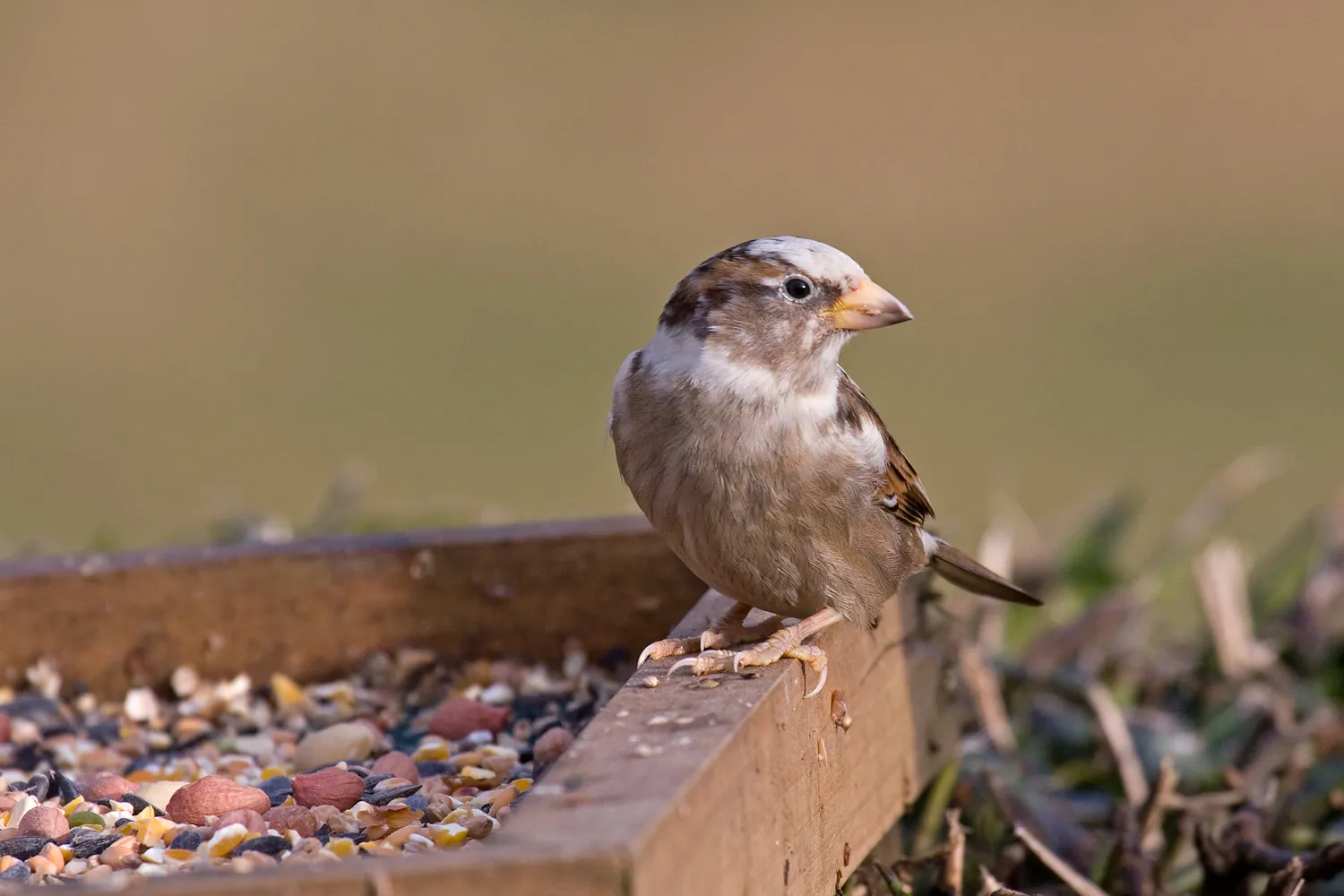
The BTO Abnormal Plumage Survey is a project to find out about garden birds with unusual plumage characteristics. The survey was launched in December 2011, and is centred on pigmentation irregularities.
Anecdotal reports show that birds can turn up in gardens with a variety of unusually-coloured feathers, but questions about which species are affected most frequently, in what ways and where these birds are found remain unsolved. The Abnormal Plumage Survey is gathering data to explore these questions.
- Please note: plumage abnormalities associated with feather loss are not being recorded through the survey.
Report abnormal plumage
Help us to understand more about plumage abnormalities
Please tell us if you have ever seen a bird with unusual plumage in your garden; we would really like to hear from you! By collating reports of plumage abnormalities, the species involved and the nature of the abnormality, we hope to identify common patterns. By submitting your sighting to our simple survey you can help us to build up a better picture.
Causes of pigmentation problems
From time to time, you may encounter a bird with plumage that is rather different from that which would be typical for the species. Some of these abnormalities may result from abnormal feather growth or feather loss, while others may be a consequence of problems with pigmentation.
Our survey findings so far
To date, 58 species have been recorded through the Abnormal Plumage Survey. If we bear in mind that only garden habitats are being considered, this total is particularly impressive. The birds that have been spotted range from the very small – such as Goldcrest and Wren – to the very large – including Buzzard and Herring Gull – and the variety of abnormality types is also substantial.
Despite this diversity, a few species and abnormality types have been logged disproportionately often. Of the c.3,000 records submitted so far, 82% have been classed as involving ‘leucism’; compared with just 3% as ‘albinism’; 4% as ‘melanism’; and 11% as ‘other’.
Of all the species recorded, Blackbirds have been seen most frequently, accounting for over 40% of records. Most of these birds have sported odd white feathers or have been completely white. House Sparrows, with 281 records submitted to date, are the next most frequently seen species through the Abnormal Plumage Survey, with Jackdaw (171) and Carrion Crow (157) next on the list.
Of the 112 records of ‘melanistic’ birds, about 40% have been of Great Tits (30) and Blue Tits (16), with 18 other species also logged. In the case of Great and Blue Tits, it is often the case that the white cheeks or yellow bellies appear as a much darker colour.
Other fascinating abnormalities have included a Chaffinch with a green crown in West Sussex, a Siskin with ‘slate-grey’ wings and body in Worcestershire and a ‘primrose yellow’ Blue Tit in North Wales. On a handful of occasions, individual birds have looked so unusual that participants have had to resign themselves to writing ‘species unknown’.