Read reviews of the books we hold in the Chris Mead Library, written by our in-house experts. A selection of book reviews also features in our members’ magazine, BTO News.
Featured review
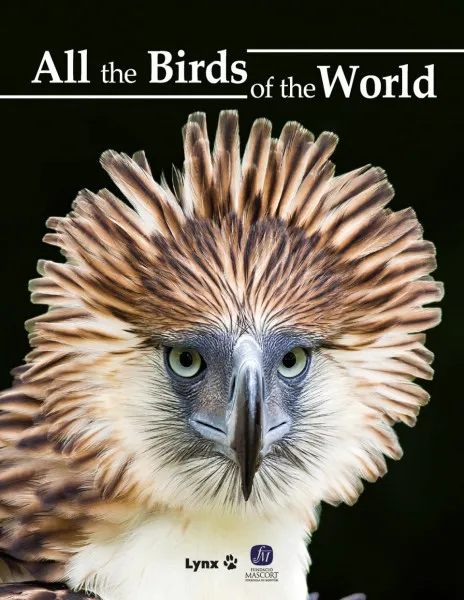
All the Birds of the World
Lynx have had a long-term project to produce an exhaustive guide to the birds of the world. It started out with the 17 volumes of the Handbook of the Birds of the World (1992–2013) which has family and species accounts for all birds. This was followed by the two volumes of the Illustrated Checklist of the Birds of the World (2014–2016). They have now published the third and final stage of this avian odyssey with this current book.
Search filters
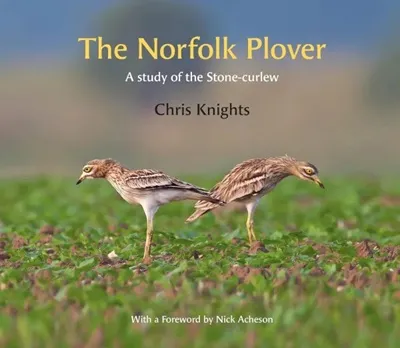
The Norfolk Plover: A Study of the Stone-curlew
Author: Chris Knights
Publisher: Wild Breckland Books
Published: 2023
Back in 2002, one of my first jobs in conservation was being part of a four-person RSPB team that monitored and protected the nests of Stone-curlews in the Breckland area of Norfolk, and my love of Stone-curlews is still as strong today. The patch I was assigned to was an estate farmed by Chris Knights, which had a well-trained team of gamekeepers and farm staff who were very adept at finding and protecting the nests. This patch is the inspiration for his book, which looks at Chris’s lifelong interest in these fascinating birds. With their cryptic plumage and large yellow eyes, Stone-curlews are curious birds with very interesting behaviour that most people only get to see distantly in the heat haze at Breckland reserves such as Weeting Heath. As a photographer, Chris is fortunate to farm on a large estate which has a very healthy population of Stone-curlews, and so has easy access to these birds where he can erect hides close to nests and bring to life all aspects of the intimate life of these birds. The book is written with a real passion for both the species and the Breckland landscape. It is a real labour of love from over 60 years photographing them, with stunning photographs throughout which capture many postures and behaviours, often quite comical, that most people would never see, and really endear you to them. I have thoroughly enjoyed reading and reviewing this book, and it has brought back lovely memories of that summer spent with these special birds, and anyone with an interest in not just Stone-curlews but birds and wildlife in general will enjoy it.
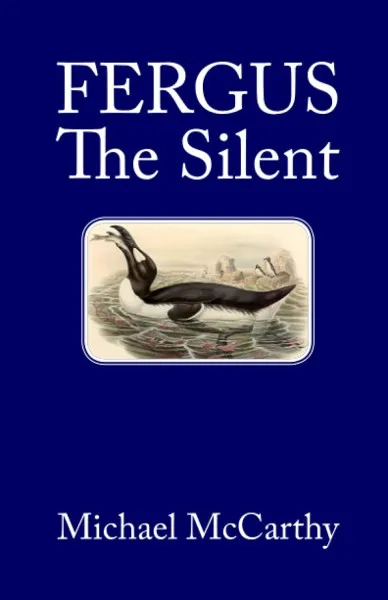
Fergus The Silent
Author: Michael McCarthy
Publisher: YouCaxton Publications
Published: 2021
Michael McCarthy is perhaps best known for his environmental journalism and nature writing. His skills were recognised by BTO back in 2011, when he was awarded the annual Dilys Breese Medal for outstanding communication of science to new audiences. Fergus The Silent marks a departure from his usual work, in that it is a foray into fiction. You have to admire the ambition of somebody whose first published fictional work is a 440-page novel! Given its length, you won’t be surprised to hear that Fergus covers a lot of ground, from the damage parents can inflict on their children, to toxic academic ambition, seabird conservation and a particularly tricky moral dilemma. The main plot revolves around Miles Bonnici and is set at the turn of the millennium. At the start of the book, we learn about Miles’ career trajectory to a fellowship at the ‘Niko Tinbergen Institute’ at Oxford University, having had a Nature front cover for a paper on extra-pair paternity in Guillemots breeding on the Pembrokeshire island of ‘Skarholm’ during his PhD. However, his interest in birds is purely as a means to surpass the career of his brilliant but unloving physicist father. Miles gets together with Jenny Pittaway, a New Zealander working in Oxford as she finds her way in the world after her own university studies. Miles proceeds to break her heart, but only realises why this (and the birds) matter when he’s sent to report on the effects of the Erika oil spill on the west coast of France by the ‘United Kingdon Offshore Conservation Agency’. The devastation he witnesses finally cuts through his ambition and exposes his soul, specifically when he finds the body of ‘Arty Bu-bu’, a Guillemot from Skarholm whose behaviour underpinned his famous Nature paper. We don’t meet the Fergus of the book’s title until the novel’s second half. The island of ‘Lanna’, the most remote in Britain and Ireland, is threatened with its own oil disaster when exploration starts taking place. Lanna has been closed since 1939, and no seabird surveys take place there. The data on its importance for seabirds could prevent licenses for drilling from being granted. However, Lanna’s seabirds are closely guarded by Fergus, the mysterious warden who spends every breeding season on the island and is weighed down by a secret about the wildlife there. Miles convinces Jenny to come with him to Lanna to survey the seabirds, where they discover Fergus’s secret and grapple with its implications. Since I could hardly precis the plot into less than two paragraphs (and even then I have stopped well short of ending to avoid any spoilers), you’ll realise that Fergus The Silent has many twists and turns, and we meet a large number of characters in a variety of places. I enjoyed working out which UK and European academic and seabirder luminaries inspired the various characters, and unsurprisingly, the author’s descriptions of the natural world and the damage human activity can inflict upon it are excellent. However, I was less convinced by the female characters in the book, who I found a little two-dimensional and shoehorned into traditional gender roles. I also felt like some parts of the plot could have moved along a little more quickly. I see there are some glowing reviews out there from some of the very same people I suspect might have partly inspired some of the characters. Despite my small misgivings, I did think Fergus The Silent was a page turner. So why not get hold of a copy and see what you think?
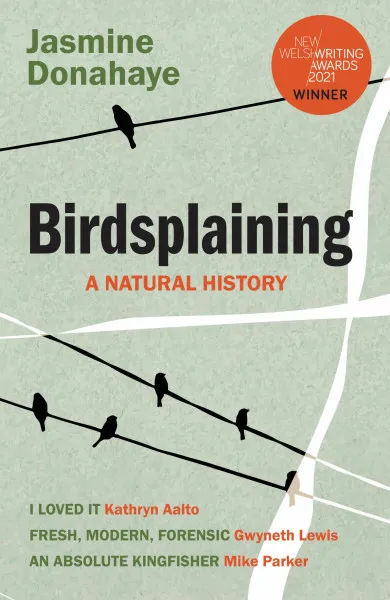
Birdsplaining: A Natural History
Author: Jasmine Donahaye
Publisher: New Welsh Review, Aberystwyth
Published: 2023
The author herself acknowledges in her opening note that some offence may be taken by the title, but Jasmine Donahaye’s collection of short essays is much more than it first seems. She elucidates a multi-faceted explanation for Birdsplaining, adding to the anticipated definition the notion of using birds as a way to explore the relationship humans have both to each other and to the natural world, as well as seeing in them a means to understand personal experience. From the Swallows seeking a place to nest in her 18th century Welsh cottage home to a Western Bluebird spotted in California, birds are at the heart of this book. Set within the frame of the author’s own experiences, the 14 individual but connected essays bring up important issues: the human tendency to anthropomorphise the natural world; the colonial history of ornithology and the names of the local guides who have been largely forgotten; the equity of access to nature; the status of birdwatching as a traditionally male-dominated interest to name but a few. However, this isn’t a book that tries to tell you what to think, and functions more as a way to start a conversation rather than an attempt to conclude it. The experiences Jasmine Donahaye describes in Birdsplaining provide a means for personal reflection. It is an unusual, vivid, book which still manages to remain remarkably easy-to-read and enjoyable. It doesn’t shy away from taking on difficult subjects, and I’ve often found myself thinking about it in the days since finishing it.
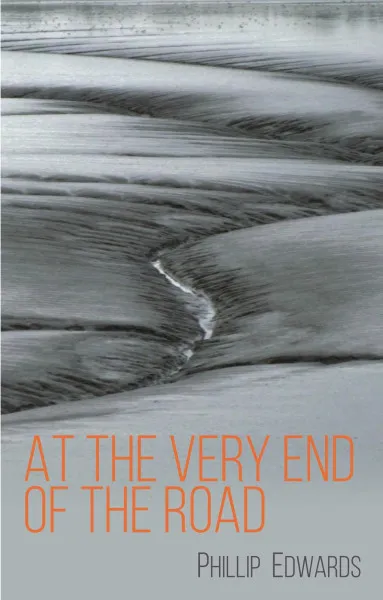
At the Very End of the Road
Author: Phillip J Edwards
Publisher: Whittles Publishing, Dunbeath
Published: 2021
This book takes you through a year on the author, Phillip Edward’s, home ‘patch’ – a complex area of farmland, saltmarsh, river and coastline. Each chapter covers a calendar month, describing in intricate detail encounters with not just birds but mammals, plants, insects and everything else. Britain's fickle weather provides a backdrop to the seasonal changes. Each month is split into eight different accounts of an observation or discovery from that period. The intimate observations of wildlife are often described in remarkable detail – clearly the author immerses himself in each and every experience, however fleeting it may be. This is an immersive book, but for me a few things might have helped. It’s very much a book with ‘place’ at the heart of it but we never know where that place is – western England is as much information as we get. It would have helped me to know the landscape and surroundings a little better if we were told where it is. Even a sketched map of the immediate area would have helped. There is also one species conspicuous by its absence – human beings. Any thoughts, feelings, or human touches are actively excluded and given that the UK is almost entirely a manmade landscape that seems a missed opportunity. I like places where people and wildlife rub alongside each other, and adding some personal stories may have helped. There are numerous stunning passages in this book and it can really transport you to moments in time. I would treat this as a book to dip in and out of – making a point of picking it up each month to read a section (or chapter) appropriate to the season. This would definitely get you in the right frame of mind to head out there and make your own observations in the field
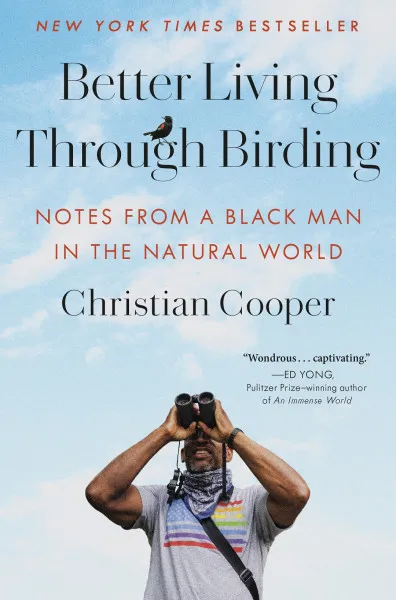
Better Living Through Birding: Notes from a Black Man in the Natural World
Author: Christian Cooper
Publisher: Penguin Random House, New York
Published: 2023
2nd place in Best Bird Book of the Year 2023 When starting Better Living Through Birding, I was not sure what to expect. Cooper is perhaps most widely known in the UK for the infamous incident in Central Park in 2020, but after reading this book I hope he will be best known in the birding community for his profound connection with birds, his eloquent prose, and his inspiring and often comical insights into the world of birding. This book is a unique blend: part autobiography, part birding almanack, and part exploration of the fascinating realm of comics. It weaves together the threads of Cooper’s life, with birds consistently serving as the vibrant red thread that holds it all together. As a seasoned writer, Cooper expertly intertwines stories from his childhood, his family, his birding adventures around the world, and a cast of endearing characters from his Central Park birding community. If you are a more experienced birder, you will undoubtedly recognise yourself and others in Cooper’s descriptions, both of people and of his experiences with birds. You will ache to see a Blackburnian Warbler from his detailed and emotive descriptions, and feel the renewed sense of awe at a Common Grackle as he talks about his experience seeing the bird through new eyes. For the beginning birder, Cooper’s top tips and “seven wonders of birding” are a great introduction to the hobby. His enthusiasm is infectious, and all birders will find themselves yearning to pick up binoculars and head outdoors to (re)discover the beauty of birds for themselves. Cooper’s personal anecdotes, along with his absolute skill for storytelling, make this book an engaging read from start to finish. His experiences are often humorous, touching, and thought-provoking, making it easy for readers to connect with his journey on a personal level. No matter your background, experience level, or whether you’re a US- or UK-based birder, I thoroughly recommend this book as a balm to the heart.
Finding W. H. Hudson: The Writer Who Came to Britain to Save the Birds
Author: Conor Mark Jameson
Publisher: Pelagic Publishing, London
Published: 2023
Of American parentage, William Henry Hudson was born in Argentina in 1841. Arriving in London in 1874, he struggled for some years to make ends meet, before making his name as a naturalist. Hudson is best known for his nature writing, most notably The Naturalist in La Plata, Birds in a Village, Birds in London, and Hampshire Days, but he also wrote a handful of novels; these were significantly less successful than Hudson’s other books, with the author regarding the whole literary business as a poor second to his true vocation, that of naturalist. Publishers’ reader Edward Garnett, a friend of Hudson, provides the most vivid description of how people succumbed to the spell of Hudson’s personality, something that is evident in Conor Jameson’s account of this fascinating man. While Hudson provides the framework for Jameson’s book, the account strays much further than a typical biography, encompassing as it does a wealth of other characters. These include Sir Edward and Lady Dorothy Grey, at whose fishing cottage on the River Itchen Hampshire Days was conceived, and ‘Don Roberto’ Cunninghame Graham, the first socialist to take a seat in Parliament and an explorer who searched for a lost goldmine in Spain and attempted to visit the mythical Moroccan city of Tarudant, which was closed to foreigners. It was through Edward Garnett that Hudson was connected to many of the important literary figures of the time, including Joseph Conrad and Edward Thomas (the latter another excellent field naturalist). Unsurprisingly, given Jameson’s strong RSPB connections, the book draws out Hudson’s work with the Society for the Protection of Birds (later the RSPB) and its pioneering women. The tale of the early days of the Society has been wonderfully told by Tessa Boase, but Jameson’s book suggests that Hudson played a more important role than perhaps has been previously apparent. Hudson’s connections, together with his growing reputation as a writer and evident knowledge of birds, clearly helped the Society to gain traction and persuade more and more influential people to take up the cause. From my knowledge of Edward Thomas and Edward Garnett it is evident that the book is well researched, with Jameson drawing on a broad range of sources, and it is well written. It is refreshing to see a biographer’s obvious interest in his or her subject come through so clearly, in a genre where the scholarly approach usually restricts such personal reflection. My only criticism is that, by restricting the book to paperback and ebook formats, the publisher has reduced its appeal to a broader audience. It’s price almost reaches that of a hardback, and it has the feel of an academic textbook. Surely, this is an account that – in hardback – would have rightly captivated a broader bookshop audience, in just the way that Helen Smith managed with Edward Garnett, Jena Moorcroft Wilson with Edward Thomas, and Tessa Boase with the beginnings of the RSPB.
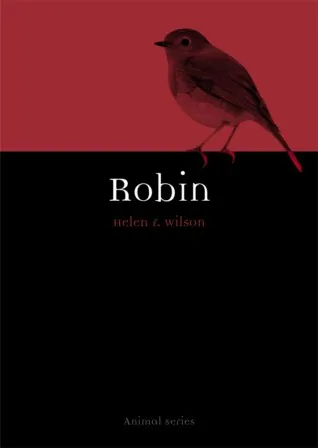
Robin
Author: Helen F Wilson
Publisher: Reaktion Books, London
Published: 2022
As part of the Reaktion books’ ‘Animal’ series, Helen F Wilson brings together the various ways that Robins have permeated our culture, whether in books, folk stories, newspaper stories, adverts or artwork. As you work your way through the book for every poem or picture you’ll be familiar with, there are another 10 that will be completely new and often surprising. This is all underpinned by knowledge and research on the actual bird, showing how much of the folklore around Robins is from attempts to understand them. Fortunately, Robin doesn’t stray into being too twee or sentimental, with plenty of tales surrounding the darker side of these birds or the darker side of our impact on them. Next time I see a photo of a Robin nesting in a plant pot or discarded welly, I’ll remember it could just as easily be the skull of a hanged man. The main thrust of the book investigates the roles that the Robin (aka European Robin) plays in our culture, but space is allotted for other ‘robin’ species, including the unrelated American and Australian Robins which have been named after our familiar garden equivalent. The final chapter of the book investigates the future of the Robin, which feels an interesting choice given the ubiquity of them and how resilient they have generally been to human activity compared to many birds. However, this is put into the context of the unnecessary gauntlets which even common birds must run in a modern landscape. If you are interested in the cultural history of birds then this is a small but rich book for you.
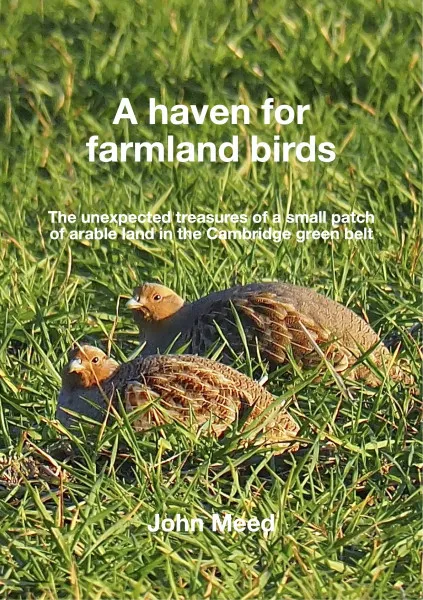
A haven for farmland birds: the unexpected treasures of a small patch of arable land in the Cambridge green belt
Author: John Meed
Publisher: Independent Publishing Network
Published: 2022
John Meed’s succinct capsule of the relationship between farmland bird abundance, behaviour, breeding success, and land management on a small patch of East Anglian farmland encompasses so much more than the kilometre square his feet have clearly lovingly tramped for a decade. In the great tradition of British ornithology, at the heart of this book is a birder’s obsession with their local patch, and their favourite species. However, John also brings into play the knowledge he has amassed by carefully noting local land management and discussing this with local land managers, as well as his own grounding in the wider literature and correspondence with other projects and enthusiasts elsewhere. Nor does he shy away from complex and at sometimes controversial topics, such as predator control and shoot management, communicating his own take on these matters. Like many people who do this well, John has followed the ‘hourglass format’ perfectly; his introductory summary of the changes to British agriculture over the last century, and the resulting threats to farmland birds, starts off broad and far-reaching. John then takes the reader through a much narrower, in-depth description of two farmland birds of high conservation concern on his patch, the Grey Partridge and Corn Bunting. He then expands his scope again, covering other key farmland bird indicator species and other taxa, and the wider reasons why his patch bucks the trend for farmland bird declines. He finishes on the broader lessons this may have for maintaining and restoring biodiversity on arable farmland across the UK. Within my own sphere of work with breeding waders, I have come to highly value multi-faceted approaches to farmland bird conservation, but also the power within local individuals’ and groups’ passion; we are lucky to have people like John, who will spend long hours peering over hedgerows and creeping through ditches, caretakers for the great British natural capital we are all too often oblivious of (as the book’s final two pages may sadly indicate). This lovely book is well worth the 144 whistle-stop pages.
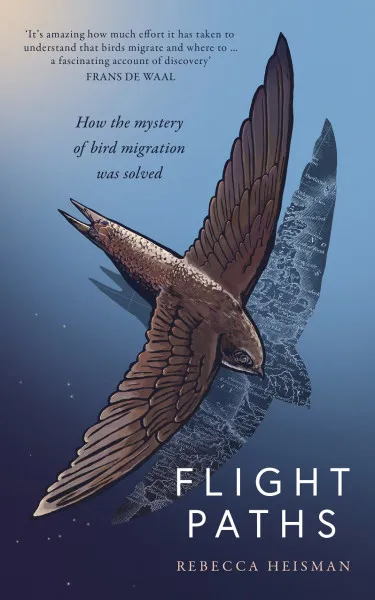
Flight Paths: How the Mystery of Bird Migration Was Solved
Author: Rebecca Heisman
Publisher: Swift Press, London
Published: 2023
This fascinating book opens with a question: where do the birds go? People have, of course, been asking this question for centuries, and over time our knowledge has increased enormously and, indeed, is still increasing – from BTO’s own work revealing new migration routes of Cuckoos to the recent revelation that Scottish Red-necked Phalaropes winter off the Pacific coast of South America. The book does not answer this question directly but delves into the question of how we know where birds go. Early on, the author notes that there is no single best way to work out where birds go. Rather there is a toolbox of techniques each with its own strengths and the book provides a great introduction to these, starting with ‘bird banding’ (the book is written almost entirely from a western hemisphere perspective). From there it moves on to ‘noc-migging’ (which has an unexpectedly long and venerable history) and the study of ‘angels’ – and if you don’t know what they are, this book is for you. Next up is a brief history of radio-tracking, starting with the extraordinary tale of how a Wood Thrush was tracked on its migration (and, yes, that was a single thrush tracked for nearly 1,000 miles over seven days across America), before describing more recent technologies, such as geolocators and satellite tags. The book finishes with chapters on the role of ‘community science’ projects, such as BirdTrack, and which ask how all this has helped bird conservation efforts. A brief consideration of the ethics of migration studies, primarily the potential impacts of tags on the individuals who wear them, is welcome but a point made right at the end of the book particularly struck me. As is rightly becoming more common, the author acknowledges she lives on stolen land and I did pause to wonder what indigenous knowledge of bird migration have we lost over the centuries? Science may give us the details, but cultural associations and meanings are equally important. The book is a great read, and hearing about some of the challenges people faced when pioneering some of these techniques certainly adds an extra level of appreciation to the already wondrous stories about bird’s migratory feats. Indeed, I could easily have read more – at just over 200 pages (plus a good selection of footnotes) the book is quite short, although if that encourages more people to pick it up, so much the better.