What to record for the Winter Bird Survey, including birds, mammals (optional), habitat and weather. You can also download recording forms for the survey on this page.
Recording birds
Walking your transect
Walk along your transect route at a slow, methodical pace. You can pause to scan for birds, but you should not stop for long periods. As a rough guide, each 1-km transect should take around 45 minutes.
How to record
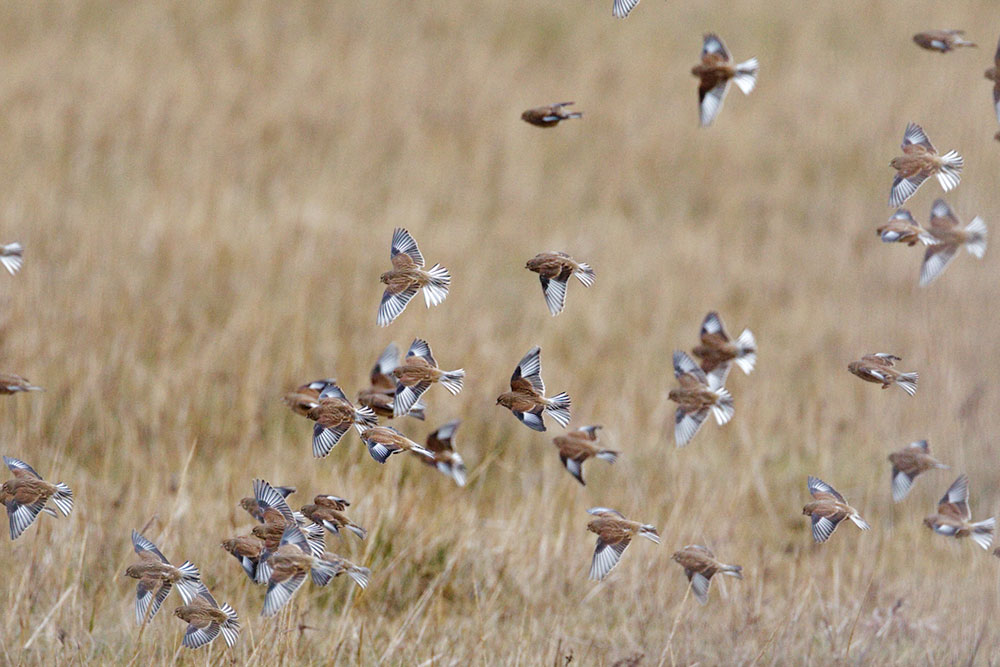
Record all birds you see or hear (with the exceptions shown below) on your Field Recording Sheet as you walk.
- Record birds in the appropriate 200-m transect section (1–10), as shown on your route map. Each transect section is a separate box on the Field Recording Sheet.
- Please use the standard two-letter BTO species codes, shown on the back of the Field Recording Sheets.
- For larger flocks, please make your best estimate of the numbers of birds. ‘Around ...’, 'at least ...’ etc. cannot be used or analysed; an estimate is far more valuable.
- Don’t forget to note the date, and the start and finish times for each transect.
Which birds should you record?
Record all birds (including juveniles) to the sides of your transect line, even if they are outside the square boundary. Don’t record birds that are behind you as you start a transect, or beyond the end of the transect as you finish.
- Try to avoid recording the same birds twice, e.g. a mobile flock of finches in a farmland or woodland setting.
- If a bird is at the boundary of two transect sections, record it in one or the other, but not both.
- There is no need to record the activity or sex of the birds.
- Record all free-flying birds, including feral and escaped species.
- Birds that can be positively identified as juveniles (birds of the current year) SHOULD be counted (in contrast to Breeding Bird Survey methodology). There is no need to record them separately; please just provide the total count.
Distance bands
Please record birds in one of the following distance bands, according to where they are first noted:
- Band 1 – Within 25 metres either side of the transect line
- Band 2 – Between 25 and 100 metres either side of the line.
- Band 3 – More than 100 metres either side of the line, including birds outside the 1-km square boundary.
- Band F – Birds in flight only, at any distance. Record by marking the species code with an arrow.
Distances are measured at right angles to the transect line. For example, a bird seen 200 metres ahead of you but within 25 metres of the transect line should be recorded in Band 1, in the appropriate transect section.
The approximate locations of distance band boundaries can be viewed on your online route map and printed to take into the field.
Recording mammals
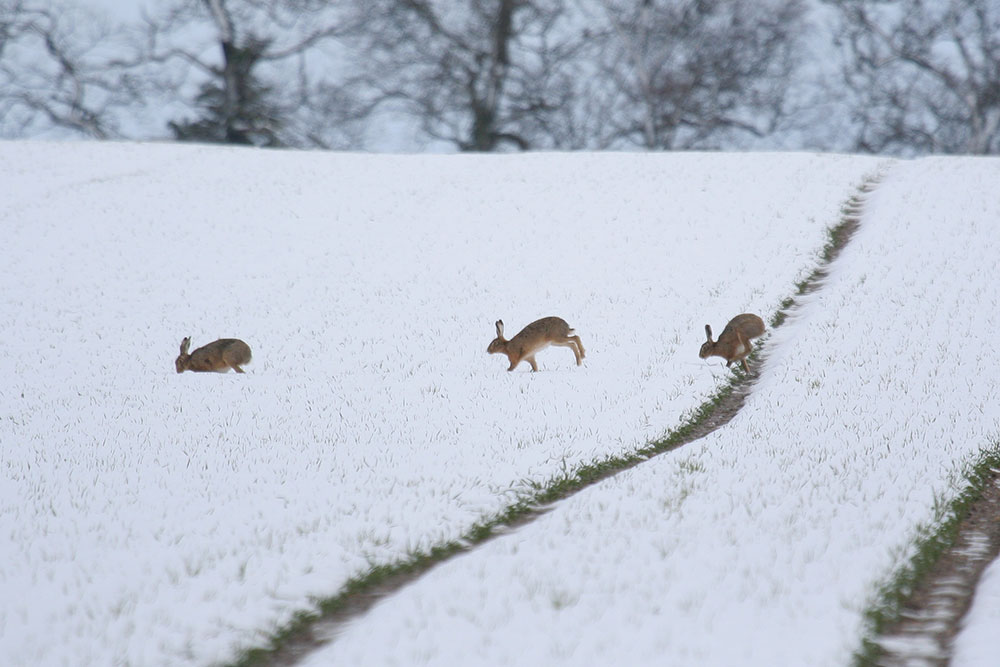 Recording mammals in the Winter Bird Survey is optional. If you wish to record mammals, please note that you should only record live mammals and not mammal tracks or signs (in contrast to Breeding Bird Survey methodology).
- While you walk your transect route, count all live mammals that you see.
- Record mammals on the Field Recording Sheet in the appropriate transect section. For Mammals, please use full names or unequivocal abbreviations. We have some suggested three-letter codes to use (e.g. GSQ for Grey Squirrel).
- You should also record mammals in distance bands (in contrast to Breeding Bird Survey methodology).
When submitting data online, please check ‘Yes’ in the relevant field on the page if you looked out for mammals (even if you saw none – this is still valuable information!).
Enter ‘No’ if you did not participate in mammal recording.
Recording habitat
You will need to complete a simple habitat survey as part of your Winter Bird Survey visits.
Your survey square may contain several farmland features, which you should record on the Field Recording Sheet. Use the downloadable guide to winter crop and habitat features to help you.
If your square does not contain any of these farmland features, you still need to indicate that you have completed the habitat survey on your form.
Recording the weather
Please record the weather using the codes shown below. If the conditions change during your visit, select the single category that best represents the overall conditions.
- Please do not survey in heavy rain, very poor visibility or strong wind.
| Cloud cover | Rain | Wind | Visibility | Temperature |
|---|---|---|---|---|
| 1 – 0–33% | 1 – None | 1 – Calm | 1 – Good | 1 – <0 °C |
| 2 – 34–66% | 2 – Drizzle | 2 – Light | 2 – Moderate | 2 – 0–10 °C |
| 3 – 67–100% | 3 – Showers | 3 – Breezy | 3 – Poor | 3 – >10 °C |
Survey forms, instructions and resources
Everything you need for your survey can be downloaded below, and printed if necessary. You can also request paper copies of forms and instructions by emailing winterbirds@bto.org.
We recommend that you familiarise yourself with the survey forms before your first visit.
Survey instructions and guidance
Recording sheets
Please use these sheets to record your observations in the field.
- Field Recording Sheet (for birds, mammals and weather) – short format
- Field Recording Sheet (for birds, mammals and weather) – long format
- Habitat Recording Form (for habitat)
Resources
Habitat guidance
- Habitat guidance: guide to winter crop and habitat features
- Further habitat tips: guide to new and tricky farmland habitats **NEW**