Ashok is sponsored by all at Xenolith Ltd. In memory of Ashok Kumar Kapur, who was one of the very best of people. We hope he travels well and is able to inspire others along his way.
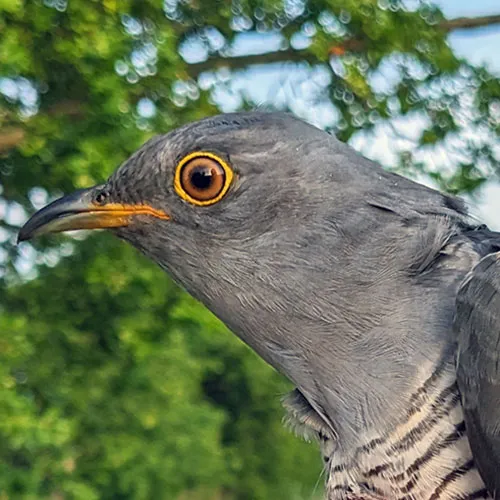
Tagged : Sat, May 31, 2025 - 05:45
Age when found : Adult
Tagging Location : Worlingham Marshes, Suffolk
Wing Length (mm) : 221
Sex : Male
Ashok's journey from 31st May 2025 to 9th June 2026
Updates on Ashok 's movements
Ashok returns!
We’re delighted to report that Ashok is once again back on Suffolk soil, after his surprise U-turn back to France just days after first arriving back in early April.
BTO Cuckoo experts noted a drop in temperature which coincided with Ashok’s initial arrival, which is almost certainly what caused him to fly back across The Channel. Now, after a good spell in the Loir-et-Cher department of central France, he has returned and is back around Worlingham Marshes, Suffolk, where he was tagged last May.
Ashok's surprise Suffolk visit
As the first of our tagged birds to arrive in Europe, we anticipated that Ashok may also be the first to make it to the UK this spring. Having spent a few days just to the west of Valencia in early April, he continued his journey north. Last weekend he covered over 1,000 km (620 miles), crossing the Pyrenees and flying onward through central France.
After a short stop in the large forest of Rambouillet, just to the west of Paris, he swiftly carried on and touched down in Suffolk on 7 April. While we were delighted to see Ashok back on UK soil, he seemed less impressed… in less than 48 hours Ashok had flown 300 km (186 miles) south and returned to France! He is currently on the banks of the River Seine, close to the city of Rouen in Normandy. Hopefully he will find plenty of food here to fuel his journey back to Suffolk!
Ashok heads into Europe
After he’d reached Cameroon in early March, we hadn’t received any signals from Ashok’s tag until this morning.
It would appear that rather than heading west to join the other Cuckoos, he took off north across the central Sahara at some point in the last week, arriving in north-eastern Algeria. Since then he powered purposefully on, crossed the Mediterranean and arrived in the Almería region of south-east Spain yesterday evening!
Ashok is not only the first of our tagged Cuckoos to arrive in Europe this spring but this is also the earliest ever date that one of our satellite tagged birds has done so.
A shock reappearance for Ashok
Back in early December all seemed good with Ashok, and we were receiving steady signals from his tag as he explored the forests of central Gabon. Then, things went quiet. We often lose the signals when the Cuckoos are deep in the forests, so this in itself was not so unusual. What was unusual, however, was the signal that we received in early February which suggested he’d moved over 2,700 km (1,678 miles) east into Ethiopia!
Now, we know enough about Cuckoos to know that this was an anomalous signal and we were certain that Ashok was actually still in the Gabon jungle. But we hadn’t received any further signals… Then, late yesterday, Ashok’s signal sprang back into life and we can now see that he has moved 680 km (423 miles) north of his wintering site in Gabon and made his way into Cameroon!
Final update for 2025
As we head into December, we can expect our tagged Cuckoos to be fairly settled for the next few weeks. They should now be firmly in their ‘wintering’ grounds in the Congo basin, feasting on tropical insects, and trying to avoid getting eaten themselves – there are lots of predatory birds, mammals, and reptiles in that region!
Of the 11 tagged Cuckoos that left the UK in summer, we have continued to receive regular updates from nine.
The furthest east of our birds are Joe and Sayaan, both of whom are in Democratic Republic of the Congo. They are currently just 12 km (7 miles) away from each other, in the dense rainforests to the north of the Busira River.
Cleeve is deep in the Republic of the Congo, close to the Léfini Faunal Reserve. He is in the same area as Wingston, who has in recent days been less than 40 km (25 miles) away from him.
Cuckoo Norman is the furthest south of our birds, and is the only tagged Cuckoo in Angola.
Furthest north we find Jim and Arthur, both in Gabon. Nearby is Ashok, less than 50 km (31 miles) to the south of Jim. Frederic has recently crossed the border of Republic of the Congo and headed east into the Democratic Republic of the Congo, where he is currently by the large freshwater Lake Mai-Ndombe.
Two birds, Cores and Wilfrid, made it across the Sahara but after some promising movements, we soon lost track of them. Cores’ signal stopped on 27 October, when he was in southern Chad, while we last heard from Wilfrid on 20 September as he moved toward Nigeria from Niger. It may be that these two ‘lost’ Cuckoos have reached the end of their lives, though the sensor data indicated possible battery charging issues so they could still be out there, alongside our other Cuckoos.
We may never know what happened to this pair, but we do know that each bird has provided us with remarkable information that has allowed us invaluable insights into the complex stories of Cuckoo migration.
The remaining Cuckoos will likely remain in their wintering areas until February, when we will hope to see some movement as they prepare to commence their long flights back to Europe for the 2026 breeding season. For some of this Cuckoo cohort, it will be the first time that we get to follow their remarkable journeys north.
We will, as always, keep an eye on the Cuckoos and as soon as we see signs that they’re starting to head back we will post updates and track their incredible progress once more!
Ashok’s African adventure
Having spent the last few weeks on the border of Chad and Central African Republic, Ashok has made a move of almost 500 km (310 miles) south in recent days and is currently close to the northern border of Republic of the Congo.
Ashok heads towards the tropics
After a while recovering from his Saharan crossing, Ashok has moved further south into Chad. He is now close to the border with the Central African Republic, on the edge of the Réserve de Faune de la Nana Barya, which is home to African Elephants, Lions, Leopards and Giant Elands, among many other species.
Ashok’s shock move
The first of our tagged birds to reach North Africa, Ashok has ploughed on with zeal, flying across the Sahara and on into Chad, covering over 3,000 km (1,864 miles) in under three days!
In that time Ashok covered the length of Libya, flew through eastern Niger, and as of 7.26 this morning was in the Sahel region of Chad, having cleared the vast expanse of the Sahara desert.
Ashok arrives in Africa!
We’d not heard much from Ashok in recent days, and he seemed to be lingering in Suffolk. However, we suddenly received a signal telling us that he had not only left the UK, but had crossed mainland Europe, flown across the Mediterranean via Monaco and Sardinia, and made landfall in Tunisia over the weekend!
Now in northern Libya, Ashok is the first of our tagged birds to start the next leg of the major migration journey – crossing the Sahara!
Say hello to Ashok!
Ashok was tagged on May 31 at Suffolk Wildlife Trust’s Worlingham Marshes reserve in the Broads National Park.
Ashok is sponsored by all at Xenolith Ltd and is named in memory of Ashok Kumar Kapur.