Birds in Greenspaces

Birds in Greenspaces

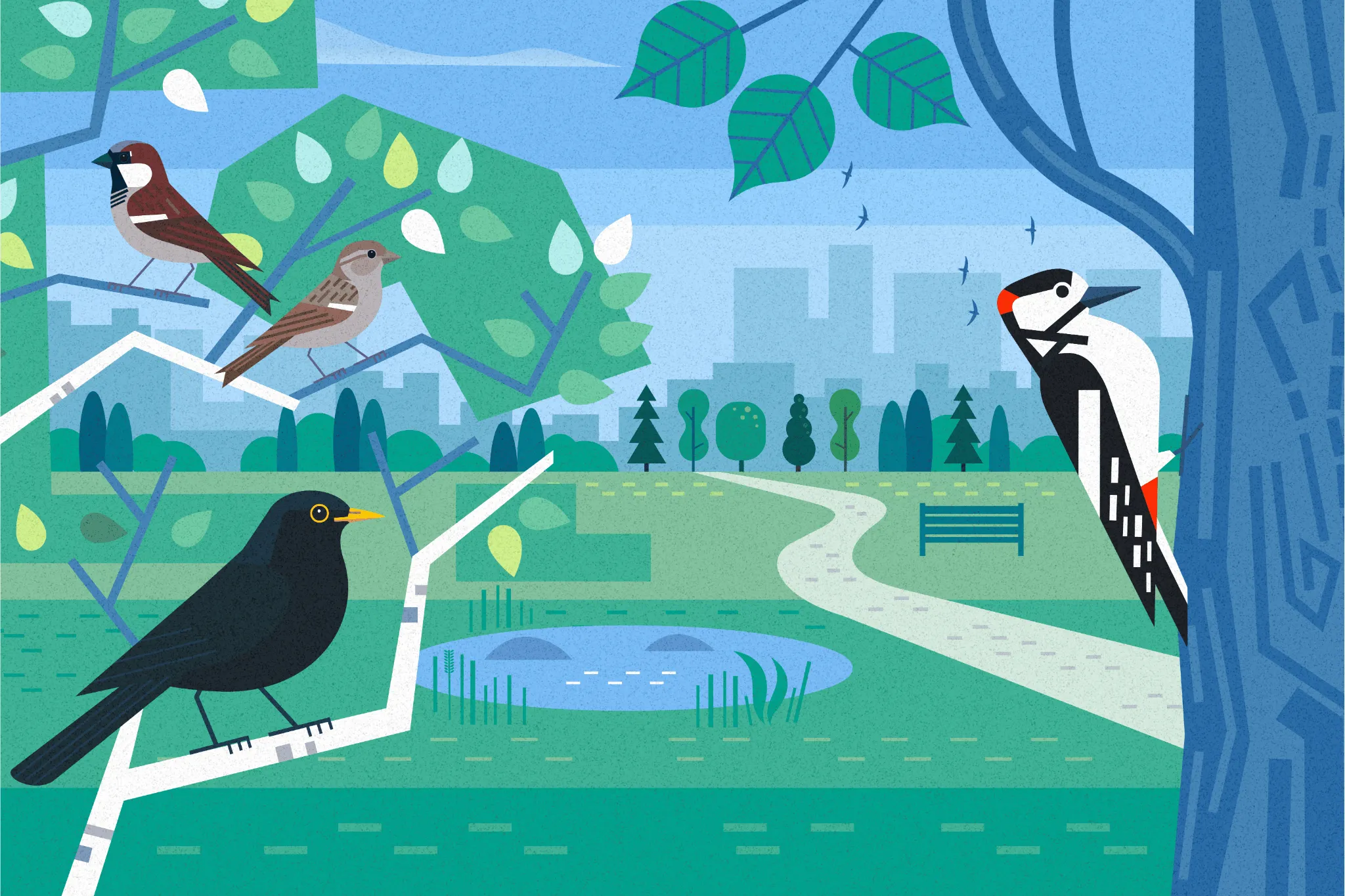
The BTO Birds in Greenspaces project aims to find out just how important greenspaces are for UK birds, and provide guidance on effective greenspace management for birds and people – and we want your help!

Time, skill and support

The project is set to launch in 2026.

A UK-wide survey for new and experienced birdwatchers alike!

Videos and training courses are available to help you develop your bird ID skills.

Project team

Contact

  • greenspaces@bto.org

About Birds in Greenspaces

Birds in Greenspaces is a new, UK-wide citizen science survey of birds that use our greenspaces. We want local groups and individuals to take part, so we can understand how people and birds interact with greenspaces. With the right evidence, we can work out how best to integrate management to benefit both birds and people in our urban areas.

The project will run in 2026, and is open to people of all ages and experience levels, across the UK. Volunteer registration opens later this year, but groups and organisations can register their interest now. Find out more about taking part

This project has been funded by a gift in Will from Denis Summers-Smith, for which we are extremely grateful.


Winter Warm-up pack

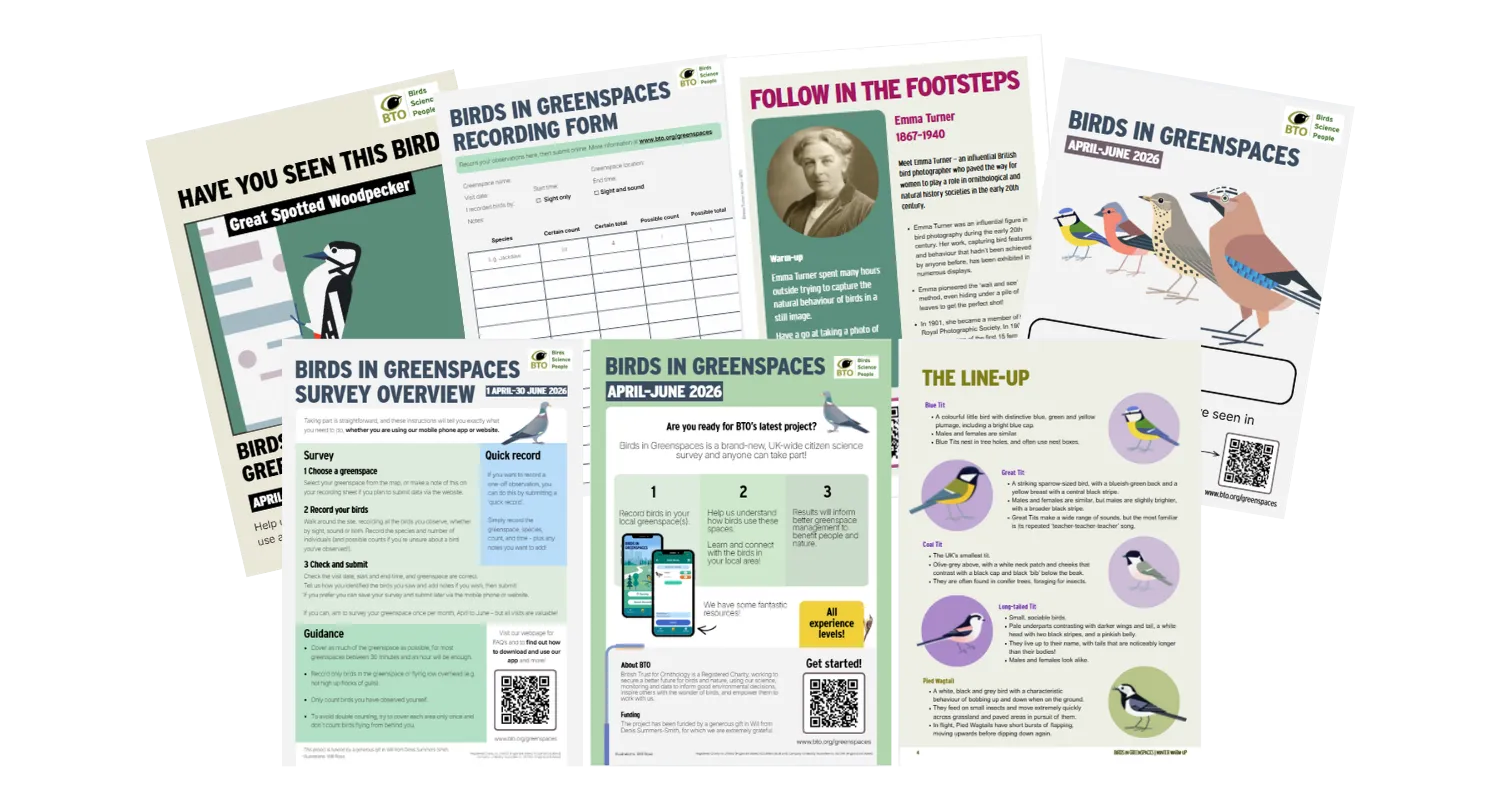
In preparation for the exciting launch of Birds in Greenspaces in April 2026, we want to help you to get to know the birds that live on your doorstep, and some of the people who helped our understanding of birds today. This pack provides a beginner-friendly ID guide to 30 species you’re likely to see in your local greenspace.

Winter Warm-up plain text

Contents


Welcome to the Birds in Greenspaces Winter Warm-up!

In preparation for the exciting launch of Birds in Greenspaces in April 2026, we want to help you to get to know the birds that live on your doorstep, and some of the people who helped our understanding of birds today.

This pack provides a beginner-friendly ID guide to 30 species you’re likely to see in your local greenspace. We’ve covered the key characteristics of this diverse set of birds, with illustrations helping you to get your eye in and observe some of them for yourself.

You’re probably familiar with Charles Darwin, but did you know who taught him how to preserve the birds he collected? Here we introduce you to some of the unsung heroes of ornithology (the study of birds).

We hope you enjoy!

The Greenspaces Team


The Line-up - Page 4

Blue Tit

  • A colourful little bird with distinctive blue, green and yellow plumage, including a bright blue cap.
  • Males and females are similar.
  • Blue Tits nest in tree holes, and often use nest boxes.

Great Tit

  • A striking sparrow-sized bird, with a blueish-green back and a yellow breast with a central black stripe.
  • Males and females are similar, but males are slightly brighter, with a broader black stripe.
  • Great Tits make a wide range of sounds, but the most familiar is its repeated ‘teacher-teacher-teacher’ song.

Coal Tit

  • The UK’s smallest tit.
  • Olive-grey above, with a white neck patch and cheeks that contrast with a black cap and black ‘bib’ below the beak.
  • They are often found in conifer trees, foraging for insects.

Long-tailed Tit

  • Small, sociable birds.
  • Pale underparts contrasting with darker wings and tail, a white head with two black stripes, and a pinkish belly.
  • They live up to their name, with tails that are noticeably longer than their bodies!
  • Males and females look alike.

Pied Wagtail

  • A white, black and grey bird with a characteristic behaviour of bobbing up and down when on the ground.
  • They feed on small insects and move extremely quickly across grassland and paved areas in pursuit of them.
  • In flight, Pied Wagtails have short bursts of flapping, moving upwards before dipping down again.

Follow In The Footsteps - Page 5

Graceanna Lewis, 1821-1912

Meet Graceanna Lewis — an American naturalist and humanitarian whose work and publications significantly contributed to the birding and wider world, a campaigner against slavery and a major advocate for girls in education and ornithology. Graceanna believed in equal education for boys and girls, greatly inspired by her Quaker upbringing. Later in life she was an influential figure in teaching ornithology, encouraging girls to pursue a career in natural history.

Graceanna and her family were part of the Anti-Slavery Society. Her first published paper called on other Quakers to do more for slaves, and the family home was part of the underground railroad. Some of her most famous work includes Natural History of Birds: Lectures on Ornithology, designed as an inexpensive resource, and articles for the American Naturalist including The Lyre Bird, in 1870, and Symmetrical Figures in Birds' Feathers, in 1871.

Graceanna was good friends with the famous natural historian John Cassin, who named a bird after her: the White-edged Oriole - Icterus graceannae.

Warm-up

A big part of Graceanna’s research included oberservation through using her senses. Take a short walk in your local greenspace. Can you stop and use one of your senses to explore? Can you see or hear a bird? Can you touch the bark or smell the trees?

ID boost


The Line Up - Page 6

Goldfinch

  • Goldfinches are small, colourful, vocal birds with a bright red face and vibrant yellow wing-bars.
  • Adults have a distinctive red, white and black head pattern, though recently fledged youngsters have a plain pale brown head.
  • They can often be seen in flocks moving through trees and fields.

Chaffinch

  • Male Chaffinches have pink, chestnut and blue-grey colours and bright white wing-bars.
  • Females are buff yellowish-brown and also have white wing-bars.

Greenfinch

  • Greenfinches are larger than Goldfinches and Chaffinches.
  • Mostly green, with yellow in the wings; females are usually a more subdued brown.
  • Their song includes a nasal, wheezing sound that often cuts through background noise.

Goldcrest

  • Goldcrests, along with Firecrests, are the smallest UK birds.
  • Mainly an olive-green colour on the body, they have a stripe on their heads which is yellow in females and orange in males.
  • Goldcrests are often found in conifers.
  • They make really high-pitched calls.

Wren

  • Wrens are the most numerous breeding bird in the UK.
  • They are one of our smallest birds, and are a chestnut brown colour with lighter brown underneath.
  • Their song is loud and explosive, with a rapid drilling sound midway through, and they often raise their tail feathers when singing or alarm calling.

Follow In The Footsteps - Page 7

Sálim Ali, 1896–1987

Meet Sálim Ali, the ‘Birdman of India’ — an Indian ornithologist who made great strides in the study of birds, helping to shape how we survey birds, and influencing conservation in India.

In his childhood, the Bombay Natural History Society played an important part in developing his interest in birds. He studied Zoology at St Xavier’s College, Kolkata, before moving to Germany to study at the Museum of Natural History in Berlin. 

Sálim recognised the importance of a systematic approach that would provide robust data and evidence, and his methodical approach to studying birds made a valuable contribution to conservation efforts in India. 

In 1941, he published his most famous book The Book of Indian Birds, which is still used by conservationists to this day. Some of his other work included The  Birds of Sikkim and Indian Hill Birds. One particular bird in the Bombay Natural History Society collection sparked an interest: the Yellow-throated Sparrow. This species gave rise to the title of his autobiography, The Fall of a Sparrow.

Warm-up

  • As we now know, Sálim Ali was a pioneer of methodical scientific surveys.
  • Visit your local greenspace and have a go at carrying out a survey.
  • Spend 30 minutes in your space and list what you see and hear.

ID boost


The Line Up - Page 8

Blackcap

  • Male Blackcaps sport the black cap that gives them their name. Females have a brown cap.
  • Most Blackcaps visit the UK from April to September to breed, but small numbers come from central Europe in autumn to spend the winter here.
  • Blackcap song is rich and melodious, and can include mimicry of other birds’ songs.

Chiffchaff

  • Chiffchaffs are small, olive-green coloured birds, with a paler line above the eye.
  • Most Chiffchaffs come to the UK to breed, from March to September, but increasing numbers are spending the winter here, too.
  • Very similar to Willow Warbler, most easily identified by song: Chiffchaffs sing their own name!  

Robin

  • An iconic bird, often depicted on Christmas cards.
  • Robins have a reddish-orange breast and brown upperparts.
  • They are often very territorial, even in the winter.
  • Their song is melodic, and can often be heard early in the morning and late in the evening.

Treecreeper

  • Found climbing up trees, with their cryptic brown, white and yellow-gold colours making for perfect camouflage against bark.
  • When searching for food, they usually start low on the tree, then make their way upwards.
  • A very small bird, with a slender downcurved beak used for probing the bark for insects and other invertebrates.

Nuthatch

  • The Nuthatch is often found in woodland and climbs up, down, and along trees.
  • A sleek bird, with blueish-grey plumage above and peachy-orange below, a white chin and a black eye stripe.
  • One of their calls sounds like a loudly dripping tap!

Follow In The Footsteps - Page 9

Emma Turner, 1867–1940

Meet Emma Turner — an influential British bird photographer who paved the way for women to play a role in ornithological and natural history societies in the early 20th century.

Emma Turner was an influential figure in bird photography during the early 20th century. Her work, capturing bird features and behaviour that hadn’t been achieved by anyone before, has been exhibited in numerous displays. Emma pioneered the ‘wait and see’ method, even hiding under a pile of leaves to get the perfect shot! In 1901, she became a member of the Royal Photographic Society. 

In 1904, Emma was one of the first 15 female ornithologists to be elected into the Linnean Society. She was one of only four women to be elected as an honorary member of the British Ornithologists’ Union. For large parts of the year, Turner lived in Norfolk on a houseboat called The Water Rail, which she designed herself.

Warm-up

Emma Turner spent many hours outside trying to capture the natural behaviour of birds in a still image. Have a go at taking a photo of your greenspace or a bird of your choice!

ID boost


The Line Up - Page 10

Blackbird

  • Females are brown, whereas males are black. Adults of both sexes have a yellow beak, but it is brighter in males.
  • They are often seen foraging for food on the ground by turning over leaves.
  • The Blackbird song is fluty and melodious,  and is a feature of summer evenings.

Song Thrush

  • The Song Thrush song is loud and clear, and features a wide range of notes, each repeated several times.
  • They have a brown back and a white breast with dark brown, triangular or heart-shaped spots.
  • They are known for hitting snail shells against rocks to reach the flesh.

Mistle Thrush

  • Larger than Song Thrush, with a longer tail and more upright stance.
  • Greyish-brown back and head, and white underparts with  dark brown spots, which are more rounded than those of  Song Thrush.
  • They have a slow, wistful song, often heard after bad weather.

Great Spotted Woodpecker

  • Plumage is a striking combination of black, red and white.
  • Females have a black cap and neck, whereas males have a red patch at the back of the head.
  • Juveniles have a red cap that extends to the forehead.
  • Known for the far-carrying drumming sound they make by hammering their beak against a tree!

Green Woodpecker

  • Our largest woodpecker, readily detected by their loud laughing call, named a ‘yaffle’.
  • Mossy green, with a red cap and black face mask. Females have an all black ‘moustache’ under the eye, whilst on males, the moustache has a red centre.
  • Their diet largely consists of ants, and they are often seen on the ground searching for them.

Follow In The Footsteps - Page 11

Louis Agassiz Fuertes, 1874–1927

Meet Louis Agassiz Fuertes — an eminent artist and natural historian who established himself as one of the most distinguished painters of birds in America.

Born to a Puerto Rican father, Estevan Antonio Fuertes, and an American mother, Mary Stone Fuertes, Louis’ parents named him after the famous naturalist Louis Agassiz. He studied architecture at Cornell University. There he met Elliot Coues, then President of the American Ornithologists Union, who was greatly impressed by Louis’s work. 

In 1895, Elliot Coues arranged for around 50 of Fuertes’ paintings to be exhibited at the American Ornithologists Union meeting, which led to Fuertes receiving many commissions. Fuertes spent over 25 years travelling extensively around the world to collect and paint, and created stunning paintings depicting lifelike birds.

Warm-up

Let’s channel our inner Louis and create a masterpiece! Create a piece of art on any UK bird. This could be a painting, drawing or clay model, or any other medium, and we’d love to see what you create.

ID boost


The Line Up - Page 12

Woodpigeon

  • Our largest pigeon, with plumage that is a mixture of pinks and blueish-greys, with a pale yellow eye and a pink and yellow bill.
  • Prominent white wing-bar and neck collar.
  • They can breed several times a year, and at any time of the year.
  • Large, loose flocks can be sometimes be seen migrating in late autumn and early winter.

Stock Dove

  • Similar to Woodpigeon, but smaller, with an all-black eye, and lacking any white on the neck or wings.
  • Black lines in the wings, visible at rest and in flight, and a black border to the wings also help to separate it from Woodpigeon.
  • Stock Doves nest in holes in trees.

Feral Pigeon

  • Typically mostly grey, but very variable in appearance, with other colour combinations including brown, white and dark blue.
  • Smaller than Woodpigeon, they too can nest all year round.
  • Males are regularly seen puffing out their chest and calling to attract a mate.

Collared Dove

  • Plumage is a mixture of pale grey and pinkish-brown colours, with a black neck collar.
  • Dark grey wing tips and white outer tail feathers both stand out on the upper side of these doves when they take flight.
  • Collared Doves only began to settle in the UK in the 1950s, but are now widespread, and found in many towns and cities.

House Sparrow

  • House Sparrows are regularly seen in urban areas, though their numbers are falling.
  • Females are predominantly greyish-brown, with some darker and paler streaks on the back, and plain or very faintly streaked underparts.
  • The upperparts of males are more chestnut-brown in tone, with a contrasting grey cap and cheeks, black throat and greyish underparts.

Follow In The Footsteps - Page 13

John Edmonstone, 1790–?

Meet John Edmonstone — a skilled taxidermist, ornithologist and teacher who helped shape our understanding of evolution. Living in British-owned Guyana, John was enslaved under the ownership of Charles Edmonstone and was taught the art of taxidermy by Charles Waterton, who pioneered new techniques for preserving dead birds. 

He was freed from slavery when he was taken to Scotland by his owner, and worked for the University of Edinburgh’s zoological museum. His teachings had an influential effect on Charles Darwin’s future – teaching him taxidermy, and collecting and preserving species from his trips, such as the voyage of the Beagle.

Tso-hsin Cheng, 1906–1998

Meet Tso-hsin Cheng — often considered the founder of modern Chinese ornithology and founder of the Bejing Natural History museum. He led a team investigating the impact of sparrows on the agricultural economy in China. At the time, sparrows were being targeted by the Chinese government as one of four major pest species to be eradicated.

The study eventually proved that the presence of sparrows not only had no negative impact people’s farming livelihood, but actually provided a positive impact by eating insects that destroy crops. Seven years after the results, the sparrow was removed from the list of pest species.

When working in Beijing, he founded the Beijing Natural History Museum, which is still in operation now. Tso-hsin lived through major periods of change in China, but still contributed significant work to natural history including A Synopsis of the Avifauna of China.

ID boost


The Line Up - Page 14

Carrion Crow

  • Carrion Crows are all black, including their powerful beaks.
  • Those beaks allow them to eat a varied diet, ranging from seeds to road-kill!
  • Whilst more likely to be found individually or in pairs than other birds in the crow family, such as Rooks, large groups can gather at communal roosts and prime feeding spots.

Jackdaw

  • Sociable and inquisitive, Jackdaws are often seen flying in large groups, especially in the early morning and evening.
  • They are mainly black, with a grey wash to the neck and back of the head, and a beady white eye.
  • Smaller than Carrion Crows, Jackdaws will nest in tree cavities, chimneys and other holes. Their characteristic ‘chack-chack’ calls can often be heard from within.

Jay

  • Jays are very colourful: a striking combination of orangey-pink head and body, with blue, white and black in the wings, a neat black ‘moustache’ and a white rump.
  • They can be quite shy in nature, most often seen flying between trees in autumn and winter, as they collect and store acorns.

Magpie

  • Magpies are a distinct combination of black and white, with some metallic greenish-blue in the wings and tail.  
  • The very long tail makes up one-third of a Magpie’s length!
  • Non-breeding birds will flock together, and pairs can often be seen together throughout the year.

Starling

  • Adult Starlings look plain black from a distance, but on closer views, their iridescent feathers have an amazing array of colours including blues, greens and purples.
  • Their fine, pointed beaks allow them to feed on various insects.
  • They can mimic other sounds, including phones and car alarms!
  • Starlings are sociable and often seen in groups, and are famous for their murmurations - huge swirling flocks - at winter roosts.

Resources

These fantastic resources will help you to further your bird observation skills, whether you’re just starting out or are a seasoned birder.

Birds in Greenspaces Newsletter

  • The best way to stay up to date! We share tips on how to get ready and get the most out of your survey straight to your inbox.
  • Sign up form

BTO YouTube Channel

BTO BirdFacts

BTO Training


Get in touch

Copyright: © BTO 2025. Quotations should carry a full acknowledgement.


Acknowledgement

This project is made possible by a generous gift in Will donation by Denis Summers-Smith


References

Taking part

Anyone can take part in Birds in Greenspaces! We will be offering recording options that are accessible to everyone, with thousands of survey sites in villages, towns, and cities across the UK. 

We want this project to engage all groups and organisations, not just those with a background in natural history. 

The project will begin in April 2026, but in the meantime we will be sharing plenty of ways to get involved. 

If you would like to be kept informed of project progress and what's coming up, you can register for our newsletter in a few short steps!


What are greenspaces?

Greenspaces are public-access areas of vegetation found in built-up areas. They can be recreational spaces like parks and playing fields, but also include places such as cemeteries, village greens, and university campuses. As with greenspace types, greenspace management varies greatly, and important factor in the way birds and people interact with these spaces.

Greenspaces and birds

Greenspaces are important for birds because they provide shelter, food, and other resources that can’t be found in the built-up areas around them. But these spaces are understudied and aren't always managed in ways that fulfil the needs of birds or other wildlife.

Greenspaces and people

For many people, greenspaces provide their only access to nature, and visiting these spaces can provide a number of health benefits. Greenspaces also hold importance to different people for a range of cultural, social, and leisure reasons, and it is important that these spaces are managed in a way that reflects this.