Starling
Introduction
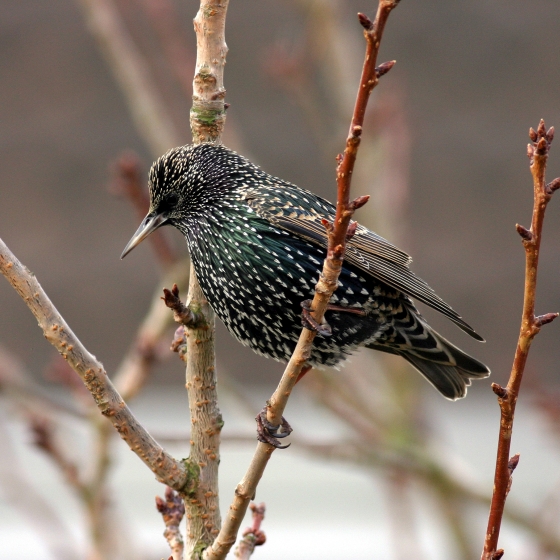
The Starling is perhaps best known for its squabbling behaviour at bird feeders, and the huge flocks which form dancing murmurations during the winter.
At close quarters, the dark-looking Starling is a colourful bird; its breeding plumage is iridescent green, blue and purple and it is spotted with silver in the winter. The Starling mainly feeds on soil invertebrates, although it commonly visits garden feeders. Starlings often nests in the eaves of our houses, where their song - full of the masterful mimicry of other birds and even machines - can be fully appreciated.
Starlings can be found across Britain & Ireland except for the highest peaks. Numbers increase dramatically during the winter months when birds arrive from northern Europe and larger roosts can number over a million birds. The species is on the UK Red List due to a sharp breeding population decline since the 1960s.
- Our Trends Explorer gives you the latest insight into how this species' population is changing.
Key Stats









Identification
ID Videos
This section features BTO training videos headlining this species, or featuring it as a potential confusion species.
#BirdSongBasics: Chaffinch and Starling
Songs and Calls
Song:
Call:
Alarm call:
Begging call:
Status and Trends
Conservation Status
Population Change
The abundance of breeding Starlings in the UK has fallen rapidly, particularly since the early 1980s and especially in woodland (Robinson et al. 2002, 2005a), and continues to be strongly downward. The BBS map of change in relative density between 1994-96 and 2007-09 indicates that decrease over that period was widespread across England and eastern Scotland but that some increase occurred in Northern Ireland, western Scotland and Cumbria. More recent BBS data suggest that populations are also now decreasing in Scotland and Wales and are broadly stable in Northern Ireland. The species' UK conservation listing has been upgraded from amber to red as the decline has become more severe. Widespread declines in northern Europe during the 1990s outweighed increases in the south, and the European status of this species is no longer considered 'secure' (BirdLife International 2004). There has been a decline across Europe since 1980 (PECBMS: PECBMS 2020a>).
Distribution
Starlings breed and winter throughout Britain and Ireland, although some parts of central Wales are unoccupied in the breeding season. Winter abundance is highest in low-lying pastoral farmland in the northeast and midlands of Ireland and in the west and southwest of Britain. In the breeding season, abundance is greatest across Ireland and in low-lying areas in eastern Britain and the Northern Isles, with other concentrations associated with urban area.
Occupied 10-km squares in UK
2007/08–10/11
or view it on Bird Atlas Mapstore.
2008–11
or view it on Bird Atlas Mapstore.
European Distribution Map
Distribution Change
The Starling's breeding range has changed little, but relative abundance within the core range has decreased, consistent with a 50% populaiton decline in the UK during 1995–2010.
Change in occupied 10-km squares in the UK
from 1981–84 to 2007–11
or view it on Bird Atlas Mapstore.
from 1968–72 to 2008–11
or view it on Bird Atlas Mapstore.
Seasonality
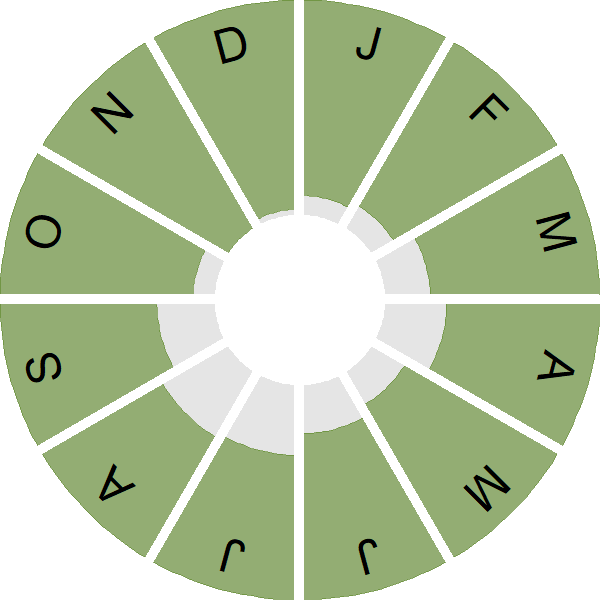
Starling is recorded throughout the year on up to 40% of complete lists.
Weekly pattern of occurrence
The graph shows when the species is present in the UK, with taller bars indicating a higher likelihood of encountering the species in appropriate regions and habitats.

Habitats
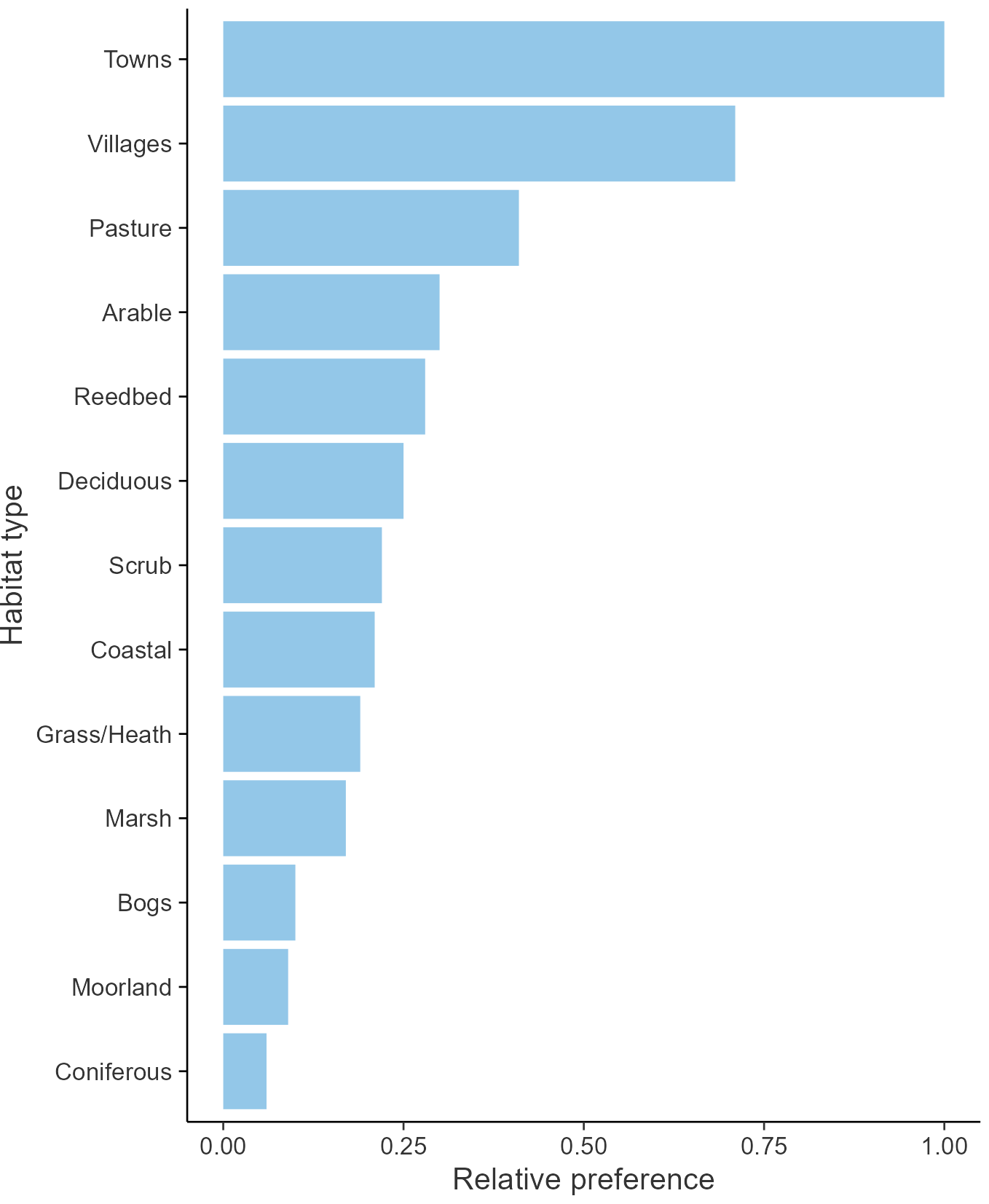
Breeding season habitats
Relative frequency by habitat
The graph shows the habitats occupied in the breeding season, with the most utilised habitats shown at the top. Bars of similar size indicate the species is equally likely to be recorded in those habitats.
Movement
Britain & Ireland movement
Foreign locations of birds ringed or recovered in Britain & Ireland
Dots show the foreign destinations of birds ringed in Britain & Ireland, and the origins of birds ringed overseas that were subsequently recaptured, resighted or found dead in Britain & Ireland. Dot colours indicate the time of year that the species was present at the location.
- Winter (Nov-Feb)
- Spring (Mar-Apr)
- Summer (May-Jul)
- Autumn (Aug-Oct)

European movements
EuroBirdPortal uses birdwatcher's records, such as those logged in BirdTrack to map the flows of birds as they arrive and depart Europe. See maps for this species here.
The Eurasian-African Migration Atlas shows movements of individual birds ringed or recovered in Europe. See maps for this species here.
Biology
Productivity and Nesting
Nesting timing
Egg measurements
Clutch Size
Incubation
Fledging
Survival and Longevity
Survival is shown as the proportion of birds surviving from one year to the next and is derived from bird ringing data. It can also be used to estimate how long birds typically live.
View number ringed each year in the Online Ringing Report.
Lifespan
Survival of adults
Survival of juveniles
Biometrics
Wing length and body weights are from live birds (source).
Wing length
Body weight
Ring Size
Classification, names and codes
Classification and Codes
- Order: Passeriformes
- Family: Sturnidae
- Scientific name: Sturnus vulgaris
- Authority: Linnaeus, 1758
- BTO 2-letter code: SG
- BTO 5-letter code: STARL
- Euring code number: 15820
Alternate species names
- Catalan: estornell comú
- Czech: špacek obecný
- Danish: Stær
- Dutch: Spreeuw
- Estonian: kuldnokk
- Finnish: kottarainen
- French: Étourneau sansonnet
- Gaelic: Druid
- German: Star
- Hungarian: seregély
- Icelandic: Stari
- Irish: Druid
- Italian: Storno
- Latvian: majas strazds
- Lithuanian: paprastasis varnenas
- Norwegian: Stær
- Polish: szpak (zwyczajny)
- Portuguese: estorninho-malhado
- Slovak: škorec obycajný
- Slovenian: škorec
- Spanish: Estornino pinto
- Swedish: stare
- Welsh: Drudwen
Research
Causes of Change and Solutions
Causes of change
There is good evidence that changes in first-year overwinter survival rates best account for observed population change. Although the ecological drivers of Starling decline are poorly understood, changes in the management of pastoral farmland are thought to be largely responsible.
Further information on causes of change
As the population has dropped, the numbers of fledglings per breeding attempt has increased markedly (see above); clutches are now larger, and rates of nest loss at the egg and chick stage have fallen. These improvements in breeding performance suggest that decreasing survival rates are likely to be responsible for the decline. Evidence for this is provided by Freeman et al. (2007b), who conducted a population modelling exercise and found that changes in first-year overwinter survival rates could best account for observed population change, and were sufficient, on their own, to explain the broad pattern of decline. This pattern is supported by a more recent, integrated, population analysis (Robinson et al. 2014). The decline in survival rates nationwide coincided with the major period of population decline. MacLeod et al. (2008) also provide evidence linking Starling declines to the environmental conditions outside the breeding season, suggesting that the species' population status is dependent on interactive or synergistic effects of food availability and predation. Recent research in The Netherlands has identified changes in juvenile survival as the most likely explanation for similar substantial declines which have affected the Dutch Starling population since the 1990s (Versluijs et al. 2016).
There is little direct evidence from studies analysing the ecological drivers of the declines. However, changes in pastoral farming practices are likely to account for at least some of the decline in the wider countryside, probably related to changes in food resources, though these are largely unquantified (Robinson et al. 2005a). In Denmark, adults selectively forage in grazed areas when feeding nestlings (Heldbjerg et al. 2017), and the decline of the Starling has been linked to changes in grassland area and grazing density (Heldbjerg et al. 2016). A review by Heldbjerg et al. (2019) concluded that cattle abundance was most likely to explain the differences in trends across Europe, rather than grassland extent or temperature. Loss of permanent pasture, which is the species' preferred feeding habitat, and general intensification of livestock rearing are likely to be having adverse effects on rural populations in the UK, but other causes should be sought in urban areas (Robinson et al. 2002, 2005a). Whilst the number of cattle has declined, sheep numbers have increased, producing a different sward structure (Chamberlain et al. 2000b, Fuller & Gough 1999) and patterns of stock rearing have changed. These may have reduced foraging opportunities for Starling (Robinson et al. 2002, 2005a). Also the use of insecticides on grassland, though low, is targeted partly at tipulids, which may have reduced foraging opportunities further (Vickery et al. 2001). Although there is little published evidence that the density of tipulids has changed over time (Wilson et al. 1999), the area of permanent pasture, in which they are mainly found, has declined and the use of insecticides on them has increased. Drainage of grasslands is also thought to have reduced the quality of foraging conditions (Newton 2004). Even after considerable decline among farmland Starlings, tipulids remain important to them for provisioning young (Rhymer et al. 2012).
Suburban habitats important for Starlings with 60% of population in urban/garden habitats but relatively little known about them (Robinson et al. 2005a, 2006), and the causes of declines unclear though nesting attempts produce fewer young than rural birds (Siriwardena & Crick 2002 ). Town populations are doing best in the north and west but declining in the south (Robinson et al. 2005a). Further research into urban Starling population dynamics is to be encouraged if we are to understand the causes of decline of this charismatic species more fully.
Information about conservation actions
In rural areas, changes to pastoral farmland are most likely to be responsible for declines, with the intensification of livestock rearing and loss of permanent pasture reducing foraging opportunities (see Causes of Change section, above). Adults selectively forage in grazed areas when feeding nestlings (Heldebjerg et al. 2017), therefore maintaining grazing at this time is likely to be important. However, as the declines are believed to be driven by reduced first year survival, continued provision of suitable foraging habitat after fledging may be more important. Starlings capture more prey on short swards and providing short swards by grazing or mowing could therefore be a good way to improve foraging habitat (Devereux et al. 2004).
A reduction in the use of insecticides on grasslands may also benefit Starlings by improving foraging opportunities. Although the use of insecticides is low, it is targeted partly at tipulids which are an important prey item for Starlings (see Causes of Change section, above).
Starlings are also declining in urban areas which support around 60% of the population (Robinson et al. 2005a). Urban Starlings produce fewer young than rural birds (Siriwardena & Crick 2002) and urban birds are declining more strongly in the south of Britain than in the north and west (Robinson et al. 2005a). However, the reasons for the decline in urban areas are unclear and further research is needed before evidence-based conservation actions can be proposed.
Publications (4)
Drivers of the changing abundance of European birds at two spatial scales
Author:
Published: 2023
Understanding how human activities drive biodiversity change at different spatial scales is a key question for conservation practitioners and decision-makers. While we have a good understanding of the primary causes of observed biodiversity declines – which include land-use change, climate change, pollution, and the over-exploitation of species – we still struggle to measure and detect biodiversity change in robust and meaningful ways.
29.05.23
Papers
Birds of Conservation Concern Wales 4: the population status of birds in Wales
Author:
Published: 2022
The latest review of the conservation status of birds in Wales. The report assessed all 220 bird species which regularly occur in Wales. There are now 60 species of bird on the Red List, with 91 on the Amber List and just 69 - less than a third of the total number of species - on the Green List. The latest review of the conservation status of birds in Wales comes 20 years after the first, when the Red List was less than half the length it is today. The report assessed all 220 bird species which regularly occur in Wales. There are now 60 species of bird on the Red List in Wales, with 91 on the Amber List and 69 on the Green List. The Birds of Conservation Concern in Wales report assesses the status of each species against a set of objective criteria. Data sources include the BTO/JNCC/RSPB Breeding Bird Survey and the BTO/RSPB/JNCC Wetland Bird Survey, as well as Bird Atlases and other BTO-led monitoring schemes and citizen science initiatives. These are used to quantify the changing status of the species’ Welsh population. The UK, European and global conservation status of the species is also considered, placing the Welsh population into a wider context. The Red ListSwift, Greenfinch and Rook – familiar breeding species in steep decline across the UK – are among the new additions to the Welsh Red List, which now also includes Purple Sandpiper, on account of a rapidly shrinking Welsh wintering population, and Leach’s Petrel, an enigmatic seabird in decline across its global range. These species now sit alongside well-known conservation priorities, such as Curlew, Hen Harrier and Turtle Dove as birds at risk of being lost from Wales for good. Uplands and woodlands Many of the species on the Red List are found in upland and farmland habitats. Starling, Tree Sparrow, Yellow Wagtail and Yellowhammer can no longer be found in much of Wales, while iconic species of mountain and moorland, such as Ring Ouzel, Merlin and Black Grouse, remain in serious trouble. Wales is well known for its populations of woodland birds; however, many of these – including Lesser Spotted Woodpecker, Willow Warbler and Spotted Flycatcher – also feature on the Red List. Goldcrest, which has seen its Welsh population shrink alarmingly in recent decades, is another new addition. On the coast The assessment for Birds of Conservation Concern Wales 4 took place before the impacts of avian influenza could be taken into account. Breeding seabird species have been struggling in Wales for many years, however, and most were already of conservation concern before the outbreak of this disease. Kittiwake, Puffin, Black-headed Gull, and Common, Arctic and Sandwich Tern remain on the Red List. Wales holds internationally significant numbers of breeding seabirds, making the decline of these colonies a global concern. The Amber ListDeclines in Wheatear, Garden Warbler and House Martin - all migrants which breed in Europe and winter in sub-Saharan Africa - mean these species have moved from the Green List to the Amber List. Many other ‘Afro-Palearctic' migrant species are also in decline, but the potential reasons for this, such as habitat loss and reduced availability of invertebrate prey, are not well understood. Closer to home, the declines in the Welsh Chaffinch population, linked to the disease trichomonosis, have seen the species Amber-listed. A number of other species have been placed on the Amber List because of the wider importance of their Welsh populations, which in each case make up more than half the UK total. Wales is home to more than three-quarters of the UK’s Choughs, for example, so recent declines are cause for concern. The nation’s breeding populations of Manx Shearwater, Pied Flycatcher, Goshawk and Hawfinch also account for more than half the UK total, as does its wintering population of Spotted Redshank. It’s not all bad news, though: some species now on the Amber List have moved up from the Red List, indicating some positive change in their population trends. These include Common Sandpiper, Great Black-backed Gull, Bullfinch, Goldcrest and Pied Flycatcher. The Green ListWhile the report contains much cause for alarm, several conservation success stories shine through. Red Kite was almost lost as a British bird during the first half of the 20th century, when only a handful of pairs remained in remote Welsh valleys. Since then, a sustained conservation effort has brought the species back from the brink. Wales is now home to more than 2,500 pairs of Red Kite and the species has now been moved to the Green List, reflecting this incredible change in fortunes. Song Thrush, Reed Bunting, Long-tailed Tit, Redwing and Kingfisher are among the other species to have gone Green, providing much-needed hope that things can go up as well as down.
06.12.22
Reports Birds of Conservation Concern
Assessing factors associated with changes in the numbers of birds visiting gardens in winter: Are predators partly to blame?
Author:
Published: 2019
11.10.19
Papers
The composition of British bird communities is associated with long-term garden bird feeding
Author:
Published: 2019
Research from BTO shows how the popular pastime of feeding the birds is significantly shaping garden bird communities in Britain. The populations of several species of garden birds have grown in number, and the diversity of species visiting feeders has also increased.
21.05.19
Papers

More Evidence
More evidence from Conservation Evidence.com
Partners




Citing BirdFacts
If you wish to cite particular content in this page (e.g. a specific value) it is best to use the original sources as linked in the page. For a more general citation of the whole page please use: BTO (20XX) BirdFacts Species: profiles of birds occurring in the United Kingdom. BTO, Thetford (www.bto.org/birdfacts, accessed on xx/xx/xxxx).