Citation
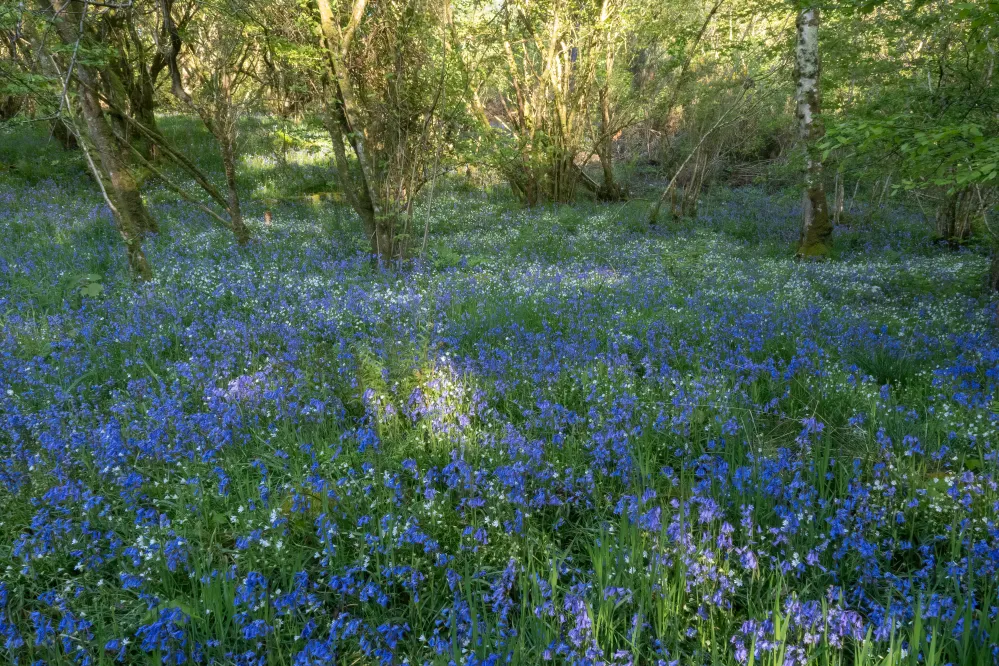
Overview
An easy-access data package combining land-cover, soil and climate data across the UK, produced as part of PhD research on scenario modelling, with BTO co-supervision.
In more detail
The UK has a wealth of environmental data, but combining them is rarely straightforward. Data can differ in classification, resolution, timeframe and spatial coverage across the devolved nations. 'UKbioprepr' brings data sources together into a single accessible analytical package, allowing researchers to extract site-level climate, habitat and soil information anywhere in the UK, from the year 2000 onwards. The package is designed to be integrated into scenario models for predicting how species occupancy may change under different future scenarios, as demonstrated in the paper with the Bluebell.
Abstract
Biodiversity modelling is essential for explaining and predicting ecological responses to environmental change and assessing progress towards targets in the Kunming-Montreal Global Biodiversity Framework (CBD 2022). The UK benefits from rich biodiversity time-series data and numerous open-source environmental datasets. However, integrating these into modelling workflows remains challenging – especially for those without considerable data processing expertise. Fragmented sources, spatial and temporal discrepancies and undocumented or unreproducible processing methods often create barriers and hinder coordination. We present ‘ukbioprepr', a user-friendly R package developed to address key environmental data preparation challenges in UK biodiversity modelling. It provides functions for downloading, harmonising and extracting site-level environmental variables from open-source datasets on climate, land cover and soil properties. Data products are processed to align spatially and temporarily with UK biodiversity data, allowing consistent covariate generation from 2000 onwards. Substantial data engineering – including reprojection, temporal interpolation and spatial alignment – supports model-ready outputs, whilst limitations (e.g. sparse soil data in urban areas) are transparently documented. ‘ukbioprepr' supports both point-based and grid-based survey data and includes methods for aggregating climate variables over biologically relevant time periods (e.g. seasons, custom annual windows). These features enable integration across spatial and temporal scales and support diverse biodiversity modelling approaches. We demonstrate its application in a case study modelling occupancy of the native UK wildflower Hyacinthoides non-scripta. Using derived environmental predictors, we show how these data products can inform ecological forecasts under future climate scenarios, predicting a 12.4% reduction in suitable habitat area under the most severe scenario (RCP8.5). By lowering technical barriers and enabling consistent environmental data integration, ‘ukbioprepr'supports scalable, reproducible biodiversity modelling across all four nations in the UK. The package exemplifies how targeted frameworks can streamline modelling workflows and improve coordination across biodiversity research and policy – principles that can be applied globally.
Staff author(s)

This work was jointly funded by the Natural Environment Research Council and Biodiversify Ltd through the ARIES Doctoral Training Partnership (grant no. NE/S007334/1).