Citation
Overview
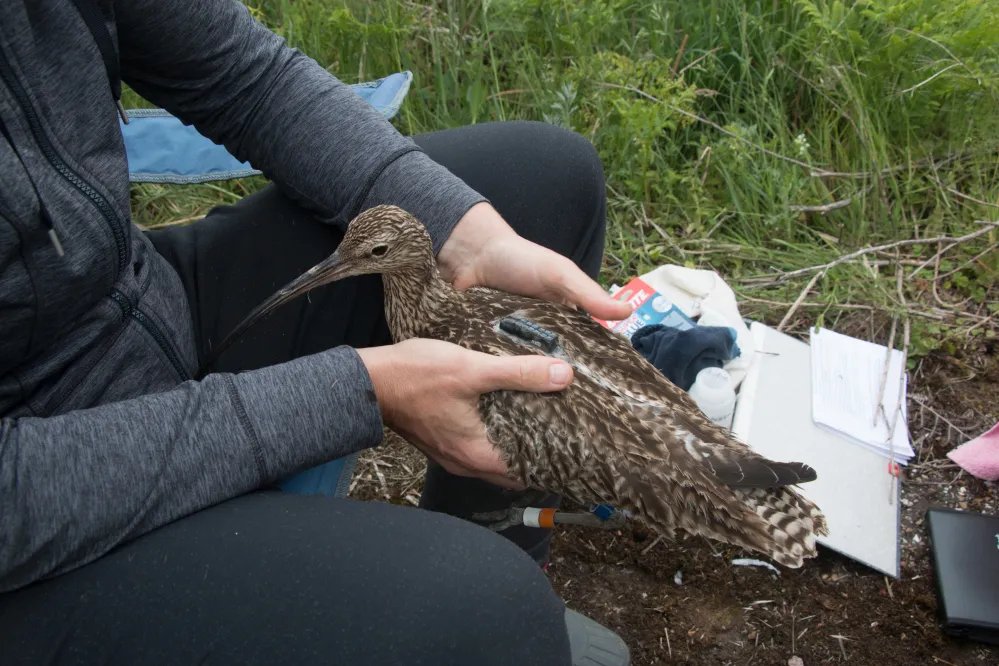
Tracking studies, where individual devices are fitted to birds to follow their movements, are becoming increasingly common in ornithology. This paper uses previous research tracking waders to evalutate how various factors, including tag attachment type and power source, affect the likelihood that a study will meet its goals, and provides guidelines for selecting a tracking technique to optimise the chances of success.
In more detail
The research compiled data from 54 published and unpublished datasets, comprising 2,745 tag deployments on 37 wader species at 128 sites as part of 54 separate projects. Most of these involved capturing birds in North America and Europe, and the studies considered included BTO research tracking Curlew in the Brecks, and on the Humber Estuary. The studies spanned those using 29 different kinds of tag, with various different attachment types (e.g. harnesses, glue) and power sources (i.e. battery or solar).
The results showed differences in the effectiveness of different tag types depending on the species involved, their preferred habitats, and the time of year. For example, tracking studies in remote upland locations were more likely to be successful when the tags involved had a lighter mass relative to the bird, were attached with a leg-loop harness instead of glue or a body harness, provided data via satellite, or were deployed outside the breeding season. Such knowledge can inform the selection of tracking technology and attachment methods to help ensure that future studies are effective.
Tracking studies provide important insights into wader ecology that can help understand the factors causing population declines in many species. However, tagging can have negative consequences for the individual birds concerned, making the opimisation of tracking studies essential.
Abstract
Animal-borne trackers are commonly used to study bird movements, including in long-distance migrants such as shorebirds. Selecting a tracker and attachment method can be daunting, and methodological advancements often have been made by trial and error and conveyed by word of mouth. We synthesized tracking outcomes across 2745 dorsally mounted trackers on 37 shorebird species around the world. We evaluated how attachment method, power source, data retrieval method, relative tracker mass, and biological traits affected success, where success was defined as whether or not each tag deployment reached its expected tracking duration (i.e. all aspects succeeded for the intended duration of the study: attachment, tracking, data acquisition, and bird survival). We conducted separate analyses for tag deployments with remote data retrieval (‘remote-upload tag deployments') and those that archived data and had to be recovered (‘archival tag deployments'). Among remote-upload tag deployments, those that were a lighter mass relative to the bird, were beyond their first year of production, transmitted data via satellite, or were attached with a leg-loop harness were most often successful at reaching their expected tracking duration. Archival tag deployments were most successful when applied at breeding areas, or when applied to males in any season. Remote-upload tag deployments with solar power, satellite data retrieval, or leg-loop harnesses continued tracking for longer than those with battery power, other types of data retrieval, or glue attachments. However, the majority of tag deployments failed to reach their expected tracking duration (71% of remote-upload, 83% of archival), which could have been due to tracker failure, attachment failure, or bird mortality. Our findings highlight that many tag deployments may fail to meet the goals of a study if tracking duration is crucial. Using our results, we provide guidelines for selecting a tracker and attachment to improve success at meeting study goals.
Staff author(s)



Funding was provided by Audubon Alaska; Alaska Department of Fish and Game; Alberta Environment and Parks; Arctic Landscape Conservation Cooperative; ArcticNet; Aves Uruguay; B.P. Exploration (Alaska), Inc.; Bird Conservancy of the Rockies; BirdLife Netherlands; Birds Canada; British Trust for Ornithology Curlew Appeal; Canada Research Chair program; Canadian High Arctic Research Station; CAPES Foundation; Centro Universitario Regional del Este; Churchill Northern Studies Centre Northern Research Fund (2018, 2019); Coastal Solutions Fellowship Program; Colorado Field Ornithologists; Colorado Parks and Wildlife; Commission for Environmental Cooperation; ConocoPhillips; ConocoPhillips Alaska, Inc.; Conselho Nacional de Desenvolvimento Científico e Tecnológico – CNPq; David and Lucile Packard Foundation; David Seay; Denver Field Ornithologists; Disney Worldwide Conservation Fund; Environment and Climate Change Canada; FCT/MCTES to CESAM via national funds (UIDP/50017/2020, UIDB/50017/2020, LA/P/0094/2020); Fonds de Recherche du Québec – Nature et Technologies; Fritz L. Knopf Fellowship in Avian Conservation; FUNBIO; Fundación Lagunas Costeras; German Research Foundation (Project EB590/1-1); Gieskes-Strijbis Fonds; Gladstone Ports Corporation’s Ecosystem Research and Monitoring Program; Gulf Coast Joint Venture; Gulf Watch Alaska Nearshore Component; High Meadows Foundation; Humber Nature Partnership; Icelandic Research Fund (grants 152470-052 and 217587-051); Indigenous and Northern Affairs Canada; Instituto Neoenergia; LIFE IP ‘GrassBirdHabitats’; LIFE+ Wiesenvögel (LIFE10/NAT/DE011); Lush Cosmetic grant; Manomet Conservation Sciences and donors; MAVA Foundation; Max Planck Institute for Ornithology; Max Planck Society; Migratory Connectivity Project; Mitacs; National Basic Research Program of China (grant no. 2013CB430404); National Fish and Wildlife Foundation, including the ConocoPhillips SPIRIT of Conservation program; Natural Environment Research Council (EnvEast DTP); Natural Resources Canada (Polar Continental Shelf Program); Natural Sciences and Engineering Research Council of Canada (including Discovery Grant, Graduate Scholarship); Neotropical Migratory Bird Conservation Act Program; NERC (NE/M012549/1); NWO-ALW TOP grant ‘Shorebirds in space’ (854·11·004); Organismo Provincial para el Desarrollo Sostenible; Parks Canada (Mingan); Point Blue (formerly PRBO) Conservation Science; ProPolar; RANNIS (grant 217753); SAVE Brasil; Simon Fraser University's Centre for Wildlife Ecology; Smithsonian Migratory Bird Center; T-Gear Foundation; The Centre for Wildlife Ecology at Simon Fraser University; The National Natural Science Foundation of China (31071939); The Nature Conservancy (TNC); The Netherlands Organization for Scientific Research (Spinoza Premium 2014); The Oil Spill Recovery Institute; The Research Council of the Sultanate of Oman (ORG/EBR/12/002); The Science and Technology Department of Shanghai (grant no. 12231204702); Tidal Lagoon Power Ltd; Tracy Aviary Conservation Fund; U.S. Bureau of Land Management; U.S. Bureau of Ocean Energy Management; U.S. Department of the Air Force (673 CES/CEIEC; project numbers FXSB46058118, FXSB4658119, and FXSBA53216120); U.S. Fish and Wildlife Service (Migratory Bird Management Division, Arctic National Wildlife Refuge, Candidate Conservation Species grant, Challenge Cost Share Program, NMBCA grant F18AP00634, WSFR—SWG grants T-32-1 and T-33-2020, Kanuti National Wildlife Refuge); U.S. Forest Service Office of International Programs; U.S. Geological Survey (Alaska Science Center, Ecosystems Mission Area, Science Support Program); Ubbo Emmius Fund; Universidad de la República; Université du Québec à Rimouski; University of Colorado Denver; University of Moncton; Washington Department of Fish and Wildlife; Wildlife Conservation Society and donors; World Wildlife Fund; World Wildlife Fund-Netherlands; and an anonymous donor.