Citation
Overview
BTO-led research estimates a minimum Arctic Skua breeding population of 185,131–395,315 pairs across Alaska, Canada, Greenland, and Europe combined, but highlights a data gap for Asian Russia, where an additional 40,000–600,000 pairs could be present. Given this uncertainty, the Arctic Skua should perhaps be reclassified as ‘Data Deficient’ rather than ‘Least Concern’ by the IUCN Red List at a global scale.
In more detail
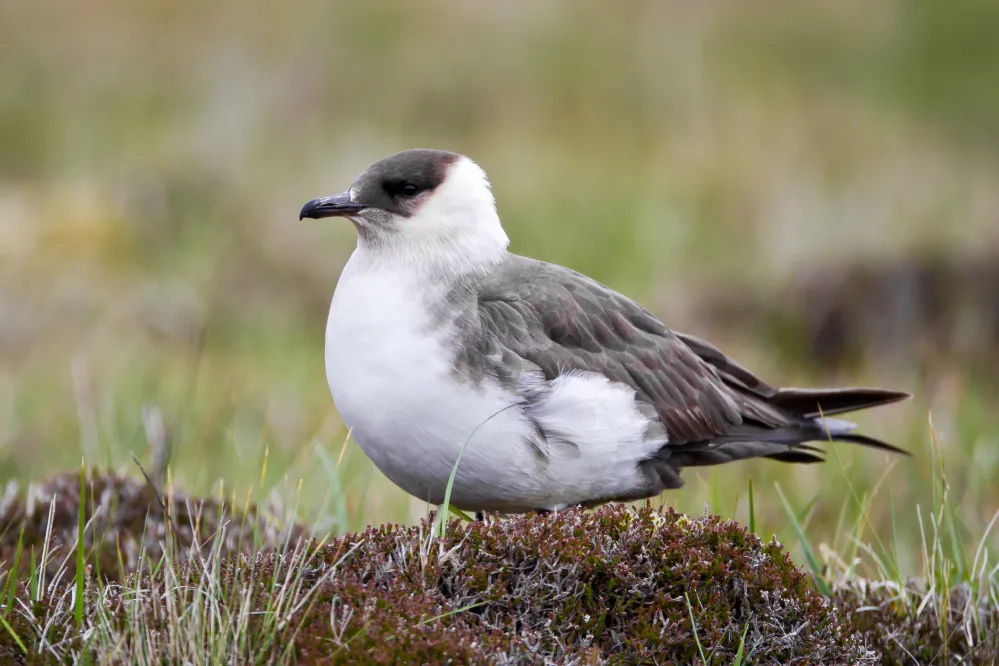
The Arctic Skua is a long-distance migratory seabird found across the Northern Hemisphere, known for both hunting its own prey and stealing food from other seabirds. In Europe, the species is classed as ‘Endangered’ on the IUCN European Red List, but as ‘Least Concern’ at a global scale. However, there is little information about the population trend away from the North Atlantic.
In this study led by BTO, scientists compiled national and regional population estimates from across the Arctic Skua’s breeding range to produce updated global figures and trends. They estimated at least 185,000–395,000 pairs breed in Alaska, Canada, Greenland, and Europe. Data were lacking from Asian Russia, although extrapolation suggested there could be an additional ~40,000–600,000 pairs. Population trends varied geographically.
North Atlantic populations, which rely heavily on stealing food from other seabirds, have declined sharply – by more than 80% in places like the UK and Faroe Islands. In contrast, the more generalist Arctic populations that breed in tundra areas and use a wider range of prey appear relatively stable, though data availability was very scarce for these regions.
The study identified several drivers of population change, including environmental change, fisheries, competition and predation, but highlighted that poor monitoring across much of the range makes it hard to quantify population trends and identify threats. Consequently, it highlights several research priorities for Arctic Skuas and suggests that they may be better classified as ‘Data Deficient’ by the IUCN Red List at a global scale.
Abstract
Data on species’ demography are essential to detect changes in population size, identify drivers of population change, motivate conservation plans, or evaluate the effectiveness of management. The Arctic Skua Stercorarius parasiticus is a seabird with a circumpolar distribution, which is listed as “Endangered” on the International Union for Conservation of Nature (IUCN) European Red List, although listed as “Least Concern” globally. It is both a predator and a kleptoparasite reliant on marine and terrestrial prey, and undertakes migrations from northern breeding habitats to temperate and tropical marine environments. Most studies of breeding populations originate from North Atlantic populations where Arctic Skuas are primarily kleptoparasitic. However, a large proportion of the global breeding population occupies remote coastal and inland tundra of Arctic regions where Arctic Skuas are more generalist in foraging modality and the range of prey taken. Here, we collated and summed national/regional population estimates to provide an updated global estimate of breeding population size and trends. We reviewed drivers of population change and knowledge gaps, and their implications for the conservation of this species. We estimated a minimum breeding population of 185,131–395,315 pairs combining Alaska, Canada, Greenland, and Europe; we extrapolated that at least 40,000 pairs could be found in Asian Russia, where no estimates were available. We noted differential trends, with substantial declines in typically kleptoparasitic populations of the North Atlantic where data quality was higher, whereas for populations in the Nearctic, trend data were scarce and geographically restricted. Various threats were identified as potential drivers of population change, including bottom-up processes, fisheries, heat stress, and interspecific competition/predation. Given the large uncertainty around abundance and population trends for much of the Arctic Skua’s range, the current global conservation status of Least Concern may be better designated as “Data Deficient”, and we encourage the implementation of a range of approaches to improve monitoring of population trends and demography globally.
Staff author(s)



BTO’s contribution to this paper was supported by funding from Gifts in Wills and individual donors, for which the authors are extremely grateful.