Citation
Overview
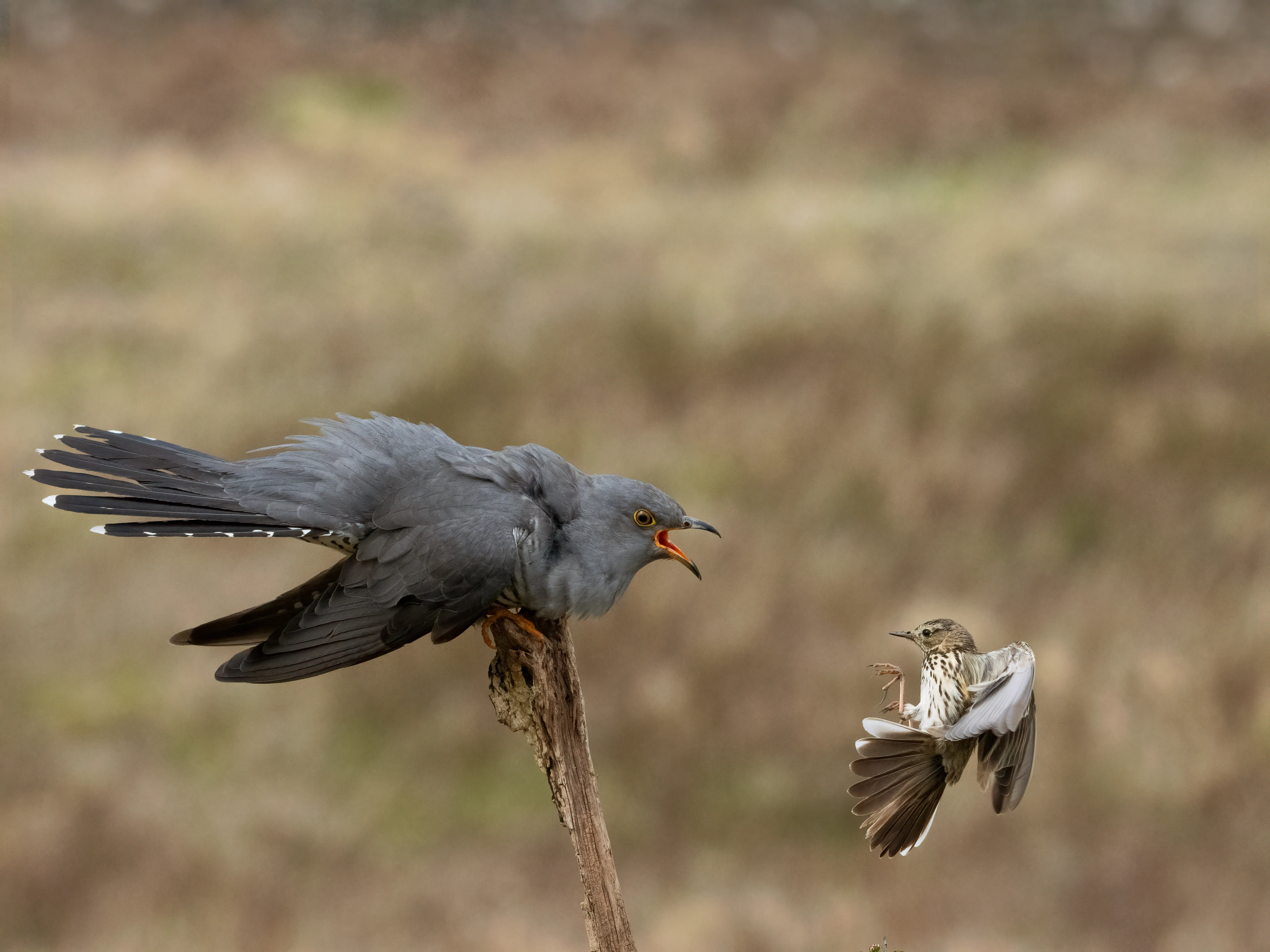
Cuckoos are brood parasites, meaning they lay their eggs in other species' nests, and the resulting chicks are raised by the host species. Cuckoos therefore face strong evolutionary pressure for their eggs and offspring to match those of their hosts, yet each Cuckoo species parasitises multiple hosts. This study examines the genetic basis of egg coloration in the Common Cuckoo and the Oriental Cuckoo.
Abstract
Host-parasite arms races facilitate rapid evolution and can fuel speciation. Cuculus cuckoos are deceptive egg mimics that exhibit a broad diversity of counterfeit egg phenotypes, representing host-adapted subpopulations (gentes). Genome analysis of 298 common (Cuculus canorus) and 50 oriental cuckoos (Cuculus optatus) spanning 15 egg morphs revealed that eggshell background coloration is predominantly influenced by matrilineal genetic variation. Recurrent mitochondrial mutations and an ancient W chromosome–linked translocation of an autosomal assembly factor for respiratory complex I provide a tentative link between mitochondrial function and pigment synthesis through the heme pathway. Biparentally inherited loci contribute to phenotypic variation in both species, mainly for maculation. The evolutionary tug-of-war over a sex-limited, mimetic trait integrates autosomal components with the nonrecombining, matrilineal genome without catalyzing genome-wide divergence between gentes.
Staff author(s)


Computing was performed on the BioHPC hosted at Leibniz Rechenzentrum Munich funded by German Research Foundation grant INST 86/2050-1 FUGG (J.B.W.W.). This work was funded by LMU Munich (J.B.W.W.); German Research Foundation grant WO 1426/2-1 (J.B.W.W.); The Research Council of Norway grant 151641/177709/218144 (F.F. and B.G.S.); Russian Federation grant 122021000096-7 (M.G.); National Natural Science Foundation of China grants 32270526 and 32470513 (W.L.); and National Key R&D Program of China grant 2023YFF1304600 (W.L.).