Citation
Overview
Climate and land-use change have already contributed to species declines and extinctions in Great Britain, and are expected to cause further substantial alterations in plant and animal communities. More extinctions are likely even under optimistic scenarios, partly due to accumulating extinction debts. Reducing emissions and moving towards a more sustainable society could help ‘bend the curve’ of biodiversity loss, but this study shows that the actions taken during the next 20 years will be crucial.
In more detail
Understanding how climate and land‑use change translate into biodiversity change is essential for informing effective policy. Such knowledge helps decision‑makers prioritise vulnerable species and protect critical areas, and plan management actions that support future conservation targets.
In this study, scientists (including from BTO) used data from several UK biodiversity monitoring schemes, including the BTO/JNCC/RSPB Breeding Bird Survey, to statistically model future scenarios and estimate how biodiversity may respond. The novelty of this research lies in the development of integrated scenarios that combine climate, land‑use, and socio‑economic pathways, and in modelling species responses at the community level rather than species by species. This approach allows interactions among species to be incorporated.
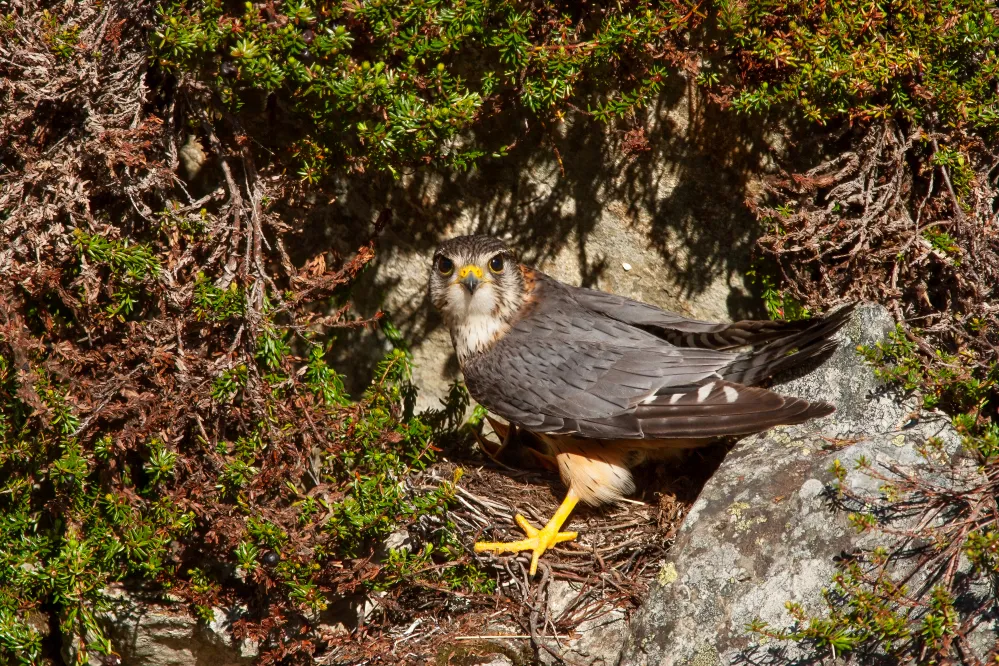
The results indicate substantial future changes in species composition for plants, butterflies, and birds, even under mild climate‑change scenarios. Under stronger climate‑change pathways, the impacts become far more severe. For example, under the worst‑case scenario, a median of 48% of plant species and 16% of bird species currently present in a 1‑km square in Britain are projected to be lost or replaced by 2070. Entire bioclimates (combinations of species assemblages and climate) may disappear; 37% of Britain could lose its current bioclimates by 2070. Extinction risks also rise sharply, particularly for plants, with up to 20% of plant species and 13% of bird species (including Merlin) heading towards extinction under the most extreme scenarios.
Current trajectories suggest that we are moving toward intermediate scenarios (RCP6.0 and RCP4.5), which would still lead to substantial ecological change and potentially cascading effects on ecosystem functioning, including services vital to humans. It is not too late to reduce these risks, but the window for effective action is narrowing. Decisions made over the next two decades will be critical for securing more positive outcomes for biodiversity.
Abstract
Projections of biodiversity futures are needed to translate global policies into national action. We use dissimilarity modelling to project climate change scenarios for 1002 plant, 56 butterfly, and 219 bird species across Great Britain up to 2080. Under all scenarios we find extensive community reorganisation, with the disappearance of current bioclimates and emergence of novel ones. We also explore impacts of combined climate and land-use change, finding that even optimistic scenarios could see accumulating extinction debts. Scenarios featuring reduced emissions and a more sustainable society could bend the curve of loss, reducing species heading for extinction by 32% for plants, 14% for butterflies, and 20% for birds. Scenarios differ in impact between groups, with plants showing the most severe responses to environmental change. Overall, we show that actions taken during the next 20 years are crucial to mitigate the worst effects of climate and land-use change for biodiversity in Britain.
Staff author(s)

This work was supported by National Capability funding as part of the Spatially explicit Projections of EnvironmEntal Drivers (SPEED) work package of the Natural Environment Research Council UK-SCAPE programme NE/R016429/1 (RC, CoH, SMW, ChH, RD-B, PH, ELR, NJBI, JMB). The work was also supported by the GLiTRS (Global Insect Threat-Response Synthesis) project from the UK Natural Environment Research Council NE/V007548/1 (RC, CaH, JR, NJBI) and NE/V006800/1 (AP). The work was also supported by Excalibur, from the European Union’s Horizon 2020 research and innovation programme under grant agreement No 817946 (VJB, AP), and by the Helmholtz Association (CB). This work used JASMIN, the UK’s collaborative data analysis environment (https://www.jasmin.ac.uk). The authors thank Kazuhito Ichii and Dan Henri who obtained the Net Primary Productivity data. The authors are extremely grateful to all the participants in the monitoring schemes for plants, butterflies, and birds in Great Britain without whom this study would not have been possible. The National Plant Monitoring Scheme is run and funded by the Botanical Society of Britain and Ireland (BSBI), the UK Centre for Ecology and Hydrology (UKCEH), Plantlife, the Department of Agriculture, Environment and Rural Affairs (Northern Ireland), and the Joint Nature Conservation Committee (JNCC). The UK Butterfly Monitoring Scheme is organised and funded by Butterfly Conservation, the UK Centre for Ecology & Hydrology, British Trust for Ornithology, and the Joint Nature Conservation Committee. The UK Breeding Bird Survey is a partnership jointly funded by the British Trust for Ornithology, Royal Society for the Protection of Birds, and the Joint Nature Conservation Committee, with fieldwork conducted by volunteers.