Citation
Overview
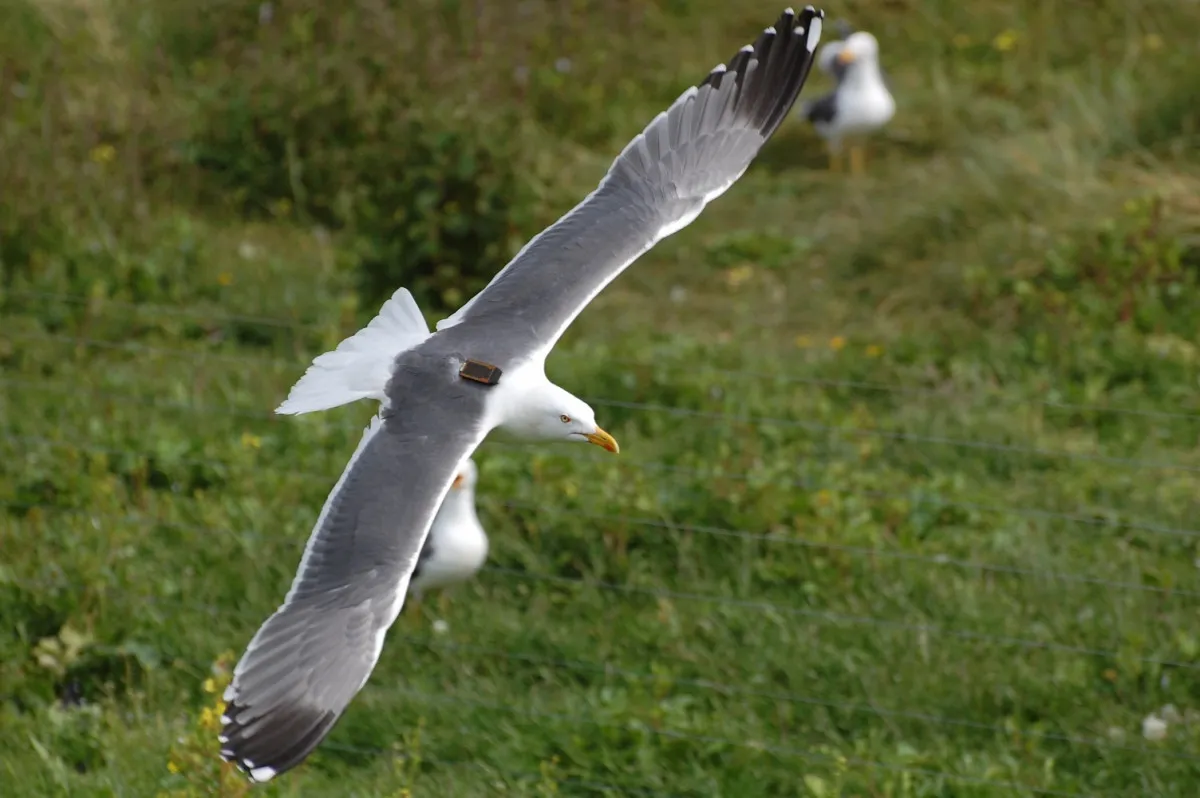
This study examines the foraging ranges of Herring Gulls and Lesser Black-backed Gulls during the breeding season to help identify and resolve potential human–wildlife conflicts.
In more detail
Breeding birds must routinely return to their nest site, to incubate eggs and care for chicks. This constraint imposes a ‘foraging range’ (i.e. the straight-line distance between their nest and the places they visit to feed).
Foraging range information can play an important role minimising potential conflicts between humans and wildlife. For example, for seabirds within the offshore environment, foraging ranges have helped to designate Marine Protected Areas, and to determine the potential overlap of species distributions with marine energy installations such as offshore wind farms. Foraging ranges are also important for onshore renewable energy developments, and for other concerns in the terrestrial environment such as safety around airports, for which licenses can be issued to control bird numbers.
Several gull species use many different onshore and offshore habitats. It is important to understand of how far these birds travel in both terrestrial and marine environments, how variable their foraging ranges actually are in relation to the habitat type where they breed (e.g. coastal, island, urban and inland) and how they vary over the course of the breeding season.
Using GPS tracking data collected over 12 years (2010–2022), this study looked at the breeding season movements of Lesser Black-backed Gulls from 11 UK colonies, and Herring Gulls from seven UK colonies. Not only were the foraging ranges of Lesser Black-backed Gulls larger than those of Herring Gulls, but the species also differed in how far they travelled offshore and inland. During nesting, the foraging ranges of Lesser Black-backed Gulls within marine environments were greater than those in terrestrial ones (a mean average of 19.5 ± 23.1 km, compared to 14.9 ± 15.9 km), whereas for Herring Gull the opposite pattern was found (9.1 ± 10.7 km in terrestrial environments, compared to 7.1 ± 8.1 km in marine environments).
Further differences between species were found within the breeding season. For terrestrial environments, the foraging ranges of Lesser Black-backed Gulls when birds were likely looking after eggs and chicks were notably smaller than before breeding started, or after it had finished. For for Herring Gulls, the largest ranges were found when birds had likely eggs and chicks. These patterns for both species were different for marine environments, however, with progressively larger ranges found from pre-breeding to breeding to post-breeding for both species.
Among different breeding colony habitat types, those birds nesting in urban locations had the smallest foraging ranges, agreeing with previous findings from other studies. Island colonies had some of the largest ranges.
This study improves the precision of foraging range information for these two species of gull, providing more detailed estimates specific to the foraging environment, breeding stage and colony type than previously available. Seabirds are highly threatened by overfishing, bycatch, pollution, and disturbance from energy developments such as wind farms. The data from this study will help to reduce uncertainty within consenting process for proposed offshore wind farm developments, as well as in decisions about issuing licenses to control their numbers.
Abstract
How far animals travel to gather food for offspring or themselves is a central component of ecology. Among birds, the ‘foraging range’ (straight-line distance between a central place and a destination) is used to assess potential interactions with anthropogenic stressors such as wind farms. Recent reviews have summarized marine foraging ranges for UK breeding seabirds. However, for species that span the terrestrial/marine divide (some gulls, terns, sawbills and divers), terrestrial ranges are unknown, as is an understanding of how ranges may vary by breeding colony and their surrounding habitat. Using global positioning satellite (GPS) telemetry, we studied the movements of Lesser Black-backed Gulls Larus fuscus and Herring Gulls L. argentatus from 11 and seven UK breeding colonies, respectively, over 12 years. We investigated the variation in foraging range using general mixed effects models with respect to: (i) terrestrial and marine environments; (ii) stages of the breeding season; and (iii) colony types according to habitat (natural: island, coastal, inland; and urban: coastal), accounting for sources of potential sampling bias. Lesser Black-backed Gulls had significantly larger ranges than Herring Gulls. During likely active nesting periods (incubation and chick-rearing: ‘true breeding’), marine foraging ranges of Lesser Black-backed Gulls (local mean 19.5 ± 23.1 km, max 175.5 km) were greater than terrestrial ranges (local mean 14.9 ± 15.9 km, max 145.4 km). By contrast, terrestrial ranges were largest for Herring Gulls (terrestrial, 9.1 ± 10.7 km, max 83.8 km; marine, 7.1 ± 8.1 km, max 74.4 km). For terrestrial environments, true breeding foraging ranges of Lesser Black-backed Gulls were smaller than during pre- or post-breeding phases, whereas for Herring Gulls the reverse was true. Marine ranges of both species were smallest during pre-breeding and largest during post-breeding phases. For both species, urban colonies had the smallest foraging range and island colonies some of the largest. Terrestrial and marine foraging ranges were predicted UK-wide based on colony type and breeding phase, highlighting concentrations of foraging range. This study provides more precise foraging range information specific to foraging environment, breeding stage and colony type than has currently been available, and will therefore help to reduce uncertainty in the consenting process for proposed developments as well as in licensing control of wild birds.
Staff author(s)


Katherine Booth Jones
Nigel Clark
Gary Clewley




Emily Scragg



Fieldwork, equipment, analysis and reporting for individual studies was funded by the Department for Energy Security and Net Zero (DESNZ) Offshore Energy Strategic Environmental Assessment (OESEA) research programme (Orford Ness, Skokholm and Walney), the contract being managed through John Hartley of Hartley Anderson Ltd, Ørsted (Walney), NatureScot, Natural England (Bowland, Ribble), BAE Systems (Ribble), Natural Resources Wales (Bangor), Northern Ireland Environment Agency, Northern Ireland Water, and the Agri-Food and Biosciences Institute (Belfast) and NGO Challenge Fund (Grant M51) (Copeland), Galloper Wind Farm Ltd (Havergate), and further for Walney through the Environmental Research Institute (North Highland College, University of the Highlands and Islands), funding from the Marine Renewable Energy and the Environment (MaREE) project (funded by Highlands and Islands Enterprise, the European Regional Development Fund and the Scottish Funding Council). The analysis of foraging ranges was funded by NatureScot and the DESNZ OESEA.