Bird migration in late October 2025.

Last week’s blog reported increased arrivals of winter visitors and that trend has accelerated since then. BirdTrack data show big increases in the reporting rates for winter visitors such as Redwing, Fieldfare and Brambling, as well as for species such as Song Thrush, Blackbird, Robin and Goldcrest, where migratory populations join our resident birds here in the winter
As well as these common migrants, reports have also spiked of some scarcer visitors. We have mentioned Yellow-browed Warbler in most recent blogs and, after a slow start to the autumn, the last week or so has seen a big spike in reports. The species was recorded on around 4% of complete lists across Britain and Ireland in the most recent week, but this masks significant regional variation, with the highest reporting rates in east coast counties, notably East Yorkshire (17%) and Norfolk (14%).
The scarcer Pallas’s Warbler has also been recorded at many sites along the east coast, as well as a few Hume’s, Radde’s and Dusky Warblers, and several Red-flanked Bluetails. Of the really rare vagrants, there was a brief sighting of a Rufous-tailed Robin in Orkney, two Black-faced Buntings were found, one each in Yorkshire and Shetland, and an Eyebrowed Thrush made it to the Isles of Scilly. However, the biggest news of the week has not been of an eastern vagrant but an American species, after late news emerged of a Great Crested Flycatcher on Shetland on 13 October, the first ever record of this species anywhere in Europe
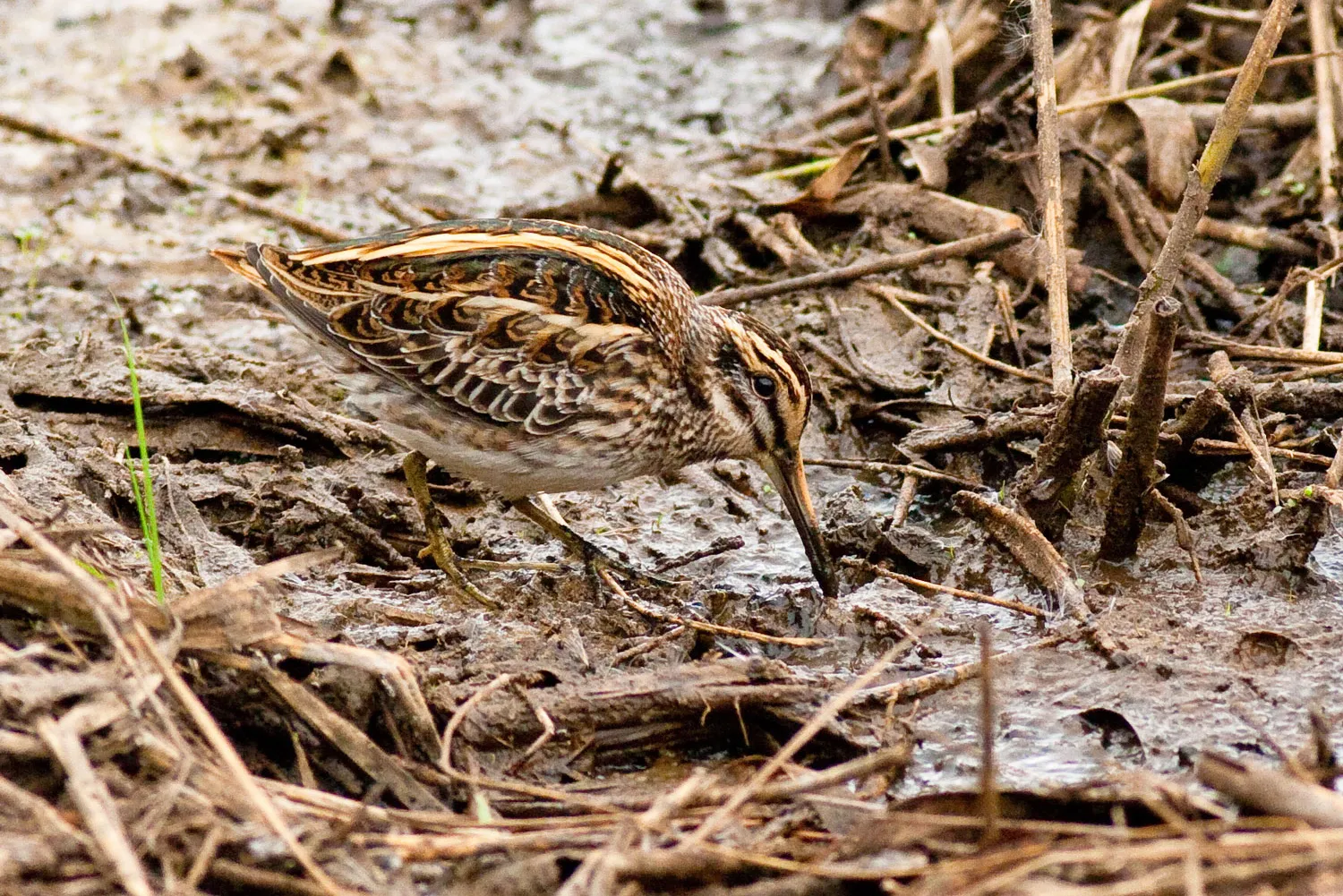
Another species which has seen a big spike in its reporting rate over the past week is the Jack Snipe. Unlike the Common Snipe, which breeds in Britain and Ireland, Jack Snipe is solely a winter visitor, arriving here from a broad breeding zone across Fennoscandia and Russia. Known for its distinctive bobbing behaviour while foraging, the Jack Snipe is generally seen singly around the well-vegetated edges of wetlands, whereas Common Snipe is more gregarious and more confident in venturing from the margins. One might only expect to see one Jack Snipe for every 100 Common Snipe, but given the elusive nature of the former the actual ratio of wintering populations in Britain is probably around 10:1 in favour of the Common Snipe. You can get more tips on separating the two species in our video: Identifying Common Snipe and Jack Snipe.
It’s also been good to see Short-eared and Long-eared Owls being recorded at many sites on the east coast recently. Witnessing one of these owls arrive ‘in off’, having crossed hundreds of kilometres of sea while at risk from storms, gulls and other hazards, is always a slightly peculiar but thrilling sight. At the moment the reporting rate for Short-eared Owl is still some way behind the historic average, suggesting it won’t be a great winter to see this species here; however, the reporting rate for Long-eared Owl has been slightly above the historic average.
Over the course of this autumn’s migration blogs we have frequently mentioned hotspots on the east coast, including places like Flamborough Head and Spurn on the Yorkshire coast, where you can witness the spectacle of large numbers of migrant birds arriving into Britain. However, this isn’t the end of these birds’ journeys, as they will now be filtering south and west across Britain and Ireland, with some spending all winter here and some continuing further south into France and Iberia. BirdTrack data capture this progression of birds across the country very clearly, for example the main arrival of Redwing in Cornwall is around a month later than the main arrival in East Yorkshire.
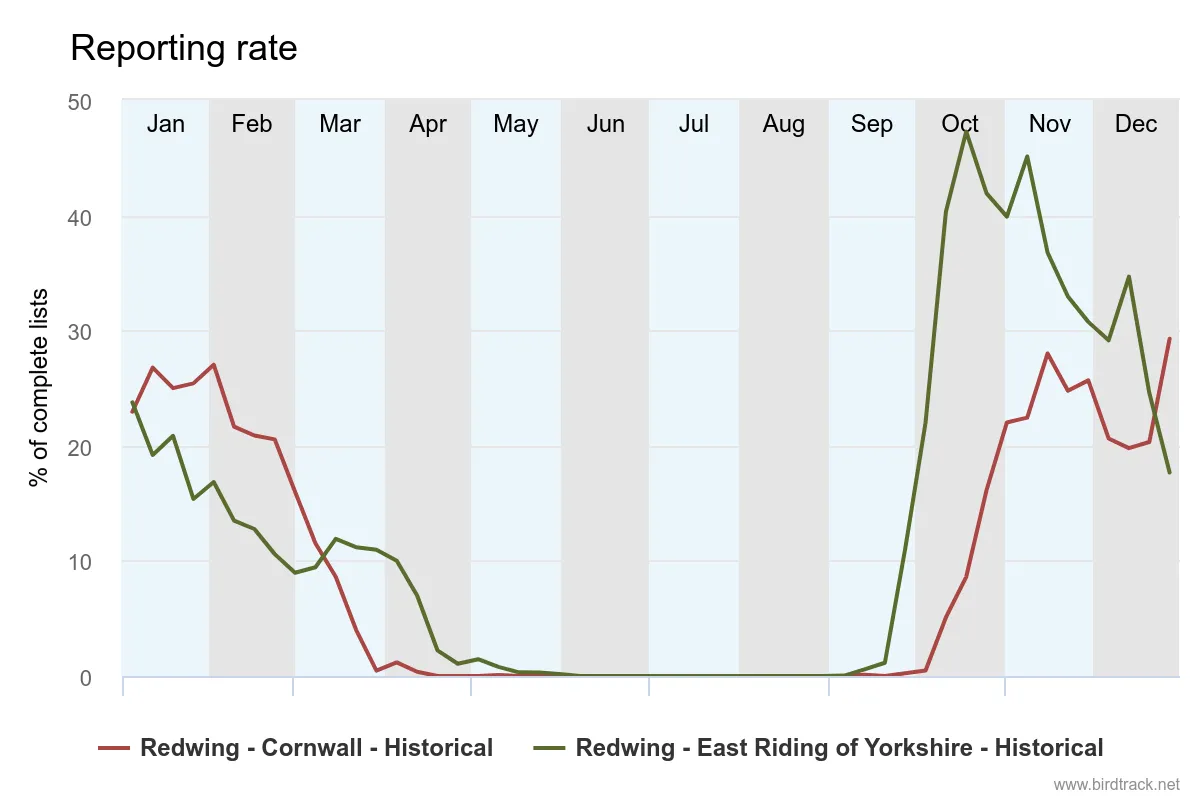
So if you live away from the east coast and are still awaiting your first Redwing or Fieldfare of the autumn, they are on their way! In fact, almost all of the species mentioned in this blog will likely be found at sites across Britain and Ireland in the coming weeks. If you have an inland local patch, keep checking tit flocks for the chance of a Yellow-browed Warbler, listening out for the distinctive ‘tsoo-eet’ call. Jack Snipe are possible in almost any well vegetated wetland and, as well as the previously mentioned Short-eared Owls, late autumn is also a great time to find Hen Harrier and Merlin as they move from upland areas to lowland habitats such as coastal marshes and farmland.
Wherever you are, I wish you a good week of late autumn birding and don’t forget to add your sightings to BirdTrack
Add your sightings to BirdTrack
Help us track the departures and arrivals of migrating birds by adding your sightings to BirdTrack. It’s free, quick and easy, and signing up also allows you to explore trends, reports and recent records in your area.
Author(s)
Tom Jordan