Bird migration over Easter 2026.
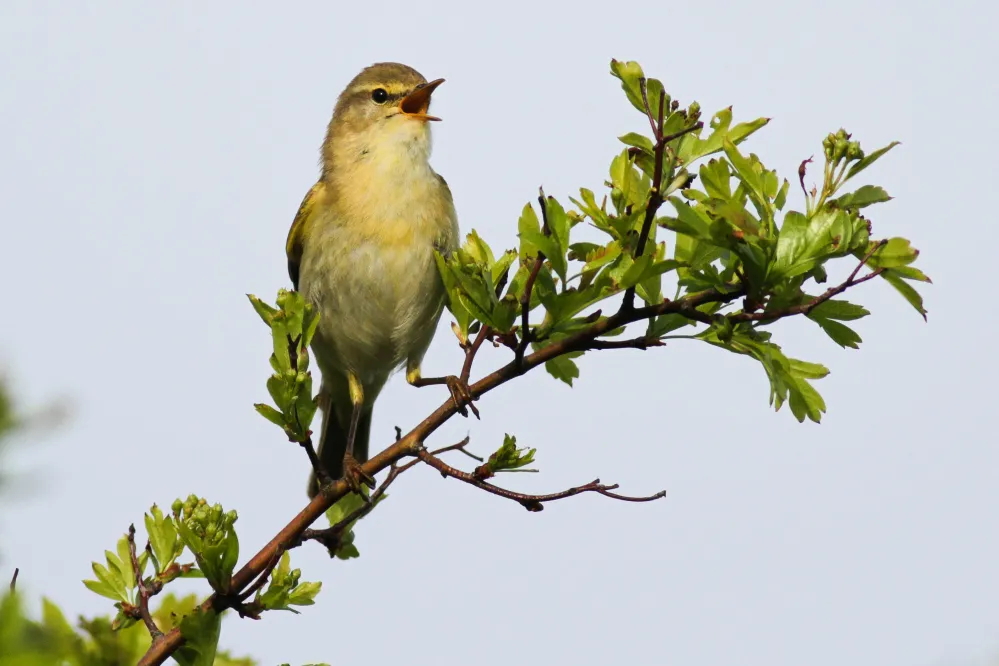
It’s been another week of summer visitors trickling in, with reporting rates continuing to tick up for all of our earlier arriving species. During the last week Chiffchaffs have been recorded on 60% of Complete Lists in BirdTrack and Willow Warblers on 3%, up from 0.75% in the previous week. The reporting rate for Chiffchaff is unlikely to rise much higher, but I would expect Willow Warbler to increase to double figures by this time next week, before peaking in the second half of April. Blackcaps are also increasing quickly, up to 21% in the last week, while Sand Martin, Swallow and Little Ringed Plover also continue to increase by the day.
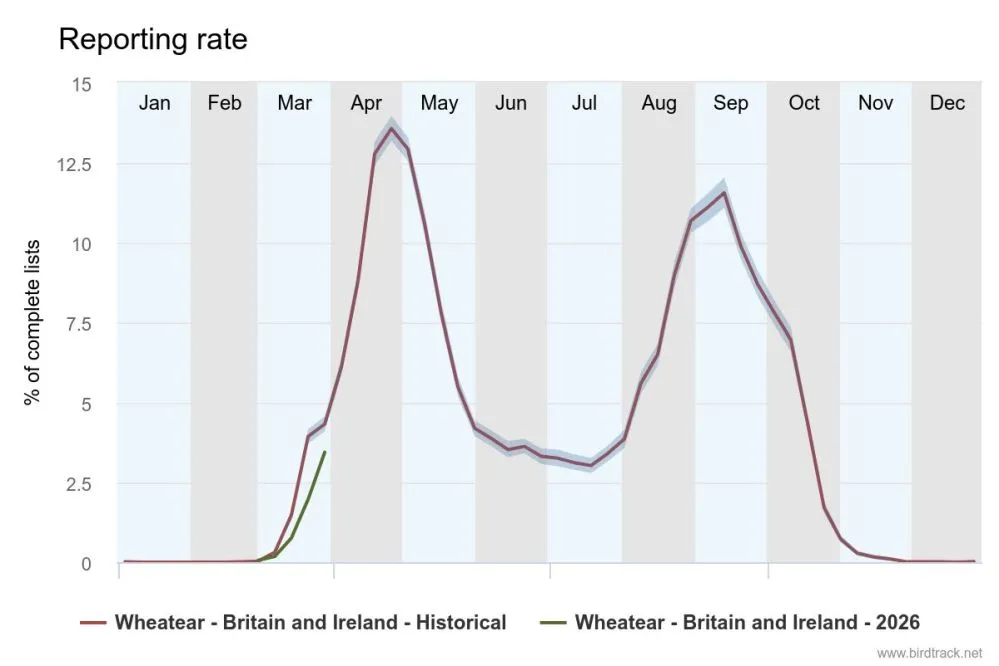
The reporting rate for Wheatear has also increased – to 3.5% in the last week – but continues to be behind the historic curve. Garganey, although always an uncommon species, has also been reported less frequently than typical so far, appearing on 0.38% of Complete Lists in the last week compared to 0.68% for this week historically.
One of the features of spring migration is that birds tend not to stay long, if at all, at coastal sites when they first arrive on our shores. Compared to the autumn departure of our summer migrants, when birds linger to build up fat reserves ahead of crossing the sea, new arrivals typically move on quickly to their breeding sites.
The result is that summer migrants can suddenly appear at their breeding sites without there having been noticeable ‘falls’ at the coast. This has certainly been the case so far this spring, with most species arriving in line with or earlier than historic patterns despite seemingly quiet birding along the south coast of England. However, falls of migrants can occur in spring, typically when good conditions to the south – southerly winds, warm temperatures and clear skies – trigger a northward movement of birds, before a band of colder or wetter conditions causes them to land.
One such fall happened at Portland Bird Observatory, Dorset, on Wednesday, when 300 Willow Warblers, 100 Chiffchaffs and 30 Blackcaps were recorded. In this instance there were actually north-westerly winds across the English Channel, but clear skies overnight followed by a band of heavy cloud in the morning was enough to produce a nice fall of birds.
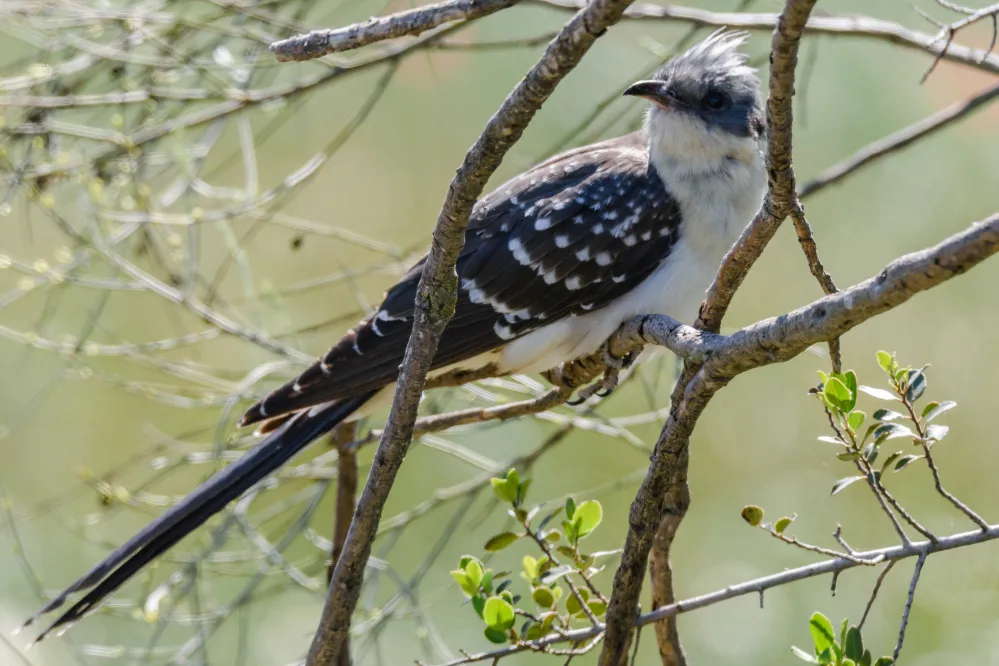
Looking ahead, the forecast is starting to look more favourable for further such arrivals. Forecasts can change quickly, but at the time of writing it appears we will see more southerly winds from early next week, but with spells of rain also expected. Arrivals of common migrants seem likely – hopefully including more Wheatears – and it wouldn’t surprise me if some ‘overshoots’ from Europe arrived in Britain and Ireland after what has been a quiet week for rarities. Most likely would be species such as Night Heron, Hoopoe and Woodchat Shrike, but more left field possibilities could include a Great Spotted Cuckoo or an Alpine Accentor.
Of course, the spring migration isn’t just about birds which come to breed in Britain and Ireland during the summer. Concurrently, our winter visitors are departing and many birds are passing through en route to elsewhere. One species we have come to learn more about in recent years is Common Scoter. An estimated 130,000 Common Scoters winter around the coast of Britain, with important sites including Liverpool Bay and Carmarthen Bay. Although it has been known for a long time this primarily coastal species can migrate overland, the popularisation of a branch of birding known as ‘nocmig’ – which involves listening for or recording the calls of birds migrating at night – has produced a lot more records of nocturnal overland movements of scoters. March and early April has proven to be a peak time for this phenomenon and in the last week there have been numerous reports of Common Scoters heard moving across Britain at night, with most coming from Greater Manchester, Lancashire and Yorkshire, reflecting what is clearly an established migration route of Common Scoters from Liverpool Bay to the North Sea, as they head to their breeding grounds in Fennoscandia and Russia.
So, migration is going on all around us now, with even species that we associate with the coast flying across the country at night. Summer migrants are arriving, with the rate of arrivals likely to increase over the next week, and the potential for rarities is rising as we enter April.
As always, thank you for adding your sightings to BirdTrack and I wish you a good week of birding and a happy Easter.
Add your sightings to BirdTrack
Help us track the departures and arrivals of migrating birds by adding your sightings to BirdTrack. It’s free, quick and easy, and signing up also allows you to explore trends, reports and recent records in your area.
Author(s)

Tom Jordan