Whimbrel
Introduction
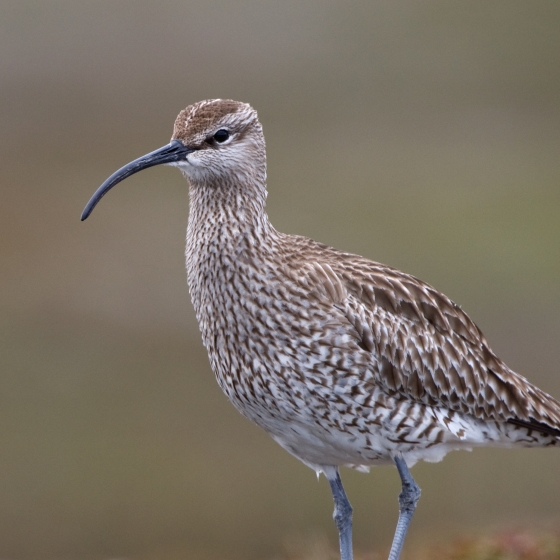
Whimbrel is a smaller version of the Curlew, with a shorter, straighter then down-curved bill and pale crown-stripe. The 'seven-whistle' call is diagnostic.
This elegant wader has a very restricted UK breeding range, with a small population nesting mostly in Shetland. Birds start to arrive back on territory from the last week of April, having spent the winter in southern Europe and Africa.
Birdwatchers are most likely to encounter Whimbrel in spring, as birds pass through Britain & Ireland heading for their arctic breeding grounds, which stretch from Greenland to Siberia. Individuals or small flocks can be seen virtually anywhere around our coasts, and sometimes at inland locations in England.
Key Stats








Identification
ID Videos
This section features BTO training videos headlining this species, or featuring it as a potential confusion species.
Curlew and Whimbrel
Songs and Calls
Song:
Call:
Status and Trends
Conservation Status
Population Change
Most Whimbrel seen in Britain are passage migrants en route to Iceland, Scandinavia and Russia, and the small British breeding population is almost entirely confined to Shetland. The population is monitored by specical surveys: An estimate of 479 breeding pairs in 1989–94 was similar to a previous estimate for 1983–86 (Dore et al. 1996) although the most recent such survey estimated a population of 290+ breeding pairs suggesting a slight decline (Jackson 2009). However, the population remains higher than the estimate of c.150 pairs during 1968–72 (Sharrock 1976).
Distribution
Whimbrels have a very restricted breeding distribution in Britain, with most of the population and 76% of the range confined to the Shetland Islands, the remainder being in Orkney, the Western Isles and Caithness. A small but growing number of Whimbrels winter in the UK, mostly at coastal sites, with a concentration along the south coasts of England and Ireland.
Occupied 10-km squares in UK
2007/08–10/11
or view it on Bird Atlas Mapstore.
2008–11
or view it on Bird Atlas Mapstore.
European Distribution Map
Distribution Change
Since the 1980s there has been a large increase in wintering Whimbrels, with a 212% increase in the number of occupied 10-km squares in Britain & Ireland, probably as a result of milder winters.
Change in occupied 10-km squares in the UK
from 1981–84 to 2007–11
or view it on Bird Atlas Mapstore.
from 1968–72 to 2008–11
or view it on Bird Atlas Mapstore.
Seasonality
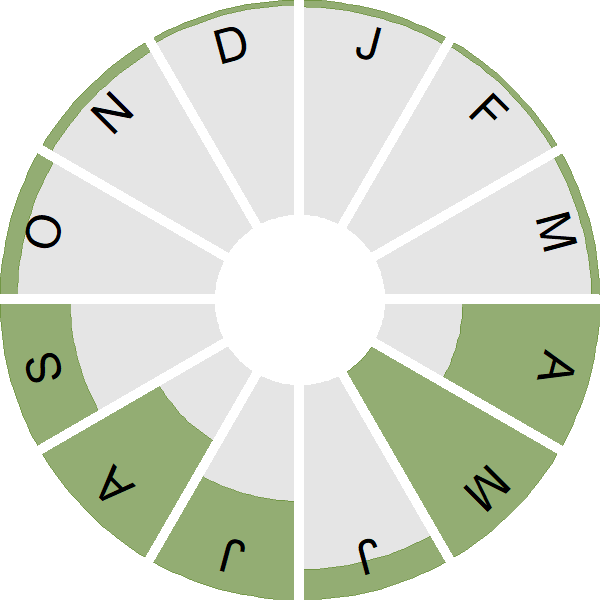
Aside from a few records in winter and a small northern breeding population, most Whimbrels are encountered during the narrow spring passage period, and in the slightly more protracted autumn migration period, the latter starting from early July.
Weekly pattern of occurrence
The graph shows when the species is present in the UK, with taller bars indicating a higher likelihood of encountering the species in appropriate regions and habitats.

Movement
Britain & Ireland movement
Foreign locations of birds ringed or recovered in Britain & Ireland
Dots show the foreign destinations of birds ringed in Britain & Ireland, and the origins of birds ringed overseas that were subsequently recaptured, resighted or found dead in Britain & Ireland. Dot colours indicate the time of year that the species was present at the location.
- Winter (Nov-Feb)
- Spring (Mar-Apr)
- Summer (May-Jul)
- Autumn (Aug-Oct)

European movements
EuroBirdPortal uses birdwatcher's records, such as those logged in BirdTrack to map the flows of birds as they arrive and depart Europe. See maps for this species here.
The Eurasian-African Migration Atlas shows movements of individual birds ringed or recovered in Europe. See maps for this species here.
Biology
Productivity and Nesting
Nesting timing
Egg measurements
Clutch Size
Survival and Longevity
Survival is shown as the proportion of birds surviving from one year to the next and is derived from bird ringing data. It can also be used to estimate how long birds typically live.
View number ringed each year in the Online Ringing Report.
Lifespan
Survival of adults
Biometrics
Wing length and body weights are from live birds (source).
Wing length
Body weight
Ring Size
Classification, names and codes
Classification and Codes
- Order: Charadriiformes
- Family: Scolopacidae
- Scientific name: Numenius phaeopus
- Authority: Linnaeus, 1758
- BTO 2-letter code: WM
- BTO 5-letter code: WHIMB
- Euring code number: 5380
Alternate species names
- Catalan: polit cantaire
- Czech: koliha malá
- Danish: Småspove
- Dutch: Regenwulp
- Estonian: väikekoovitaja
- Finnish: pikkukuovi
- French: Courlis corlieu
- Gaelic: Eun-Bealltainn
- German: Regenbrachvogel
- Hungarian: kis póling
- Icelandic: Spói
- Irish: Crotach Eanaigh
- Italian: Chiurlo piccolo
- Latvian: lietuvainis
- Lithuanian: vidutine kuolinga
- Norwegian: Småspove
- Polish: kulik mniejszy
- Portuguese: maçarico-galego
- Slovak: hvizdák malý
- Slovenian: mali škurh
- Spanish: Zarapito trinador
- Swedish: småspov
- Welsh: Coegylfinir
- English folkname(s): May bird, Tang Whaup, Seven-whistler
Research
Causes of Change and Solutions
Causes of change
The drivers of changes in the Whimbrel population are unclear, but potential factors that may have affected breeding sites include afforestation, peat extraction, agricultural changes and climate change (Birds in Scotland).
Publications (1)
The risk of extinction for birds in Great Britain
Author:
Published: 2017
The UK has lost seven species of breeding birds in the last 200 years. Conservation efforts to prevent this from happening to other species, both in the UK and around the world, are guided by species’ priorities lists, which are often informed by data on range, population size and the degree of decline or increase in numbers. These are the sorts of data that BTO collects through its core surveys. For most taxonomic groups the priority list is provided by the International Union for Conservation of Nature (IUCN) – the IUCN Red List comprises roughly 12,000 species worldwide and their conservation status. However, for birds in the UK, most policy makers refer to the Birds of Conservation Concern (BoCC) list, updated every six years (most recently in 2015). A new study funded by the RSPB and Natural England in cooperation with BTO, WWT, JNCC, and Game & Wildlife Trust has carried out the first IUCN assessment for birds in Great Britain. The study applied the IUCN criteria to existing bird population data obtained from datasets like the BTO/JNCC/RSPB Breeding Bird Survey (BBS). The criteria take into account various factors, most notably any reduction in the size (both in abundance and range) of populations, loss of habitats key to the species, small or vulnerable population sizes, and extinction risk. Alongside this, the criteria look to see if there is a “rescue” effect – such as immigration from neighbouring populations that might boost the population’s numbers, reducing the risk of extinction. The species are then categorised into one of the threat levels below. The results of the new study show that a concerning 43% of regularly occurring species in Great Britain are classed as Threatened, with another 10% classified as Near Threatened. Twenty-three breeding or non-breeding populations of birds were classed as Critically Endangered, including Fieldfare and Golden Oriole (both possibly extinct as breeders), Whimbrel, Turtle Dove, Arctic Skua and Kittiwake, as well as non-breeding populations of Bewick’s Swan, White-fronted Goose and Smew., Over the past 200 years, seven species have gone extinct as breeders in Britain, including Serin, Temminck’s Stint and Wryneck in the past 25 years. The total percentage of threatened birds in Great Britain (43%) is high compared to that seen elsewhere in Europe (13%). Reasons for this are not entirely clear, although it may be that Britain’s island status has something to do with this, as there are fewer neighbouring “rescue” populations. Although the results from the IUCN assessment and BoCC assessment largely overlap, the IUCN assessment raises the level of concern for species such as Red-Breasted Merganser, Great Crested Grebe, Moorhen, Red-Billed Chough (all classed as Vulnerable), and Greenfinch (Endangered). These species might thus warrant closer monitoring in the near future. In contrast, the BoCC assessment identifies a number of species of concern whose declines have been more gradual but over long time periods (e.g. Skylark and House Sparrow). The authors emphasise that this assessment is not a replacement of the BoCC report, but rather that the two reports complement each other. With this new wealth of knowledge, there will hopefully be even more support for those species that need it most.
01.09.17
Papers
More Evidence
More evidence from Conservation Evidence.com
Partners



Citing BirdFacts
If you wish to cite particular content in this page (e.g. a specific value) it is best to use the original sources as linked in the page. For a more general citation of the whole page please use: BTO (20XX) BirdFacts Species: profiles of birds occurring in the United Kingdom. BTO, Thetford (www.bto.org/birdfacts, accessed on xx/xx/xxxx).