Sanderling
Introduction
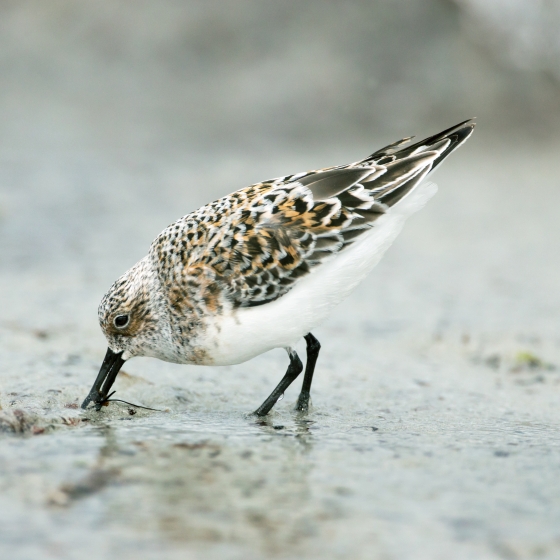
The caricature of a Sanderling is a small, white mouse-like wader chasing the tideline back and forth on a sandy beach.
These birds are winter visitors to Britain & Ireland, distributed widely around the coast and preferring long sandy beaches and sandbars.
Sanderlings are seen less frequently at inland sites than other coastal waders. It was previously thought that all our winter visitors originated from breeders in Siberia, but ringing studies have shown that we also host individuals from the Greenland population on passage, some of which stay for the winter.
Key Stats









Identification
ID Videos
This section features BTO training videos headlining this species, or featuring it as a potential confusion species.
Sanderling & Curlew Sandpiper
Songs and Calls
Flight call:
Status and Trends
Conservation Status
Population Change
This high Arctic breeder is a primarily a winter visitor to the UK (some juvenile birds over-summer), frequenting coastlines around the UK. Two sites, The Wash estuary in eastern England and The Ribble estuary in north-west England support internationally important numbers of Sanderling. The long-term trend for Sanderling is positive, with a steady increase in numbers across the UK since WeBS started monitoring this species in the 1970. The upward trend is particularly strong in Northern Ireland. Wales is the only country where the species is declining. The population trend across the East Atlantic Flyway mirrors that seen in the UK, with an increase in numbers recorded since 1979; however, in recent years, this increase has slowed, and the population may now be declining [Reneerkens 2022].
Distribution
Sanderlings in winter are predominantly coastal and much scarcer inland than most other waders. They can be found along most stretches of coast but are most abundant away from estuaries, instead preferring areas where sandy beaches and sandbars prevail. The North Sea coast, Outer Hebrides, Ribble Estuary and Carmarthen Bay hold the highest densities.
Occupied 10-km squares in UK
2007/08–10/11
or view it on Bird Atlas Mapstore.
2008–11
or view it on Bird Atlas Mapstore.
European Distribution Map
Distribution Change
The Sanderling winter range has expanded by 31% and 21% in Britain and Ireland respectively since the 1980s. Gains in Britain have occurred throughout most of the coastline, and at inland sites, although distribution along the North Sea coast has remained stable. In Ireland, gains have been predominantly in the west and northwest.
Change in occupied 10-km squares in the UK
from 1981–84 to 2007–11
or view it on Bird Atlas Mapstore.
Seasonality
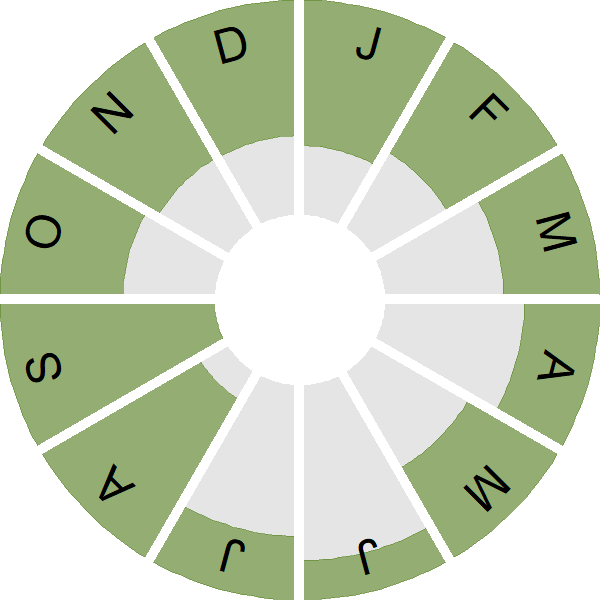
Sanderlings are winter visitors, but as a high Arctic breeder, passage continues into late May.
Weekly pattern of occurrence
The graph shows when the species is present in the UK, with taller bars indicating a higher likelihood of encountering the species in appropriate regions and habitats.

Movement
Britain & Ireland movement
Foreign locations of birds ringed or recovered in Britain & Ireland
Dots show the foreign destinations of birds ringed in Britain & Ireland, and the origins of birds ringed overseas that were subsequently recaptured, resighted or found dead in Britain & Ireland. Dot colours indicate the time of year that the species was present at the location.
- Winter (Nov-Feb)
- Spring (Mar-Apr)
- Summer (May-Jul)
- Autumn (Aug-Oct)

European movements
EuroBirdPortal uses birdwatcher's records, such as those logged in BirdTrack to map the flows of birds as they arrive and depart Europe. See maps for this species here.
The Eurasian-African Migration Atlas shows movements of individual birds ringed or recovered in Europe. See maps for this species here.
Biology
Productivity and Nesting
Nesting timing
Egg measurements
Clutch Size
Survival and Longevity
Survival is shown as the proportion of birds surviving from one year to the next and is derived from bird ringing data. It can also be used to estimate how long birds typically live.
View number ringed each year in the Online Ringing Report.
Lifespan
Survival of adults
Biometrics
Wing length and body weights are from live birds (source).
Wing length
Body weight
Ring Size
Classification, names and codes
Classification and Codes
- Order: Charadriiformes
- Family: Scolopacidae
- Scientific name: Calidris alba
- Authority: Pallas, 1764
- BTO 2-letter code: SS
- BTO 5-letter code: SANDE
- Euring code number: 4970
Alternate species names
- Catalan: territ de tres dits
- Czech: jespák písecný
- Danish: Sandløber
- Dutch: Drieteenstrandloper
- Estonian: leeterüdi e. leeterisla
- Finnish: pulmussirri
- French: Bécasseau sanderling
- Gaelic: Luatharan-glas
- German: Sanderling
- Hungarian: fenyérfutó
- Icelandic: Sanderla
- Irish: Luathrán
- Italian: Piovanello tridattilo
- Latvian: gaišais šnibitis
- Lithuanian: paprastasis smiltinukas
- Norwegian: Sandløper
- Polish: piaskowiec
- Portuguese: maçarico-branco / pilrito-das-praias
- Slovak: pobrežník belavý
- Slovenian: pešcenec
- Spanish: Correlimos tridáctilo
- Swedish: sandlöpare
- Welsh: Pibydd y Tywod
- English folkname(s): Towillee, Curwillet
Research
Causes of Change and Solutions
Causes of change
Despite Sanderlings being common across the flyway, the exact reasons for both the long-term increase and the more recent stabilisation are unknown [van Roomen et al. 2022]. Previous studies have identified threats to Sanderling populations including density-dependent factors [Ntiamoa-Baidu et al. 2014], habitat destruction, climate change [Reneerkens et al. 2016, Schmidt et al. 2019, Reneerkens 2020], human disturbance [Burger & Gochfeld 1991], pollution [Bianchini & Morrissey 2018] and hunting, but it is unclear to what extent these factors have affected Sanderling population growth. A more recent study by Reneerkens [2022] identified that the growth of the Sanderling flyway-population is currently limited by annual variation in clutch survival and adult survival in West Africa.
Publications (2)
Consequences of population change for local abundance and site occupancy of wintering waterbirds
Author:
Published: 2017
Protected sites for birds are typically designated based on the site’s importance for the species that use it. For example, sites may be selected as Special Protection Areas (under the European Union Directive on the Conservation of Wild Birds) if they support more than 1% of a given national or international population of a species or an assemblage of over 20,000 waterbirds or seabirds. However, through the impacts of changing climates, habitat loss and invasive species, the way species use sites may change. As populations increase, abundance at existing sites may go up or new sites may be colonized. Similarly, as populations decrease, abundance at occupied sites may go down, or some sites may be abandoned. Determining how bird populations are spread across protected sites, and how changes in populations may affect this, is essential to making sure that they remain protected in the future. These findings come from a new study by Verónica Méndez and colleagues from the University of East Anglia working with BTO. Using Wetland Bird Survey (WeBS) data the study looked at changes in the population sizes and distributions of 19 waterbird species across Britain during a period of 26 years and their effect on local abundance and site occupancy. Some of these species saw steady increases in population size (up to 1,600%, Avocet), whereas other saw mild declines (-26%, Purple Sandpiper and Shelduck). The results showed that changes in total population size were predominantly reflected in changes in local abundance, rather than through the addition or loss of sites. This is possibly because waterbirds tend to be long-lived birds, with high site fidelity and new suitable sites may not always be available. Thus colonisation of new sites may typically occur when their existing sites approach their maximum capacity. As changes in populations are largely manifested by changes in local abundance – and as sites are often designated for many species – the numbers of sites qualifying for site designation are unlikely to be affected. Understanding the dynamic between population change and change in local abundance will be key to ensuring the efficiency of protected area management and ensuring that populations are adequately protected. Data from the Wetland Bird Survey and its predecessor schemes, which are celebrating 70 years of continuous monitoring of waterbirds this year, have been integral to both the designation of protected sites and monitoring of their condition. Continuation of this monitoring through future generations will ensure that the impacts to waterbird populations of future environmental changes may be understood.
20.09.17
Papers
More Evidence
More evidence from Conservation Evidence.com
Partners




Citing BirdFacts
If you wish to cite particular content in this page (e.g. a specific value) it is best to use the original sources as linked in the page. For a more general citation of the whole page please use: BTO (20XX) BirdFacts Species: profiles of birds occurring in the United Kingdom. BTO, Thetford (www.bto.org/birdfacts, accessed on xx/xx/xxxx).