Red-throated Diver
Introduction
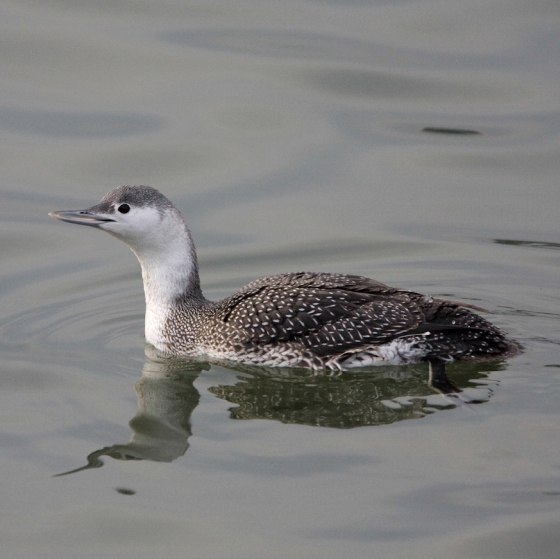
The Red-throated Diver has a restricted breeding distribution within Britain and Ireland, favouring small lochs and lakes close to the sea in the north of Ireland and north and west of Scotland.
The small breeding population is joined by a much larger number of birds during the winter months, when individuals can be found around our entire coastline – although with the greater proportion of these to be found off the east coast.
The Red-throated Diver is a well-studied, long-lived species; data from bird ringing reveal that individuals regularly reach 25 years of age. The species feeds mainly on small fish.
- Our Trends Explorer gives you the latest insight into how this species' population is changing.
Key Stats







Identification
ID Videos
This section features BTO training videos headlining this species, or featuring it as a potential confusion species.
Winter Divers
Songs and Calls
Song:
Flight call:
Status and Trends
Conservation Status
Population Change
Breeding numbers are quite variable between years and not monitored annually by the BTO; trends are hard to assess except by intensive survey. There was a full UK survey in 1994 (935 pairs; Gibbons et al. 1997) and a repeat in 2006, by when the estimated UK breeding population had increased significantly by 34%, with stability in Shetland and Orkney but increase across the Hebrides and Scottish mainland (Dillon et al. 2009). Complete surveys of Shetland indicated a decrease of 36% there between 1983 and 1994 (Gomersall et al. 1984, Gibbons et al. 1997) and there was minor further decrease there by 2006 (Smith et al. 2009). The full surveys indicate that Shetland held 46% of the national total of breeding pairs in 1994 and 33% in 2006, though this decrease reflects the significant increases elsewhere in Scotland rather than the small decline in Shetland (Smith et al. 2009). JNCC's Seabird Monitoring Programme shows that breeding numbers at sample study areas in Shetland fluctuated without long-term change during 1980-2005, with low points in 1980, 2000 and 2004 (Mavor et al. 2008). Though previously amber listed through its 'depleted' status in Europe, the species was moved to the UK green list in 2015 (Eaton et al. 2015). Wintering numbers, mostly of birds from northern Europe, peaked in 2011/12 but have since decreased and are now similar to numbers in the early 1990s (WeBS: Frost et al. 2020).
Since the 1980s, there may have been some tendency for more pairs to hatch a second chick, although two-chick broods are only occasional in Orkney and changes in the distribution of nests recorded might have influenced the results. In 2011, however, there were fewer two-chick broods in Shetland than in any year since at least 1979 (Holling et al. 2013).
Distribution
Wintering Red-throated Divers are recorded all round the coast of Britain & Ireland, plus at a scatter of inland sites, mainly in northern and eastern England. The highest concentrations are along North Sea coasts, southwest Scotland and southwest Ireland. Breeding birds are restricted to freshwater lochs and bogs in Co. Donegal in Ireland and in north and west Scotland.
Occupied 10-km squares in UK
2007/08–10/11
or view it on Bird Atlas Mapstore.
2008–11
or view it on Bird Atlas Mapstore.
European Distribution Map
Distribution Change
Red-throated Diver winter range has expanded by 32% since the 1981–84 Winter Atlas, with a large part of this being off northwest Scotland and parts of western Ireland. Some of this increase may be due to better coverage but some gains are likely to be real.
Change in occupied 10-km squares in the UK
from 1981–84 to 2007–11
or view it on Bird Atlas Mapstore.
from 1968–72 to 2008–11
or view it on Bird Atlas Mapstore.
Seasonality
Red-throated Divers are recorded year-round
Weekly pattern of occurrence
The graph shows when the species is present in the UK, with taller bars indicating a higher likelihood of encountering the species in appropriate regions and habitats.

Movement
Britain & Ireland movement
Foreign locations of birds ringed or recovered in Britain & Ireland
Dots show the foreign destinations of birds ringed in Britain & Ireland, and the origins of birds ringed overseas that were subsequently recaptured, resighted or found dead in Britain & Ireland. Dot colours indicate the time of year that the species was present at the location.
- Winter (Nov-Feb)
- Spring (Mar-Apr)
- Summer (May-Jul)
- Autumn (Aug-Oct)

European movements
EuroBirdPortal uses birdwatcher's records, such as those logged in BirdTrack to map the flows of birds as they arrive and depart Europe. See maps for this species here.
The Eurasian-African Migration Atlas shows movements of individual birds ringed or recovered in Europe. See maps for this species here.
Biology
Productivity and Nesting
Nesting timing
Egg measurements
Clutch Size
Incubation
Fledging
Survival and Longevity
Survival is shown as the proportion of birds surviving from one year to the next and is derived from bird ringing data. It can also be used to estimate how long birds typically live.
View number ringed each year in the Online Ringing Report.
Lifespan
Survival of adults
Survival of juveniles
Biometrics
Wing length and body weights are from live birds (source).
Wing length
Body weight
Ring Size
Classification, names and codes
Classification and Codes
- Order: Gaviiformes
- Family: Gaviidae
- Scientific name: Gavia stellata
- Authority: Pontoppidan, 1763
- BTO 2-letter code: RH
- BTO 5-letter code: RETDI
- Euring code number: 20
Alternate species names
- Catalan: calàbria petita
- Czech: potáplice malá
- Danish: Rødstrubet Lom
- Dutch: Roodkeelduiker
- Estonian: punakurk-kaur
- Finnish: kaakkuri
- French: Plongeon catmarin
- Gaelic: Learga-ruadh
- German: Sterntaucher
- Hungarian: északi búvár
- Icelandic: Lómur
- Irish: Lóma Rua
- Italian: Strolaga minore
- Latvian: brunkakla gargale
- Lithuanian: rudakaklis naras
- Norwegian: Smålom
- Polish: nur rdzawoszyi
- Portuguese: mobelha-pequena
- Slovak: potáplica malá
- Slovenian: rdecegrli slapnik
- Spanish: Colimbo chico
- Swedish: smålom
- Welsh: Trochydd Gyddfgoch
- English folkname(s): Rain Goose
Research
Causes of Change and Solutions
Causes of change
There is little good evidence available regarding the drivers of the breeding population change in this species in the UK.
Further information on causes of change
No further information is available.
Information about conservation actions
The main drivers of change are not known for these species. However, because food for chicks is obtained largely from the sea close to breeding lochs, a reliable supply of suitable marine prey nearby is a requirement for successful breeding. Shortages of sand eels have recently been a major factor in depressing breeding success in Shetland (Forrester et al. 2007). Divers are thus vulnerable to losses of feeding grounds and to decreases in fish stocks and hence policies which protect marine areas adjacent to breeding areas would be prudent until the reasons for the decline have been confirmed.
Outside the breeding season, this species is believed to be among the most sensitive to offshore wind farms, and in particular at risk of displacement from wind farms (Furness et al. 2013; Wade et al. 2016; Heinanen et al. 2020), and therefore winter distribution should be taken into account when making decisions about wind farm developments, to protect both British and European breeding birds.
Publications (3)
Desk-based revision of seabird foraging ranges used for HRA screening
Author:
Published: 2019
A key step in understanding the possible impacts of a proposed windfarm development is to identify potential interactions between seabird breeding colonies and the proposed development areas. Such interactions are typically assessed using generic information on foraging ranges, derived from academic studies. This report uses the latest data to provide updated estimates of foraging range, which will help to ensure that the best available information is available when new developments are being considered.
01.12.19
BTO Research Reports
Behavioural responses of non-breeding waterbirds to marine traffic in the near-shore environment
Author:
Published: 2022
Marine traffic is increasing globally, but there has been little research investigating the impact of this disturbance, particularly for non-breeding populations in near-shore environments. This study observed the behaviour of 11 seabird species in response to winter ferry passage around Orkney, increasing the evidence base available to inform impact assessments, planning and policy in the marine environment.
02.09.22
Papers
Seabird foraging ranges as a preliminary tool for identifying candidate Marine Protected Areas
Author:
Published: 2012
The UK government is committed to establishing an ecologically coherent network of Marine Protected Areas (MPAs) to manage and conserve marine ecosystems. Seabirds are vital to such ecosystems, but until now these species have received little protection at sea. This is partly because there is scant information available on the oceanic regions they use at the different stages of their lifecycle. A new study led by the BTO, in partnership with the RSPB and Birdlife International, has sought to address this by bringing together work on how far UK-breeding seabirds travel from their colonies (typically in search of food for themselves or their chicks) during the breeding season. This study used results from tracking, indirect measures and survey-based observations of seabird movements to calculate ranges over which seabirds might forage. It also assessed the validity of these ranges based on the quality of the methods underpinning them. Manx Shearwater, Northern Gannet and Northern Fulmar had the largest maximum foraging ranges at 330, 590 and 580 km respectively, while Red-throated Diver (9 km) and Little Tern (11 km) had the smallest. The approach taken in this study can be used as a first step in identifying areas of ocean away from breeding colonies that may be crucial for sustaining seabirds. Further work would then be then required to firm up the boundaries of specific MPAs. This approach is however, relatively cheap and simple, and could easily be adopted outside the UK to become an important tool in protecting seabird habitat globally.
01.01.12
Papers
More Evidence
More evidence from Conservation Evidence.com
Partners




Citing BirdFacts
If you wish to cite particular content in this page (e.g. a specific value) it is best to use the original sources as linked in the page. For a more general citation of the whole page please use: BTO (20XX) BirdFacts Species: profiles of birds occurring in the United Kingdom. BTO, Thetford (www.bto.org/birdfacts, accessed on xx/xx/xxxx).