Red Kite
Introduction
The Red Kite was persecuted to the point of extinction in Britain, just about hanging on in Wales, but a late 20th century reintroduction programme has transformed the fortunes of this species.
With centres of high population in the Chilterns, Wales, Yorkshire and eastern Scotland, Red Kites can be seen circling and drifting above major roads, farmland and woodland, even adjacent to major cities such as Gateshead.
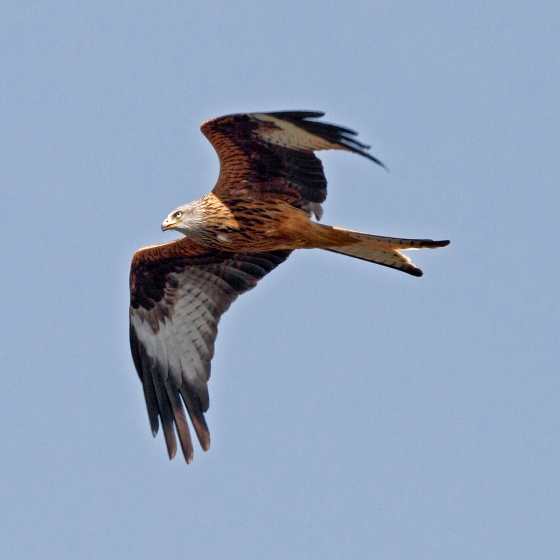
Strikingly coloured, the rich reddish-brown tones of the bird's plumage shine in good light, contrasting with white and dark brown in the wings, and the long forked tail is very evident. In some areas, such as mid-Wales, farms put out food for this carrion-eating raptor and large concentrations have become a wildlife tourist attraction
- Our Trends Explorer gives you the latest insight into how this species' population is changing.
Key Stats








Identification
Songs and Calls
Call:
Alarm call:
Flight call:
Status and Trends
Conservation Status
Population Change
Red Kite was historically widespread across Britain but, following widespread persecution, fewer than ten breeding pairs remained by the 1930s and 1940s, concentrated into a small area of mid Wales. Through careful husbandry organised by a 'Kite Committee' of local conservationists and landowners, including RSPB bounties paid to farmers for successful nests during 1922-90, the Welsh population rose to 100 pairs by 1993. Most birds were descended from a single female that had continued to breed successfully during the population bottleneck (Carter 2001). As a step towards restoring the original breeding range, birds were introduced in 1989 into the Chilterns (Oxfordshire and Buckinghamshire) and into the Black Isle in Easter Ross (Evans & Pienkowski 1991). Successful breeding populations quickly established in both areas. Further releases were begun in Northamptonshire in 1995, central Scotland in 1996, Yorkshire in 1999, Dumfries & Galloway in 2001, northeast England in 2004, Aberdeen in 2007 and County Down in 2008. Each of these centres has given rise to a productive breeding group, in some cases benefiting from large-scale provision of food (e.g. Orros & Fellowes 2014, 2015) or the development of a well-established communal roost. Introduced birds and their offspring wander widely across Britain and Ireland but, as yet, pairs have been slow to set up breeding sites distant from the release areas (Balmer et al. 2013). BBS sightings have shown a steep rise since 1995. Results from a transect survey specifically targeting Buzzards and Red Kites in central southern England, between 2011 and 2016, showed a doubling of population in the area over that period, broadly in line with the BBS trend (Stevens, M et al. 2020).
Illegal killing is continuing and in northern Scotland the use of poisoned baits deliberately to kill raptors has severely limited the growth of the Red Kite population (Smart et al. 2010, Sansom et al. 2016). Poisoning also still occurs in England and may have slowed the rate of expansion in some areas (Molenaar et al. 2017). Nevertheless, the species was moved to the green list in the UK in 2015 (Eaton et al. 2015).
Distribution
The breeding distribution maps shown here show the results of extensive reintroduction of Red Kites throughout the UK. Kites have continued to spread and filled many gaps in these maps.
Occupied 10-km squares in UK
2007/08–10/11
or view it on Bird Atlas Mapstore.
2008–11
or view it on Bird Atlas Mapstore.
European Distribution Map
Distribution Change
Change in occupied 10-km squares in the UK
from 1981–84 to 2007–11
or view it on Bird Atlas Mapstore.
from 1968–72 to 2008–11
or view it on Bird Atlas Mapstore.
Seasonality
Red Kites are present year-round and now detected on up to 8% of complete lists.
Weekly pattern of occurrence
The graph shows when the species is present in the UK, with taller bars indicating a higher likelihood of encountering the species in appropriate regions and habitats.

Movement
Britain & Ireland movement
Foreign locations of birds ringed or recovered in Britain & Ireland
Dots show the foreign destinations of birds ringed in Britain & Ireland, and the origins of birds ringed overseas that were subsequently recaptured, resighted or found dead in Britain & Ireland. Dot colours indicate the time of year that the species was present at the location.
- Winter (Nov-Feb)
- Spring (Mar-Apr)
- Summer (May-Jul)
- Autumn (Aug-Oct)

European movements
EuroBirdPortal uses birdwatcher's records, such as those logged in BirdTrack to map the flows of birds as they arrive and depart Europe. See maps for this species here.
The Eurasian-African Migration Atlas shows movements of individual birds ringed or recovered in Europe. See maps for this species here.
Biology
Productivity and Nesting
Nesting timing
Egg measurements
Clutch Size
Survival and Longevity
Survival is shown as the proportion of birds surviving from one year to the next and is derived from bird ringing data. It can also be used to estimate how long birds typically live.
View number ringed each year in the Online Ringing Report.
Lifespan
Survival of adults
Survival of juveniles
Biometrics
Wing length and body weights are from live birds (source).
Ring Size
Classification, names and codes
Classification and Codes
- Order: Accipitriformes
- Family: Accipitridae
- Scientific name: Milvus milvus
- Authority: Linnaeus, 1758
- BTO 2-letter code: KT
- BTO 5-letter code: REDKI
- Euring code number: 2390
Alternate species names
- Catalan: milà reial
- Czech: lunák cervený
- Danish: Rød Glente
- Dutch: Rode Wouw
- Estonian: puna-harksaba
- Finnish: isohaarahaukka
- French: Milan royal
- Gaelic: Clamhan-gobhlach
- German: Rotmilan
- Hungarian: vörös kánya
- Icelandic: Svölugleða
- Irish: Cúr Rua
- Italian: Nibbio reale
- Latvian: sarkana klija
- Lithuanian: rudasis peslys
- Norwegian: Glente
- Polish: kania ruda
- Portuguese: milhafre-preto
- Slovak: haja cervená
- Slovenian: rjavi škarnik
- Spanish: Milano real
- Swedish: röd glada
- Welsh: Barcud Coch
- English folkname(s): Glead
Research
Causes of Change and Solutions
Causes of change
There is little good evidence available regarding the drivers of the breeding population increase in this species in the UK. However, the initial rapid increases following re-introduction to England and Scotland may have been aided by lack of intraspecific competition and the ability of this species to exploit a previously unoccupied habitat.
Further information on causes of change
There is no evidence yet that density-dependent effects have begun to slow the rate of increase.
Information about conservation actions
The Red Kite is currently increasing across many parts of the UK following the successful reintroduction programme and therefore no specific conservation actions are currently required in many areas. However, illegal persecution still occurs in some areas where it is believed to have slowed the recovery of this species, and hence measures to reduce this in these areas may be required to ensure the success of the reintroduction programme continues (Smart et al. 2010).
Artificial feeding of Red Kites in gardens is one measure which can also help support Red Kite populations, although there may be a risk that such food provision may artificially inflate populations to such an extent that they could potentially cause problems if feeding is halted (Orros & Fellowes 2014).
Anticoagulant rodenticides (rat poisons) have been found in some Red Kite carcasses in concentrations sufficient to be considered a contributory cause of death; there is no evidence so far to suggest that this might be affecting the population growth rate but precautions such as prompt removal and safe disposal of poisoned rates, as well as continued monitoring, would be prudent (Walker et al. 2019).
Wind farm turbines have been shown to be a particular threat to raptors including Red Kite in Switzerland (Schaub 2012); hence placement of new wind farms may be important. However, it is unclear whether wind farms are likely to have any significant effect on UK populations as there is currently limited overlap between the distribution of Red Kites and wind farms.
Publications (3)
Modelling population-level impacts of wind farm collision risk on Welsh Red Kites: populations functionally linked to two Special Protection Areas
Author:
Published: 2025
This report, which is an addendum to BTO Research Report 766, examines the potential impacts of current and proposed wind farm developments on the Red Kite population in Wales
05.12.25
BTO Research Reports

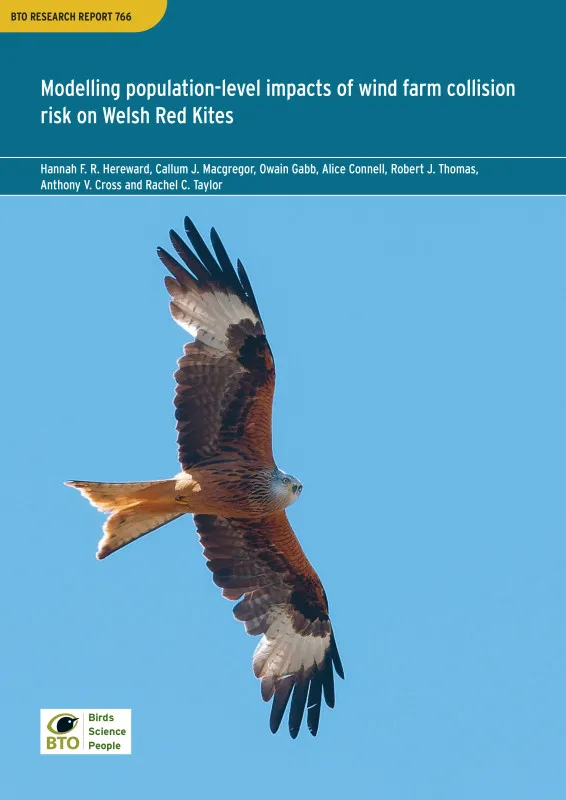
Modelling population-level impacts of wind farm collision risk on Welsh Red Kites
Author:
Published: 2024
The Welsh Red Kite population is currently in ongoing recovery after a historic decline driven by persecution, and a consequent population bottleneck during the first half of the 20th century. Trends from the BTO/JNCC/RSPB Breeding Bird Survey show that the population has grown rapidly over the past few decades. Nonetheless, the Red Kite remains a conservation concern, in particular around two Special Protection Areas (SPAs) designated for the species’ conservation: the Berwyn SPA and the Elenydd—Mallaen SPA. Wind turbines represent a known threat to Red Kite populations, causing additional mortality through collisions. A large number of wind farm sites are currently at various stages of development (ranging from aspirational schemes to proposals under assessment) in Wales, especially in Mid Wales where Red Kites are at their highest density and where the Elenydd-Mallaen SPA is situated. The aim of this analysis is to model the potential impacts of current and proposed wind farm developments on the Welsh population of Red Kites, using a Population Viability Analysis.
15.03.24
BTO Research Reports
Birds of Conservation Concern Wales 4: the population status of birds in Wales
Author:
Published: 2022
The latest review of the conservation status of birds in Wales. The report assessed all 220 bird species which regularly occur in Wales. There are now 60 species of bird on the Red List, with 91 on the Amber List and just 69 - less than a third of the total number of species - on the Green List. The latest review of the conservation status of birds in Wales comes 20 years after the first, when the Red List was less than half the length it is today. The report assessed all 220 bird species which regularly occur in Wales. There are now 60 species of bird on the Red List in Wales, with 91 on the Amber List and 69 on the Green List. The Birds of Conservation Concern in Wales report assesses the status of each species against a set of objective criteria. Data sources include the BTO/JNCC/RSPB Breeding Bird Survey and the BTO/RSPB/JNCC Wetland Bird Survey, as well as Bird Atlases and other BTO-led monitoring schemes and citizen science initiatives. These are used to quantify the changing status of the species’ Welsh population. The UK, European and global conservation status of the species is also considered, placing the Welsh population into a wider context. The Red ListSwift, Greenfinch and Rook – familiar breeding species in steep decline across the UK – are among the new additions to the Welsh Red List, which now also includes Purple Sandpiper, on account of a rapidly shrinking Welsh wintering population, and Leach’s Petrel, an enigmatic seabird in decline across its global range. These species now sit alongside well-known conservation priorities, such as Curlew, Hen Harrier and Turtle Dove as birds at risk of being lost from Wales for good. Uplands and woodlands Many of the species on the Red List are found in upland and farmland habitats. Starling, Tree Sparrow, Yellow Wagtail and Yellowhammer can no longer be found in much of Wales, while iconic species of mountain and moorland, such as Ring Ouzel, Merlin and Black Grouse, remain in serious trouble. Wales is well known for its populations of woodland birds; however, many of these – including Lesser Spotted Woodpecker, Willow Warbler and Spotted Flycatcher – also feature on the Red List. Goldcrest, which has seen its Welsh population shrink alarmingly in recent decades, is another new addition. On the coast The assessment for Birds of Conservation Concern Wales 4 took place before the impacts of avian influenza could be taken into account. Breeding seabird species have been struggling in Wales for many years, however, and most were already of conservation concern before the outbreak of this disease. Kittiwake, Puffin, Black-headed Gull, and Common, Arctic and Sandwich Tern remain on the Red List. Wales holds internationally significant numbers of breeding seabirds, making the decline of these colonies a global concern. The Amber ListDeclines in Wheatear, Garden Warbler and House Martin - all migrants which breed in Europe and winter in sub-Saharan Africa - mean these species have moved from the Green List to the Amber List. Many other ‘Afro-Palearctic' migrant species are also in decline, but the potential reasons for this, such as habitat loss and reduced availability of invertebrate prey, are not well understood. Closer to home, the declines in the Welsh Chaffinch population, linked to the disease trichomonosis, have seen the species Amber-listed. A number of other species have been placed on the Amber List because of the wider importance of their Welsh populations, which in each case make up more than half the UK total. Wales is home to more than three-quarters of the UK’s Choughs, for example, so recent declines are cause for concern. The nation’s breeding populations of Manx Shearwater, Pied Flycatcher, Goshawk and Hawfinch also account for more than half the UK total, as does its wintering population of Spotted Redshank. It’s not all bad news, though: some species now on the Amber List have moved up from the Red List, indicating some positive change in their population trends. These include Common Sandpiper, Great Black-backed Gull, Bullfinch, Goldcrest and Pied Flycatcher. The Green ListWhile the report contains much cause for alarm, several conservation success stories shine through. Red Kite was almost lost as a British bird during the first half of the 20th century, when only a handful of pairs remained in remote Welsh valleys. Since then, a sustained conservation effort has brought the species back from the brink. Wales is now home to more than 2,500 pairs of Red Kite and the species has now been moved to the Green List, reflecting this incredible change in fortunes. Song Thrush, Reed Bunting, Long-tailed Tit, Redwing and Kingfisher are among the other species to have gone Green, providing much-needed hope that things can go up as well as down.
06.12.22
Reports Birds of Conservation Concern
More Evidence
More evidence from Conservation Evidence.com
Partners




Citing BirdFacts
If you wish to cite particular content in this page (e.g. a specific value) it is best to use the original sources as linked in the page. For a more general citation of the whole page please use: BTO (20XX) BirdFacts Species: profiles of birds occurring in the United Kingdom. BTO, Thetford (www.bto.org/birdfacts, accessed on xx/xx/xxxx).