Ptarmigan
Introduction
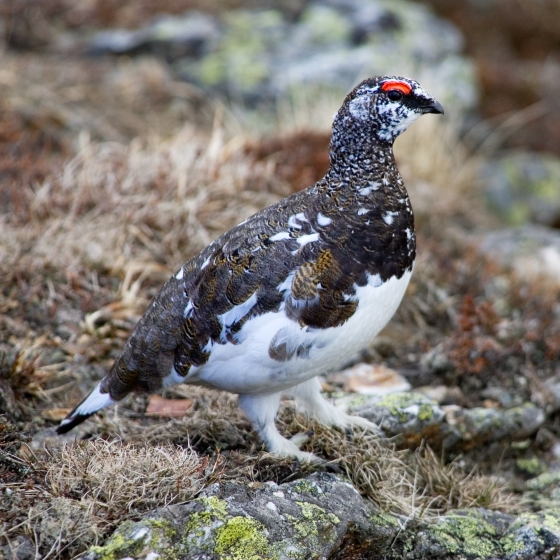
Ptarmigan are associated with tundra habitat across their range, which is why their small UK population is restricted to Scotland's mountains.
Ptarmigan are especially adapted for cold conditions. In winter they develop thick feathers on their feet, which act as snow-shoes, and individuals develop white plumage that provides camouflage against snow. In summer the upperparts are mottled brown in females and grey in males. Preferring sparsely vegetated environments, Ptarmigan consume young vegetation, berries and insects.
Ptarmigan is Red-listed in the UK as a Bird of Conservation Concern because of a severe decline in breeding numbers and the species is threatened by a warming climate. Nevertheless, Ptarmigan are still legally hunted in the UK, the open season running from 12 August to 10 December.
Key Stats








Identification
ID Videos
This section features BTO training videos headlining this species, or featuring it as a potential confusion species.
Grouse
Songs and Calls
Song:
Status and Trends
Conservation Status
Population Change
Popuation changes are unclear due to the difficulty in monitoring this montane species, but a range contraction of 11% has occurred since the 1968-72 breeding Atlas, with losses mostly on lower hills at the edge of the range, particularly in the north-west of their range (Balmer et al. 2013). A 50-year study on the Cairngorm mountain range showed that peaks and troughs in population from the mid-1940s had occurred and followed an approximate 10-year cycle (Watson et al. 2000).
Distribution
Ptarmigans occupy the high tops of the Scottish Highlands, favouring montane habitats, where they are resident, though during prolonged periods of snowfall they are sometimes forced down to lower altitudes.
Occupied 10-km squares in UK
2007/08–10/11
or view it on Bird Atlas Mapstore.
2008–11
or view it on Bird Atlas Mapstore.
European Distribution Map
Distribution Change
The winter change map shows a 64% increase in the number of 10-km squares occupied by Ptarmigans, but this is likely to be due to improved coverage during Bird Atlas 2007–11
Change in occupied 10-km squares in the UK
from 1981–84 to 2007–11
or view it on Bird Atlas Mapstore.
from 1968–72 to 2008–11
or view it on Bird Atlas Mapstore.
Seasonality
Ptarmigans are present throughout the year but most likely under-recorded in winter owing to fewer BirdTrack lists in montane habitats.
Weekly pattern of occurrence
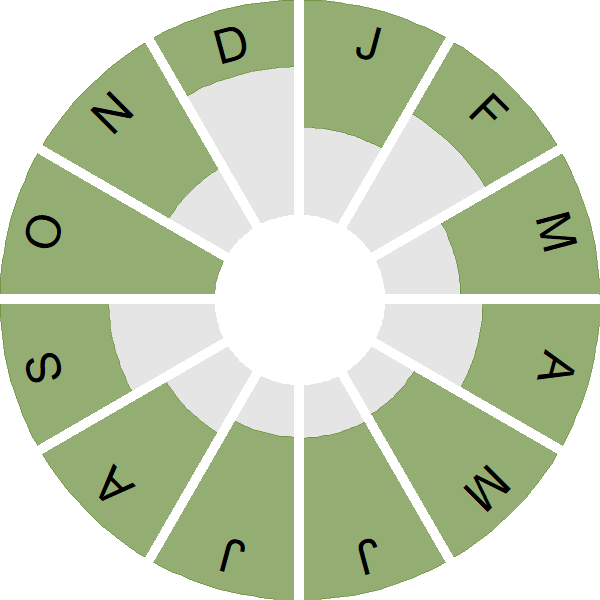
The graph shows when the species is present in the UK, with taller bars indicating a higher likelihood of encountering the species in appropriate regions and habitats.

Movement
Britain & Ireland movement
Biology
Productivity and Nesting
Nesting timing
Egg measurements
Clutch Size
Survival and Longevity
Survival is shown as the proportion of birds surviving from one year to the next and is derived from bird ringing data. It can also be used to estimate how long birds typically live.
Lifespan
Survival of adults
Biometrics
Wing length and body weights are from live birds (source).
Ring Size
Classification, names and codes
Classification and Codes
- Order: Galliformes
- Family: Phasianidae
- Scientific name: Lagopus muta
- Authority: Montin, 1781
- BTO 2-letter code: PM
- BTO 5-letter code: PTARM
- Euring code number: 3300
Alternate species names
- Catalan: perdiu blanca
- Czech: belokur horský
- Danish: Fjeldrype
- Dutch: Alpensneeuwhoen
- Estonian: lumepüü
- Finnish: kiiruna
- French: Lagopède alpin
- Gaelic: Tàrmachan
- German: Alpenschneehuhn
- Hungarian: havasi hófajd
- Icelandic: Rjúpa
- Italian: Pernice bianca
- Latvian: klinšu teteris
- Lithuanian: tundrine žvyre
- Norwegian: Fjellrype
- Polish: pardwa górska
- Portuguese: lagopo-cinzento
- Slovak: snehula horská
- Slovenian: belka
- Spanish: Lagópodo alpino
- Swedish: fjällripa
- English folkname(s): Cairn Bird
Research
Causes of Change and Solutions
Causes of change
The population trend for this species is uncertain as it is difficult to monitor the whole population and hence drivers of change are also unclear. There are patricular concerns about the potential effects of climate change on Ptarmigan as the species is adapted to montane habitats. Whilst there has been no research yet to assess whether climate change has already impacted on the species in Scotland, one study has shown that the species range in some parts of the Swiss Alps has shifted uphill over 30 years (Pernollet et al. 2015). Developments (e.g. for skiing) may cause habitat changes and hence local declines, and may also cause indirect impacts by increasing access for generalist predators such as Carrion Crows. In one study in the Cairngorms, breeding success was higher at sites further from a ski development and abnormally low closer to the development where nests were lost to crows (Watson & Moss 2004).
Publications (1)
The status of our bird populations: the fifth Birds of Conservation Concern in the United Kingdom, Channel Islands and Isle of Man and second IUCN Red List assessment of extinction risk for Great Britain
Author:
Published: 2021
Commonly referred to as the UK Red List for birds, this is the fifth review of the status of birds in the UK, Channel Islands and Isle of Man, published in December 2021 as Birds of Conservation Concern 5 (BOCC5). This updates the last assessment in 2015. Using standardised criteria, experts from a range of bird NGOs, including BTO, assessed 245 species with breeding, passage or wintering populations in the UK and assigned each to the Red, Amber or Green Lists of conservation concern. The same group of experts undertook a parallel exercise to assess the extinction risk of all bird species for Great Britain (the geographical area at which all other taxa are assessed) using the criteria and protocols established globally by the International Union for the Conservation of Nature (IUCN). This resulted in the assessment of 235 regularly occurring species (breeding or wintering or both), the total number assessed differing slightly from BOCC5 due to different rules on the inclusion of scarce breeders and colonisation patterns. The results of this second IUCN assessment (IUCN2) are provided in the same paper as BOCC5. Increasingly at risk This update shows that the UK’s bird species are increasingly at risk, with the Red List growing from 67 to 70. Eleven species were Red-listed for the first time, six due to worsening declines in breeding populations (Greenfinch, Swift, House Martin, Ptarmigan, Purple Sandpiper and Montagu’s Harrier), four due to worsening declines in non-breeding wintering populations (Bewick’s Swan, Goldeneye, Smew and Dunlin) and one (Leach’s Storm-petrel) because it is assessed according to IUCN criteria as Globally Vulnerable, and due to evidence of severe declines since 2000 based on new surveys on St Kilda, which holds more than 90% of the UK’s populations. The evidence for the changes in the other species come from the UK’s key monitoring schemes such as BTO/JNCC/RSPB Breeding Bird Survey (BBS) for terrestrial birds, the BTO/RSPB/JNCC Wetland Bird Survey (WeBS) for wintering populations and the Rare Breeding Bird Panel (RBBP) for scarce breeding species such as Purple Sandpiper. The IUCN assessment resulted in 108 (46%) of regularly occurring species being assessed as threatened with extinction in Great Britain, meaning that their population status was classed as Critically Endangered, Endangered, or Vulnerable, as opposed to Near Threatened or of Least Concern. Of those 108 species, 21 were considered Critically Endangered, 41 Endangered and 46 Vulnerable. There is considerable overlap between the lists but unlike the Red List in BOCC5, IUCN2 highlights the vulnerability of some stable but small and hence vulnerable populations as well as declines in species over much shorter recent time periods, as seen for Chaffinch and Swallow.
01.12.21
Reports Birds of Conservation Concern
More Evidence
More evidence from Conservation Evidence.com
Partners

Citing BirdFacts
If you wish to cite particular content in this page (e.g. a specific value) it is best to use the original sources as linked in the page. For a more general citation of the whole page please use: BTO (20XX) BirdFacts Species: profiles of birds occurring in the United Kingdom. BTO, Thetford (www.bto.org/birdfacts, accessed on xx/xx/xxxx).