The Winter Bird Survey builds on the 2018/19 English Winter Bird Survey (EWBS), expanding coverage to include sites across the UK.
Survey history
The Winter Bird Survey builds on the BTO/Natural England English Winter Bird Survey (EWBS) project, which ran in 2018 and 2019. It primarily surveyed sites on lowland farmland in England, and investigated how wintering birds and Brown Hare benefit from using agri-environment scheme (AES) options in winter. Many of the EWBS sites are also Breeding Bird Survey sites and were surveyed by Breeding Bird Survey volunteers.
- Read more about the English Winter Bird Survey.
The Winter Bird Survey will expand this coverage with sites across the UK, and across a range of habitats. It will utilise the same methodology as the EWBS, so data from the surveys will be comparable, and will also cover many existing Breeding Bird Survey squares.
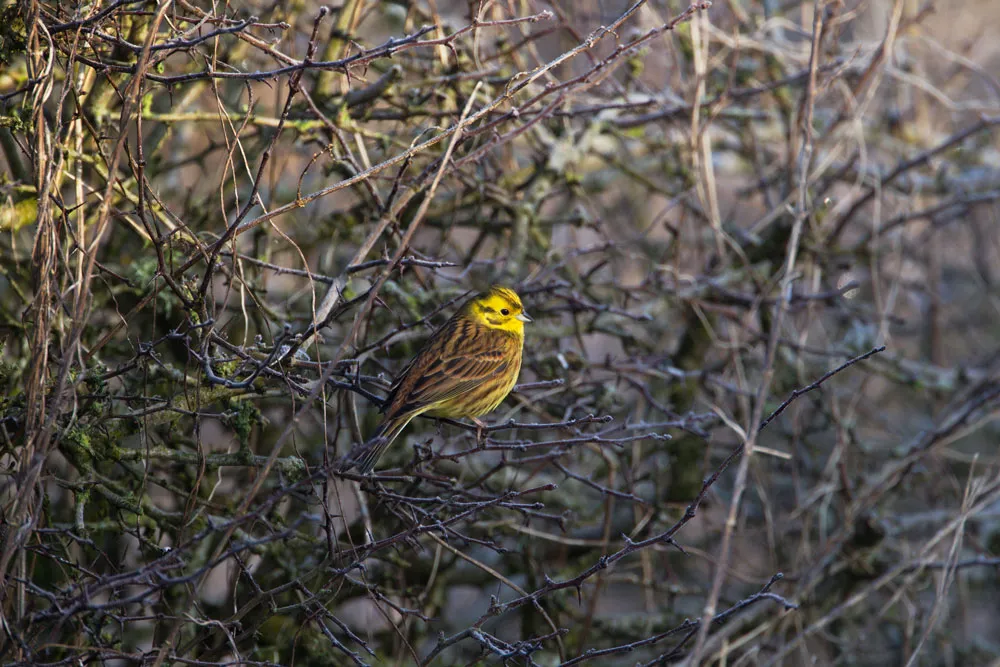
Why are we conducting the Winter Bird Survey?
The Winter Bird Survey will:
- Help us understand how wintering birds benefit from using agri-environment scheme and agri-environment and climate scheme (AES and AECS) options.
- Enable us to estimate the change in the numbers and distribution of resident and wintering species between 2018/19 and 2025/26.
- Provide data on how several land-management practices that are undertaken in the autumn and winter affect bird populations.
What data does the Winter Bird Survey collect?
The Winter Bird Survey field protocol is almost identical to that of the BTO/JNCC/RSPB Breeding Bird Survey, using repeat visits to a randomly selected square and applying the same distance-sampling methodology.
Volunteers will undertake up to four survey visits between mid September 2025 and the end of February 2026. On the visit, volunteers will record all birds seen and heard whilst walking along two 1-km transect routes.
- Juvenile and adult birds will be recorded.
- Birds will be recorded against one of three coarse distance bands (0–25m, 25–100m and >100m).
- Birds in flight are recorded separately.
The Winter Bird Survey allows volunteers to optionally record counts of live mammals during their surveys using the same distance bands.
Volunteers will also complete a simple habitat recording form when surveying their square, focused on measuring farmland habitat.