Find all of the resources you will need to take part in Birds in Greenspaces in 2026 including how-to guides and instructions and important health and safety guidance. You can also learn how to sign up and download the mobile app.
Guides and instructions
How to guides and instructions
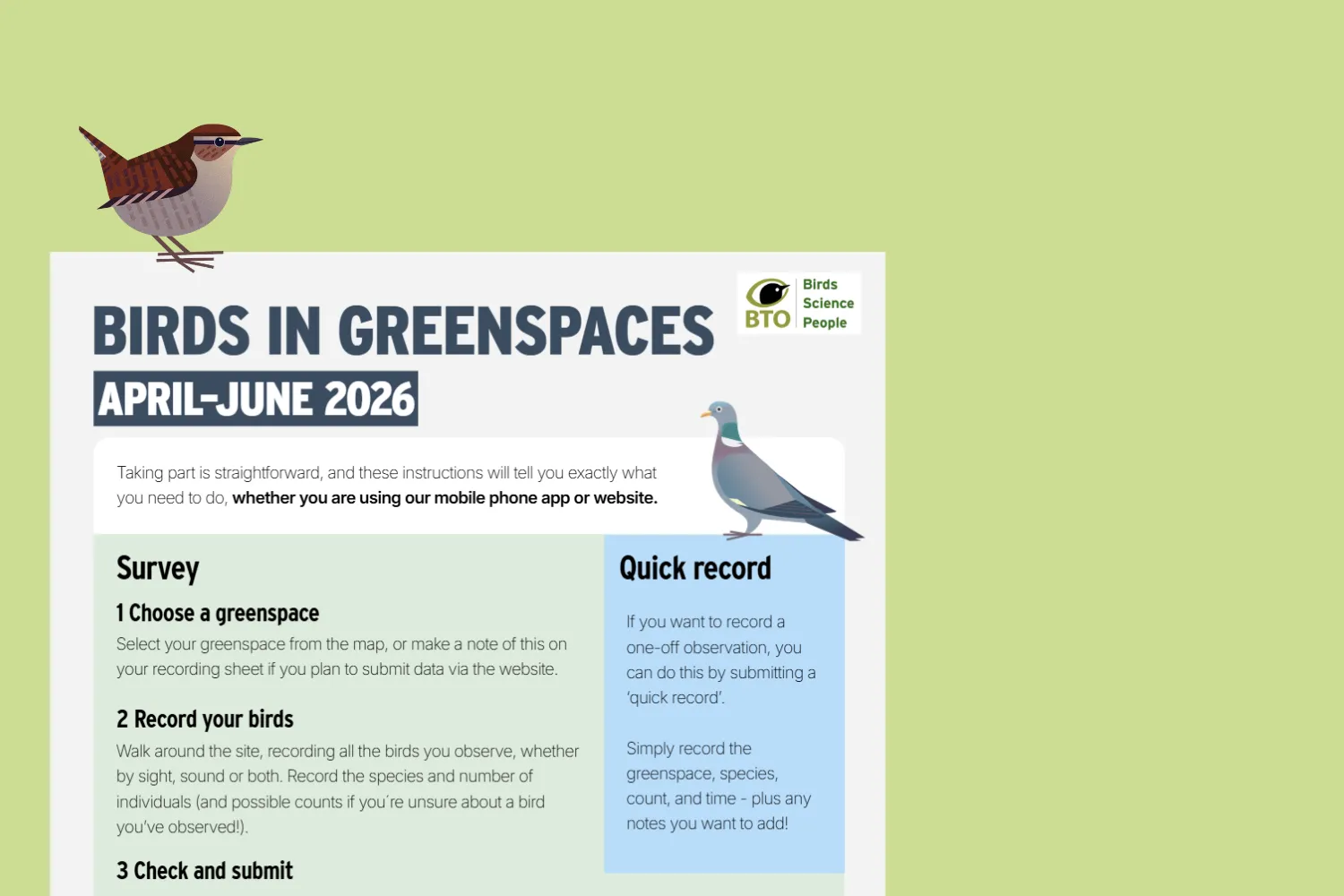
Promote the project
Customisable and printable posters
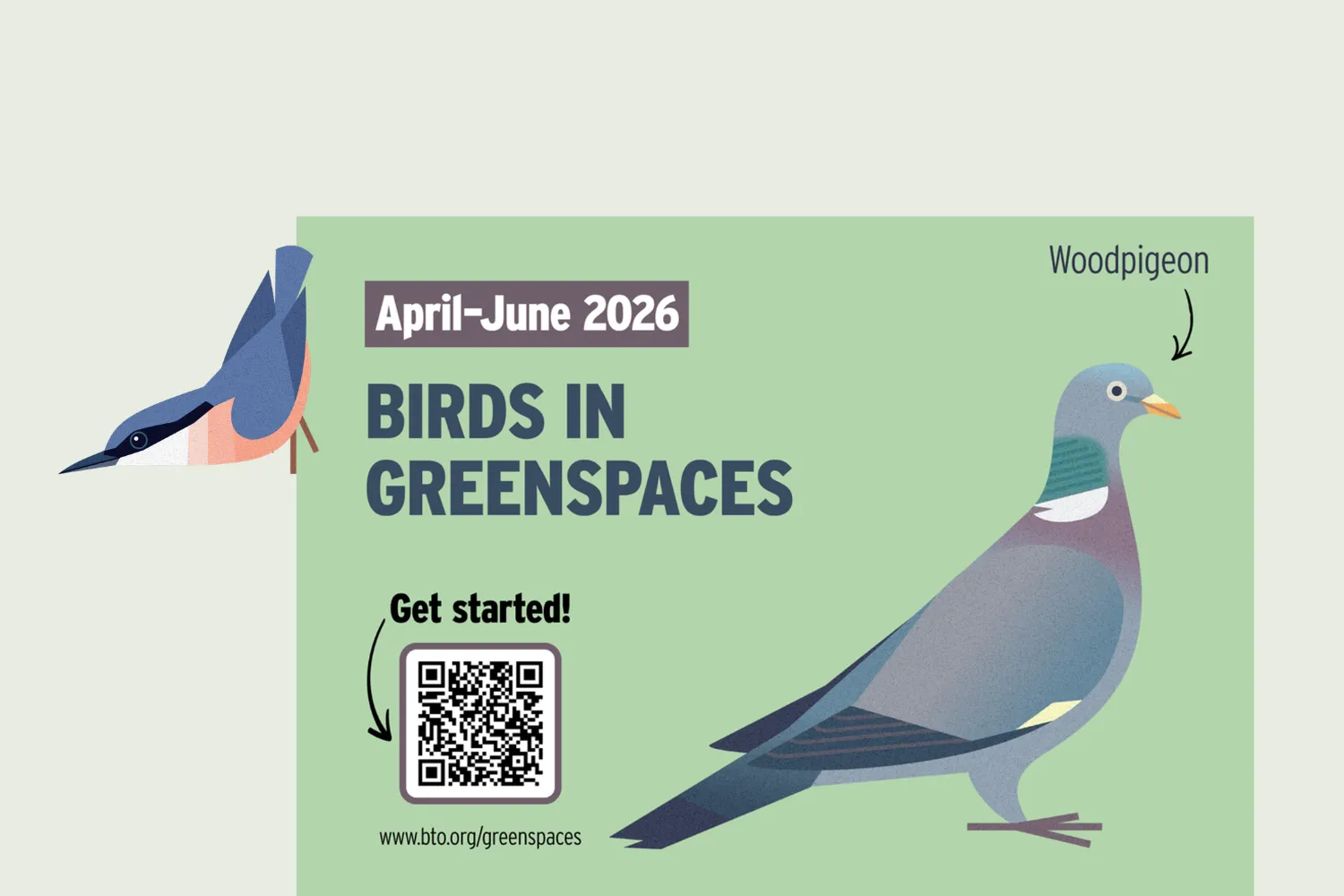
Learn more and develop
Build your knowledge, skills and confidence
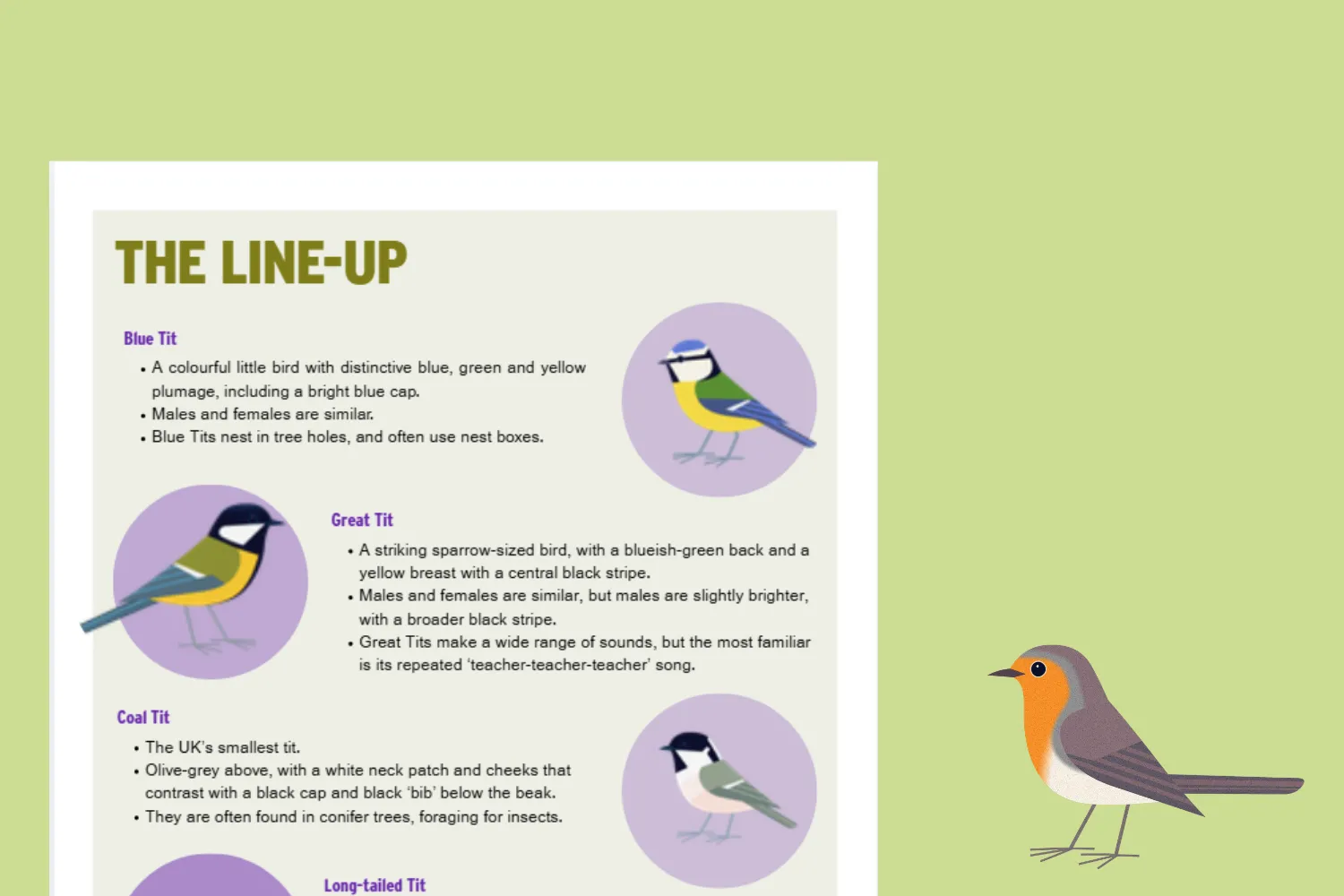
Health and safety
Conduct, guidance and policy
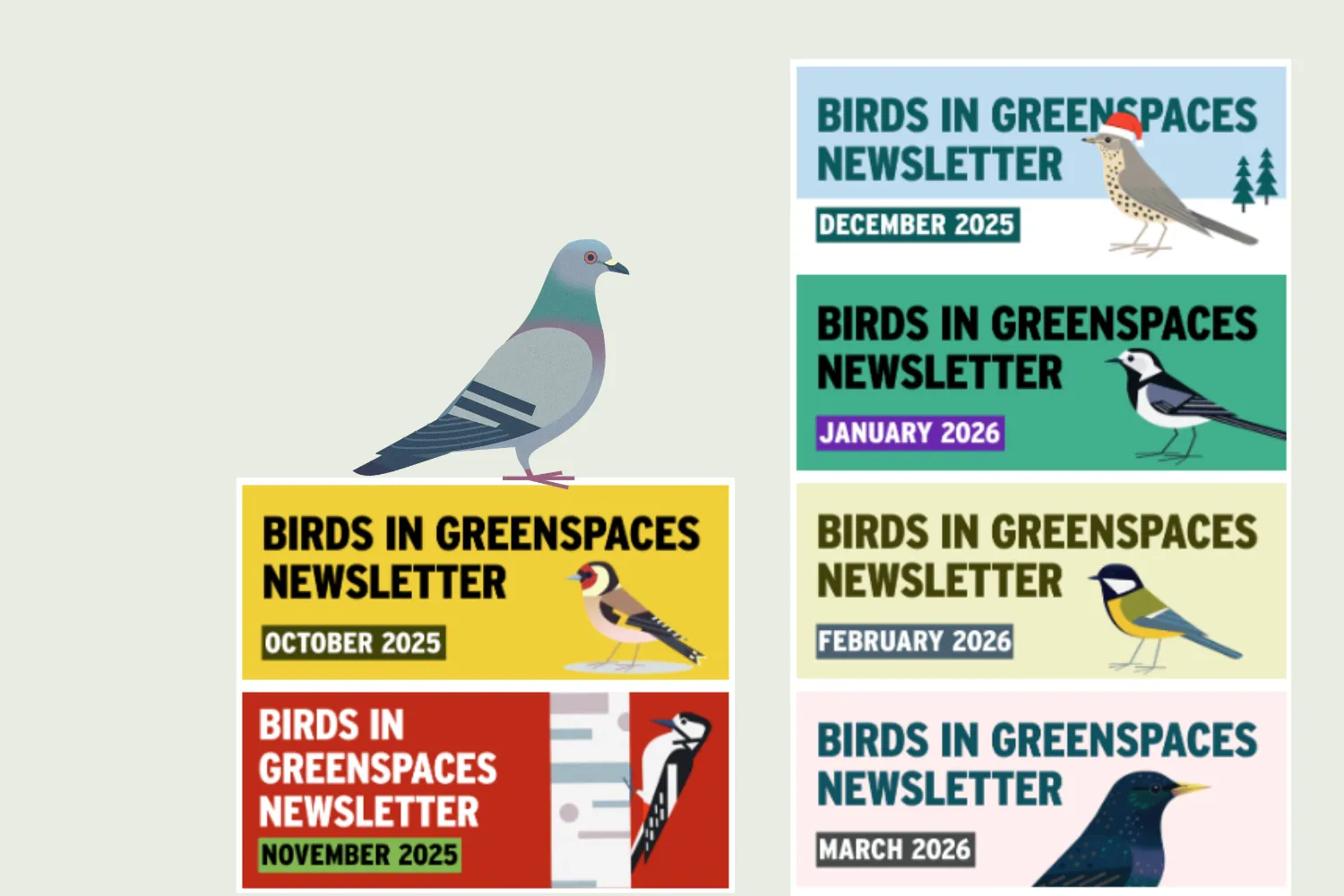
Newsletter archive
Newsletter sign up
Once a month, every month
Sign up to our newsletter to stay in touch and up-to-date with everything Greenspaces!
Activity Packs
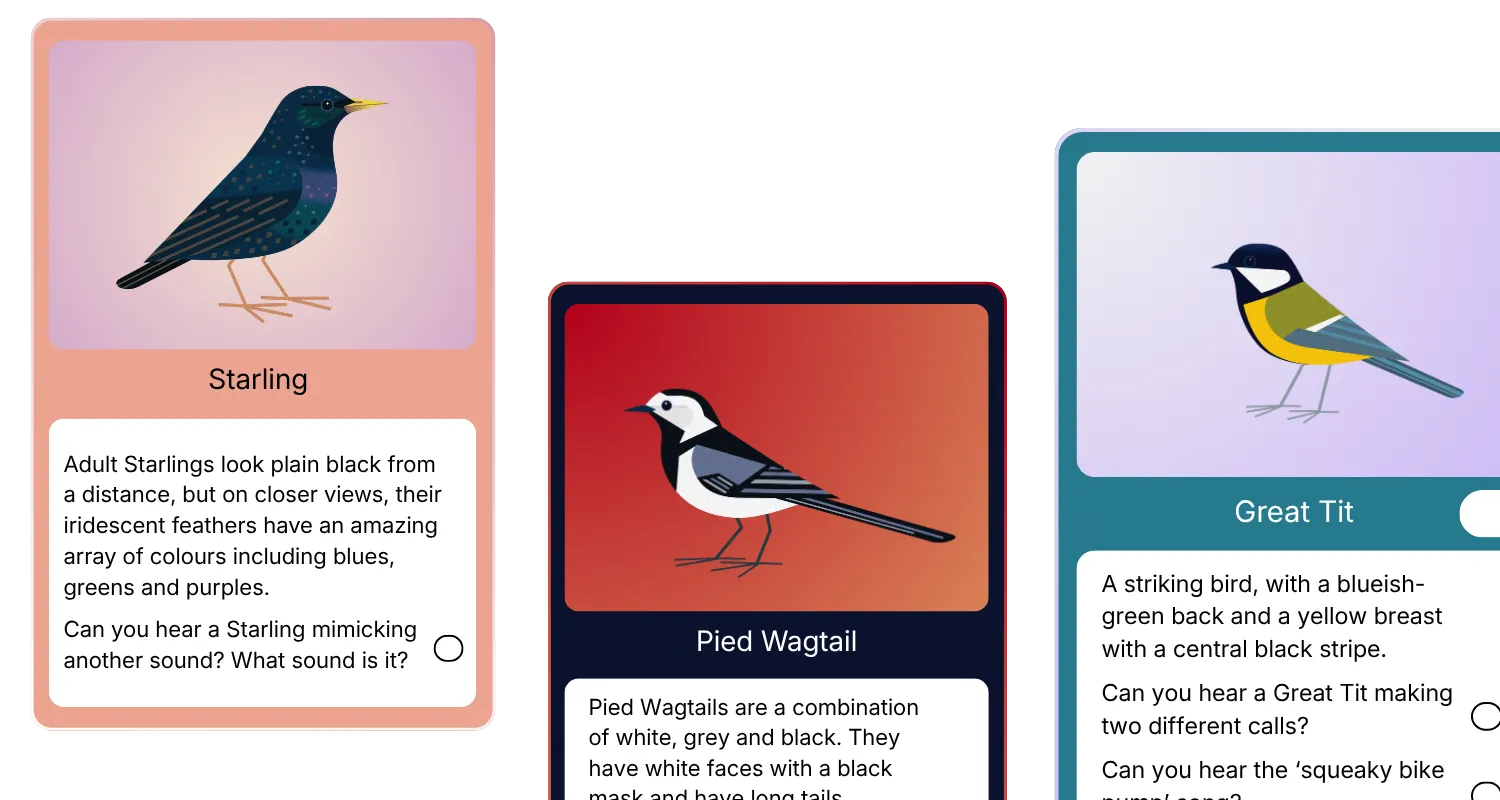
Check out our printable activity and sticker book—a family-friendly way to get even the youngest members involved and keep a record of the birds you see!
Sensory walks
We’ve teamed up with SENSE to create a sensory resource pack for disabled people with complex needs, but available to all, focused on exploring your greenspace.

Your Greenspaces
Our built-up areas can be deceptively good places to observe birds. Here we showcase some of your local greenspaces in cities, towns, and villages, and hear about the roles they play for birds and people.
Brigit’s Greenspace
Becoming a more observant naturalist
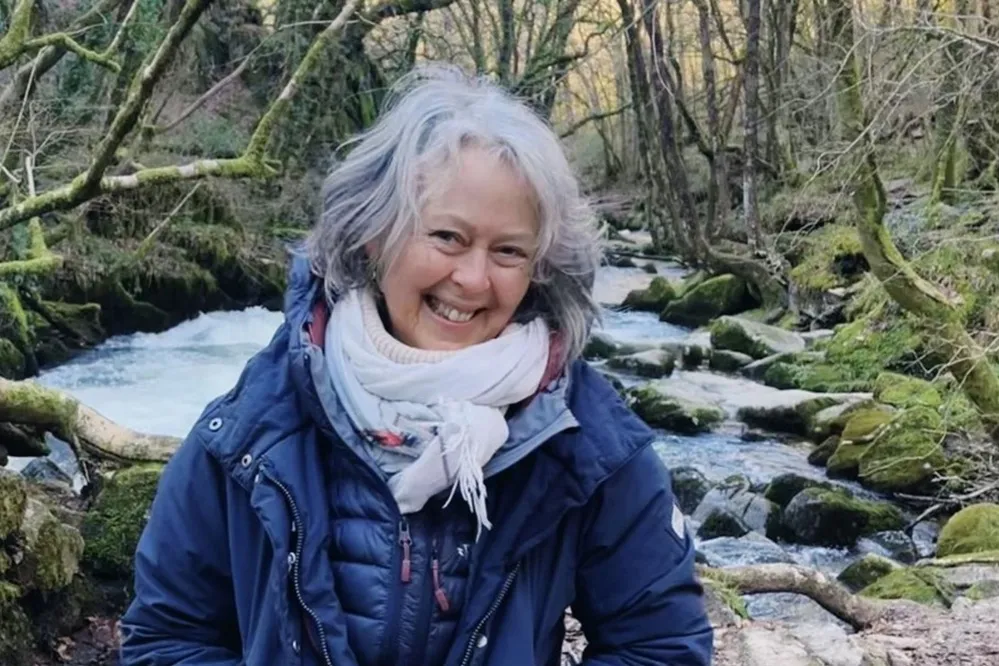
Brigit Strawbridge tells us about the fantastic birdlife on her doorstep and how regular visits to your local greenspace can be a great way to become a more observant naturalist...
This little patch of land
Just across the road from our house, sandwiched between the main road and a fast-running stream, lies a long, thin patch of mixed woodland. Designated ‘common land’ back in the mid 1960s, the land was then mostly grazed by livestock. But the sheep and cattle are now long gone; pasture has given way to scrub and native trees, and this little patch of land (around an acre and a half in size) has become a much-loved and well-used public greenspace. These days, the paths are mostly trodden by dog walkers; occasionally by ponies and their riders; during the school holidays by children; and frequently, since we moved here five years ago, by me.
A sudden flapping and clattering of wings
Despite all the human and four-legged activity, not to mention its close proximity to a very busy road, this tiny woodland turns out to be home to more bird species than I could ever have imagined. Some (Robin, Blackbird, Wren, Chaffinch) I see frequently – whilst others (Song Thrush, Blackcap, Magpie) alert me to their presence more by their songs and alarm calls – and one in particular (Woodpigeon) by a sudden flapping and clattering of wings high up in the trees.
A single, ancient sentinel
Though most of the trees in the woods are quite young, a single, ancient oak stands sentinel at the entrance – just across the road from the row of terraced houses where my husband and I live. This one tree alone provides hollows and cavities for at least half a dozen pairs of nesting Jackdaws, a pair of Nuthatches – ousted briefly last year by a swarm of honeybees – and, we think, a Tawny Owl. One of the oak’s higher-up branches is dead, and is a favourite ‘drumming’ post for a Great Spotted Woodpecker.
Beak-fulls of mud
The Jackdaws are conspicuous by the huge commotion they make with their constant chattering and cackling, as is the woodpecker by his intermittent drumming – and the owl we know about because we regularly see him gliding down from halfway up the oak, around dusk. However, it was only by chance, when I spotted a Nuthatch fly up from the edge of the stream to a hole halfway up the main trunk, that I saw her nest entrance which, to my wonder and delight, she appeared to be plastering up with beak-fulls of mud. A birder friend explained that female Nuthatches typically apply mud in this way to narrow the nest’s entrance hole and deter predators and competitors, but had I not witnessed the behaviour first hand, or been curious enough to ask, I would never have known this.
Whilst apps and online ID courses can get you so far, nothing beats observations and encounters of the close-up kind
An extremely cheeky Blue Tit
Other behaviours I notice include Long-tailed Tits collecting lichen; Blackbirds foraging for earthworms; Robins having territorial ‘sing-offs’; and Jays cutting long pieces of carefully chosen twigs with their beaks. Most interesting of all, whilst watching a pair of Treecreepers one day disappear with beaks full of feathers and moss behind some thick woody ivy, I witnessed an extremely cheeky Blue Tit systematically removing all their carefully gathered materials, and claiming their nest (despite being dive-bombed by the poor Treecreepers) for herself!
Bobbing and dipping in the fast-flowing stream
All of these birds I have enjoyed watching, but none captivate and charm me more than the pair of Dippers who live and breed on the fast-flowing stream running through the woods. Never before have I lived so close to a freshwater source, so I was barely aware of the existence of this very special bird. Now I look for them constantly, worry if I don’t see them for a few days, delight in their bobbing and dipping, and wait with bated breath, twice yearly, for their chicks to fledge.
Expanding my knowledge
When we first moved here, I was able to identify many of the birds I see in our local greenspace by sight, but more recently I have learned to identify some, also, by their sounds. This, I hasten to add, would not have happened without a lot of help from the British Trust for Ornithology’s brilliant online training courses ‘Bird Sound ID in Early Spring’ and ‘Bird Sound ID in Summer’, which have both helped me expand my extremely basic knowledge of bird sounds.
Looking back over the last five years I realise I have seen more, heard more, noticed more, and learned more on my visits to our local greenspace than I have from visiting all these other habitats together
My mission
However, there is still much to learn, and whilst apps and online ID courses can get you so far, nothing beats observations and encounters of the close-up kind. So… inspired by the BTO’s upcoming Birds in Greenspaces project, my mission this year is to further develop my existing knowledge and skills by actively searching for different birds, in different parts of the woods, and at different times of the year. I also plan, with the project’s guidance, to add my greenspace to their online map, and submit records of the birds I manage to find and identify.
More connected to the natural world
Living in Cornwall means I can explore many wonderful habitats; moors, rivers, woods, lakes, and coasts to mention but a few; but looking back over the last five years I realise I have seen more, heard more, noticed more, and learned more on my visits to our local greenspace than I have from visiting all these other habitats together. Most importantly, I feel more connected to the natural world here than I do anywhere else.
I ‘belong’; and I love that feeling
What was at first a nice-space-to-walk-through on my way to somewhere-or-the-other, has gradually become ‘my patch’. I feel really at home here, as though I ‘belong’; and I love that feeling. I also love that our local greenspace is wooded, with a stream running through it, but I would be just as happy if it happened to be a park, cemetery, playing fields, or community garden. All of these public greenspaces have their own unique ecosystems, and attract their own unique species of birds and other wildlife. Each provides wonderful opportunities for folk to connect with nature and get involved in the Birds in Greenspaces project.
Brigit