This report provides an assessment of the 2025 breeding season in terms of population sizes and breeding success, comparing this year’s results to the averages recorded over the previous five seasons. The report is based on data collected by over 200 CES volunteers.
The primary aim of BTO surveys is to monitor changes in the health of Britain’s birds, tracking declines and increases via the BTO/JNCC/RSPB Breeding Bird Survey (BBS) and exploring the factors driving them through bird ringing and nest recording. The long-term trends in abundance, survival and breeding success generated by these schemes are presented in the BTO’s Trends Explorer.
How do we monitor the breeding season?
All of the data presented here are collected by BTO volunteer ringers and we are extremely grateful for their efforts, both in collecting the data and submitting it promptly. Numbers of adult birds are monitored by qualified bird ringers running a network of approximately 100 Constant Effort Sites (CES) across Britain & Ireland between May and August. As their effort is standardised annually, the number of birds caught in each year provides an accurate measure of changes in abundance and other demographic rates. Recaptures of birds ringed in previous years also allow survival rates to be calculated. The ratio of juvenile to adult birds caught on CES provides a measure of breeding success that takes into account the number chicks fledged, the number of successful breeding attempts made per adult (as many species attempt to rear more than one brood per season) and the survival of young birds in the weeks after fledging.
CES covers 29 woodland, scrub and reedbed species. Five new species have been added to the national abundance and productivity analyses for the first time this year: Coal Tit, Marsh Tit, Kingfisher, Great Spotted Woodpecker and Goldcrest. Unfortunately, there are not yet enough encounters to enable us to produce survival trends for these species.
What was the weather like in 2025?
Winter 2024/25 was milder than average and unsettled, with named storms in December and January affecting different parts of the UK. Spring 2025 was mostly dry and settled, until late May when much of the country saw rain. It was provisionally the warmest and sunniest spring on record for the UK, as well as the second driest on record for England (and sixth driest for the UK as a whole). More records were broken later in the year, with summer 2025 being the warmest on record for the UK. Although there were stormy conditions at times, the summer rainfall totals were below average, particularly in August, for most of the country. Only western Scotland, northwest England and Orkney recorded above-average rainfall.
(a) The Central England Temperature index (data from the Hadley Centre Central England Temperature (HadCET) dataset)

(b) Rainfall index for England & Wales (data from the Met Office Hadley Centre UK Precipitation dataset)

(c) Rainfall index for Scotland (data from the Met Office Hadley Centre UK Precipitation dataset)

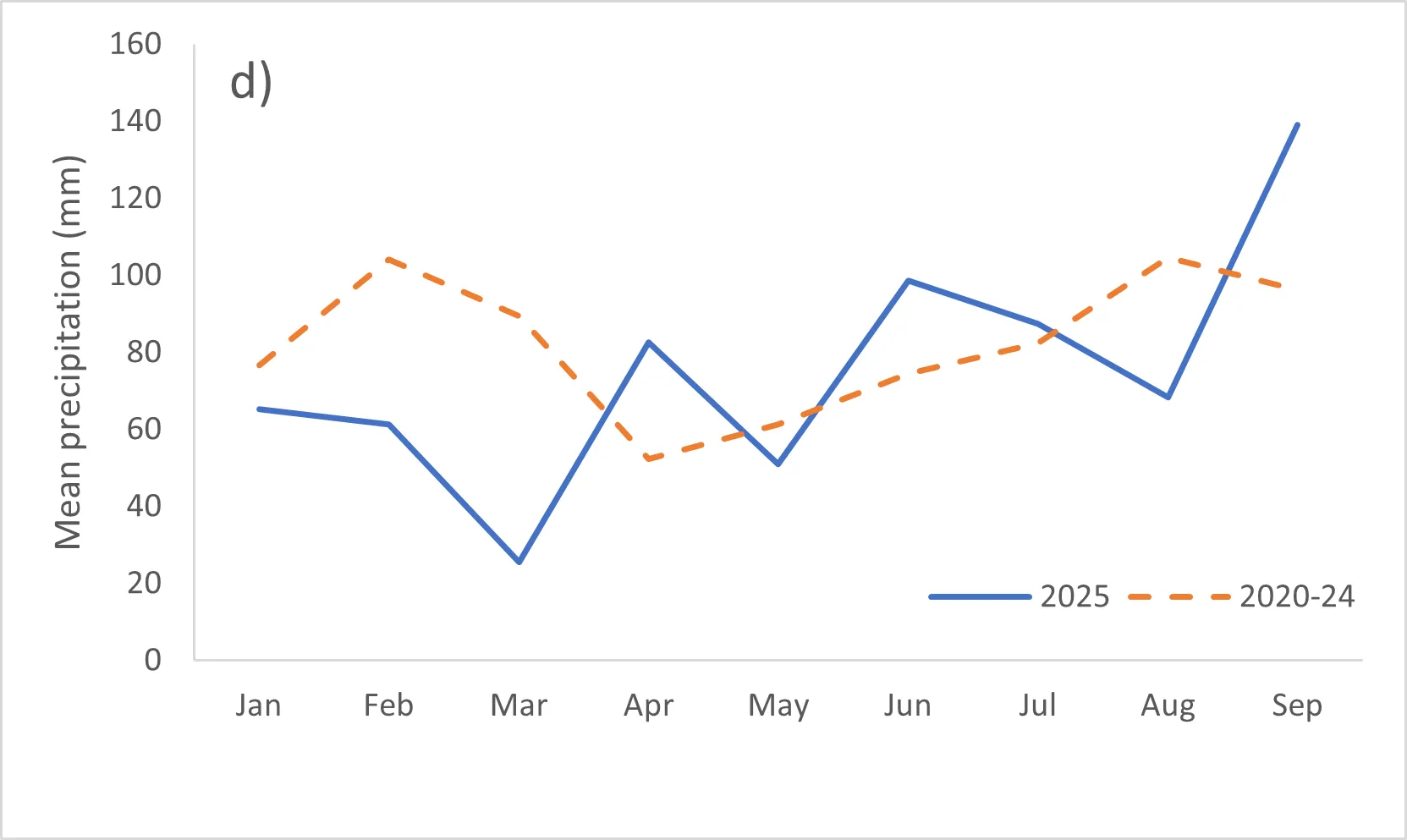
(d) Rainfall index for Northern Ireland (data from the Met Office Hadley Centre UK Precipitation dataset)
The 2025 breeding season
Overall, the 2025 season was a poor one in terms of the number of adult birds caught on CE Sites, but positive in terms of breeding success.
Migratory warblers continue downward trend
Of the 29 species monitored for CES, eight are migratory warblers. In 2025, four of these eight (Willow Warbler, Blackcap, Garden Warbler and Whitethroat) recorded significant reductions in abundance when compared to the previous five-year mean (2020–24); while Sedge Warbler, Reed Warbler and Lesser Whitethroat also recorded non-significant declines. Blackcap was the only species for which this reduction was seen across all regions as well as at a national scale; in contrast, Chiffchaff was the only species, migratory or resident, to show significantly higher abundance in 2025. For Willow Warbler and Garden Warbler, the numbers recorded in 2025 were the lowest on record, while for Chiffchaff, the numbers were the highest on record. The results show no significant changes in the numbers of migratory adult birds returning to CES sites between 2024 and 2025 when compared to the five-year mean, so poor overwinter survival of adult birds is unlikely to be the main cause of the reduction in numbers seen in 2025.
The results from 2024, in terms of numbers recorded, were similar to this year, with all warblers other than Chiffchaff showing a reduction in numbers (although not all significantly so); 2024 was also a poor year for productivity. The long-term trends (1983–2025) for the migratory warblers recorded through CES show significant reductions for all species other than Chiffchaff and Blackcap. It is therefore likely that the reduced number of birds seen is a result of fewer juvenile birds being available to recruit into the breeding population in 2025.
Traditionally, the fortunes of the two short-distance migrants recorded through CES, Chiffchaff and Blackcap, have mirrored each other. In recent years, their fortunes have diverged, with Chiffchaff continuing to increase in numbers, whereas Blackcap numbers have declined over the last five years. Blackcap adult survival rates have also declined over the same period, unlike those of Chiffchaff’s. As Chiffchaffs return to breed in Britain & Ireland a few weeks earlier than Blackcaps (and they returned even earlier than normal in 2025 according to BirdTrack data) it is possible that weather conditions later in the spring are becoming more unfavourable to migration, although further research would be needed to confirm this.
CES abundance graph for Blackcap 1983-2025. The blue line shows the trend, while the green and orange lines show the upper and lower confidence limits.

CES abundance graph for Chiffchaff 1983-2025. The blue line shows the trend, while the green and orange lines show the upper and lower confidence limits.

Mixed fortunes for resident species
Resident species fared a little better than migratory species in 2025. Only four resident species exhibited significant reductions in abundance compared with the five-year mean (2020–24): Blue Tit, Great Tit, Dunnock and Bullfinch. Like Blackcap, the reduction in Blue Tit numbers was seen across all regions. Also like Blackcap, the reduction in Great Tit numbers reflects a recent change, as this species is exhibiting a statistically significant increase in abundance in the long-term (1983–2025). The long-term change for Blue Tit is not significant either way, while both Dunnock and Bullfinch numbers are declining significantly over the longer term. Neither Blue Tit nor Great Tit recorded a significant change in adult overwinter survival between 2024 and 2025; however, both had a poor breeding season in 2024 suggesting that reduced recruitment of juvenile birds into the breeding population is likely to be the driver of this change. As neither Dunnock nor Bullfinch had a significantly poor breeding season in 2024, and neither showed a significant change in adult overwinter survival, the decline in numbers seen in 2025 is likely a result of poor juvenile overwinter survival. The long-term CES declines exhibited by both species mirror those reported by BBS since the mid-2010s.
Although the reduction in Chaffinch numbers in 2025, compared to the five-year mean, was not statistically significant, fewer individuals were recorded than in any previous season, reflecting the long-term decline in this species. Conversely, Cetti’s Warbler were seen in greater numbers than in any previous year, despite their increase in 2025 not being statistically significant and despite them recording a statistically significant decline in adult overwinter survival. This reflects the long-term change for this species; Cetti’s Warbler is the species that has increased the most since CES monitoring began, predominantly due to a range expansion facilitated by warmer winters, which have reduced levels of mortality.
Of the new species added to the analyses in 2025, Goldcrest, Marsh Tit and Great Spotted Woodpecker recorded increases in abundance while Coal Tit and Kingfisher recorded decreases, albeit none of these changes was significant. Goldcrests were seen in greater numbers in 2025 than in any previous year, however. The long-term results (1983–2025) show significant increases in abundance over time for Coal Tit, Great Spotted Woodpecker and Goldcrest.
Table 1. Adult abundance, breeding success and adult survival rates calculated from 2025 CES data. Figures represent a percentage change relative to the five-year average (2020–24). Statistically significant (p < 0.05) positive and negative changes are highlighted in bold. ‘*’ denotes a small sample size of fewer than 20 sites contributing to the trend.
| Adult abundance change (%) |
Productivity change (%) | Survival change (%) |
| Resident tits | |||
| Coal Tit | -35 | 203 | - |
| Marsh Tit | 65 | 23 | - |
| Willow Tit* | -20 | -46 | - |
| Blue Tit | -26 | 96 | -18 |
| Great Tit | -22 | 66 | -1 |
| Cetti’s Warbler | 14 | 41 | -30 |
| Long-tailed Tit | -13 | 31 | -23 |
| Migrants | |||
| Willow Warbler | -31 | 19 | 9 |
| Chiffchaff | 17 | 23 | 17 |
| Sedge Warbler | -4 | 3 | -9 |
| Reed Warbler | -1 | 18 | 3 |
| Blackcap | -22 | 58 | -16 |
| Garden Warbler | -29 | 84 | -26 |
| Lesser Whitethroat | -19 | 48 | 27 |
| Whitethroat | -21 | 55 | -9 |
| Other residents | |||
| Kingfisher | -26 | 62 | - |
| Great Spotted Woodpecker | 27 | 61 | - |
| Goldcrest | 29 | 28 | - |
| Wren | -6 | 15 | 19 |
| Treecreeper | -4 | 38 | -6 |
| Song Thrush | 1 | 10 | 1 |
| Blackbird | -7 | 3 | 6 |
| Robin | -5 | 31 | 1 |
| Dunnock | -14 | 49 | 0 |
| Chaffinch | -24 | 87 | -76 |
| Bullfinch | -24 | -7 | -36 |
| Greenfinch | 12 | -44 | 39 |
| Goldfinch | -11 | 103 | - |
| Reed Bunting | -6 | 7 | 17 |
Good year for breeding success
More positively, it was a better breeding season for migratory species with five of the eight (Chiffchaff, Reed Warbler, Blackcap, Garden Warbler and Whitethroat) recording significant increases in productivity compared with the five-year mean, and the remaining three recording non-significant increases. It is likely that all species benefited from the mild and dry spring and summer weather and that the prolonged good weather in summer 2025 increased the likelihood of second broods, leading to higher productivity. Those species that were recorded in lower numbers in 2025 may also have benefitted from reduced competition for resources, leading to above average breeding success.
Similarly, the 2025 breeding season was also a good one for residents, with nine species (Coal Tit, Blue Tit, Great Tit, Cetti’s Warbler, Long-tailed Tit, Robin, Dunnock, Chaffinch and Goldfinch) recording statistically significant increases in productivity when compared to the five-year mean (2020–24) and none recording a significant decline. As with the migratory species, the favourable weather conditions in 2025, increased likelihood of second broods and reduced competition for resources in those species that were recorded in significantly lower numbers, are likely to be contributory factors in these increases in productivity. For early breeders such as Long-tailed Tit and Robin, the mild winter and dry, settled weather in spring are also likely to have presented particularly favourable breeding conditions.
Of the nine resident species for which productivity was significantly higher in 2025, only Chaffinch is showing a significant increase in the long term (1983–2025). The productivity figure for Chaffinch was the highest on record in 2025, and the species also recorded its lowest adult survival rate figure on record this year. The record high productivity coupled with record low abundance and adult survival suggests that the decline in Chaffinch numbers is driven by poor adult and juvenile survival, likely the result of the ongoing impacts of the disease causing trichomonosis.
For the new species added to the analysis this year, 2025 was a positive breeding season, with all recording increases in productivity, although only significantly so for Coal Tit. Only Kingfisher is showing a significant increase in productivity over the long term (1988–2025).
Join us in monitoring birds in 2026
If you are a qualified ringer with access to an area of scrub, woodland or reedbed where there is the potential to catch around 200 birds or more per season, why not register a CES? And if you aren’t able to start your own site, why not consider helping out at an existing one? Contact the CES Organiser for more information. We are currently undertaking a trial of CES in garden habitats (although the results don’t yet feed into these analyses). If you are interested in participating in the trial, the CES Organiser can provide further details.
Acknowledgements
We are extremely grateful to all Constant Effort Site ringers for their monitoring efforts and for the support of the BTO/JNCC partnership, which the JNCC undertakes on behalf of the Country Agencies. Additional funding for the BTO Ringing Scheme is provided by the National Parks and Wildlife Service (Ireland) and the ringers themselves. The BTO's contribution to the Ringing Scheme is supported by funding from gifts in Wills, for which we are extremely grateful. The Breeding Bird Survey is run by the BTO and jointly funded by the BTO, the JNCC and the RSPB.