Common Nighthawk
Introduction
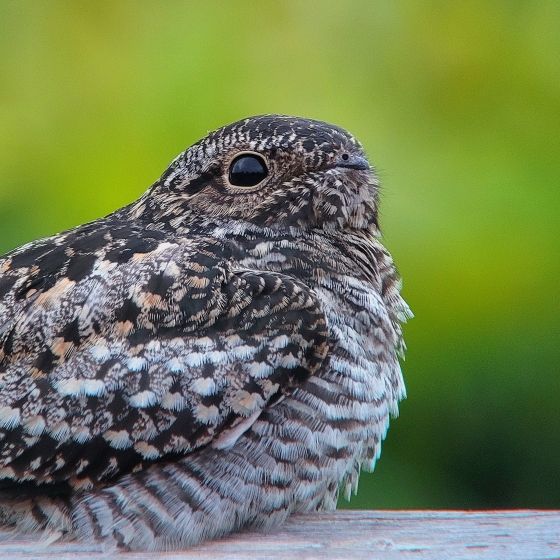
Similar in size to a Nightjar, but with larger white wing markings, the Common Nighthawk is a very rare visitor from North America
Within its native range, the Common Nighthawk is migratory, breeding in North America south of the tundra, and wintering across much of South America.
A good proportion of the British & Irish records come from the Isles of Scilly.
Key Stats








Status and Trends
Conservation Status
Population Size
Population Change
Population trends of this scarce species are not routinely monitored.
Distribution
This species is a rare vagrant and was recorded during Bird Atlas 2007–11 as shown on the map.
or view it on Bird Atlas Mapstore.
Distribution Change
This vagrant is too rarely reported to map distribution change.
Seasonality
This species has been too rarely reported to BirdTrack during 2011–22 to properly assess seasonality.
Movement
Britain & Ireland movement
Biology
Survival and Longevity
Survival is shown as the proportion of birds surviving from one year to the next and is derived from bird ringing data. It can also be used to estimate how long birds typically live.
Classification, names and codes
Classification and Codes
- Order: Caprimulgiformes
- Family: Caprimulgidae
- Scientific name: Chordeiles minor
- Authority: JR Forster, 1771
- BTO 5-letter code: COMNI
- Euring code number: 7860
Alternate species names
- Catalan: enganyapastors americà
- Czech: lelek sokolí
- Danish: Nathøg
- Dutch: Amerikaanse Nachtzwaluw
- Estonian: videvikusorr
- Finnish: isohaukkakehrääjä
- French: Engoulevent d’Amérique
- German: Falkennachtschwalbe
- Hungarian: estifecske
- Icelandic: Húmfari
- Italian: Succiacapre sparviere
- Latvian: Amerikas lelis
- Lithuanian: paprastasis sutemu lelys
- Norwegian: Nordnatthauk
- Polish: lelczyk maly
- Portuguese: bacurau-norte-americano
- Slovak: súmracník krahulcí
- Slovenian: severnoameriški legen
- Spanish: Añapero yanqui
- Swedish: större falknattskärra
- Welsh: Cudylldroellwr
Research
Publications (1)
Environmental and Geographic Conditions on the Breeding Grounds Drive Bergmannian Clines in Nightjars
Author:
Published: 2025
Bergmann’s rule (or ‘law’) is one of the oldest in ecology and evolutionary biology, first presented in 1847. This rule states that animals inhabiting colder climates/latitudes are larger, with greater volume than individuals of the same species occupying warmer climates/latitudes.
12.07.25
Papers
More Evidence
More evidence from Conservation Evidence.com
Partners




Citing BirdFacts
If you wish to cite particular content in this page (e.g. a specific value) it is best to use the original sources as linked in the page. For a more general citation of the whole page please use: BTO (20XX) BirdFacts Species: profiles of birds occurring in the United Kingdom. BTO, Thetford (www.bto.org/birdfacts, accessed on xx/xx/xxxx).