Citation
Overview
Analysis of data from long-term monitoring schemes gives a total wintering waterbird population estimate in Great Britain of 12.8 million individuals for 2017/2018 to 2022/2023. While this total is unchanged from the previous estimate, there have been notable shifts, with numbers of estuarine waders, Whooper Swans, Little Egrets and non-migratory geese increasing, and declines in several duck and goose populations, including Bewick’s Swan, Pink-footed Goose and Teal.
In more detail
Britain is internationally important for wintering waterbirds due to its temperate maritime climate, extensive network of productive estuarine and inland wetland habitats, and geographical location along the East Atlantic Flyway, making it a valuable refuge for migratory species that breed in the Arctic and subarctic. Up-to-date estimates of the populations of waterbirds present are central to national and international conservation assessments for which the UK is a signatory, such as the Ramsar Convention on Wetlands, the Convention on Migratory Species (CMS), the Agreement on the Conservation of African-Eurasian Migratory Waterbirds (AEWA) and the Convention on Biological Diversity (CBD).
This study used long-term monitoring data from schemes administered by BTO, including the BTO/RSPB/JNCC Wetland Bird Survey (WeBS), the Non-Estuarine Waterbird Survey (NEWS) and the Heronries Census to generate population estimates for 99 species and populations for the period 2017/2019 to 2022/2023. The overall estimate of 12.8 million birds was unchanged since the previous assessment in 2019. This total included 5 million waders, 2 million ducks, 1 million geese, 490,000 rails, 76,000 swans, 51,000 herons and 37,000 grebes.
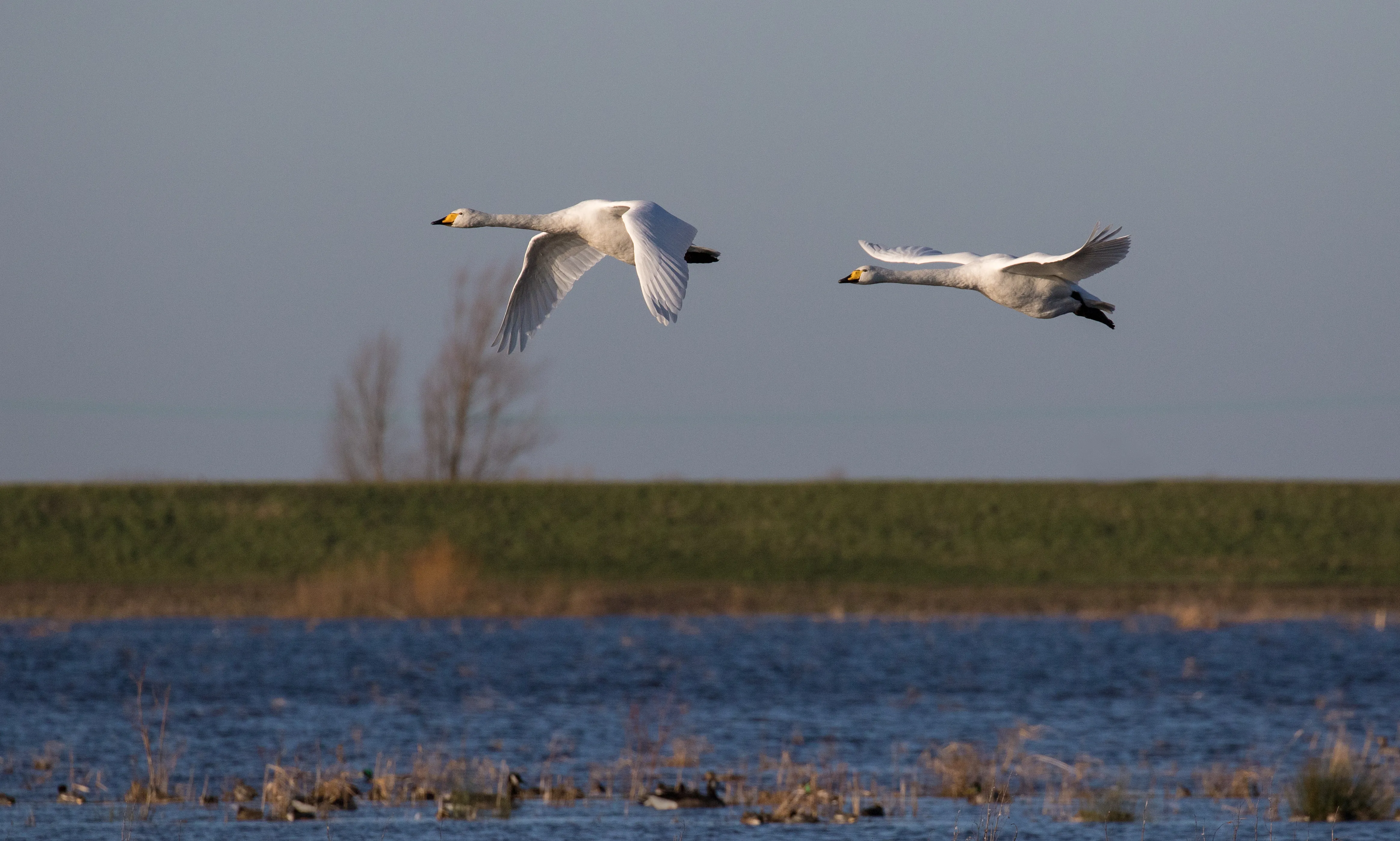
There have been notable shifts within species groups since the last assessment. Estuarine waders have increased by around 72,000 individuals, whereas ducks (excluding seaducks) have decreased by approximately 65,000 individuals, which was largely due to declines in Teal. The total number of swans wintering in Great Britain has increased, driven primarily by growth in the Whooper Swan population, but the Bewick’s Swan population has undergone a severe decline, with the current estimate representing an 85% reduction from its peak in 1990. Numbers of migratory geese wintering in Britain have declined overall, primarily driven by reductions in Pink-footed Goose and Icelandic Greylag Goose. In contrast, non-native and re-established goose populations, including Canada, British/Irish Greylag and Egyption Geese, have shown substantial increases, with a combined rise of around 66,000 individuals since the previous assessment.
Continued investment in high-quality, targeted surveys such as WeBS, NEWS and the forthcoming Bird Atlas 2027–31 is vital to ensure that national population estimates remain robust and representative. In the context of ongoing environmental change, maintaining and enhancing these monitoring schemes remains essential to ensure that conservation actions are based on sound scientific evidence.
Abstract
Great Britain supports internationally important numbers of wintering waterbirds, and accurate population estimates are essential for conservation assessment and site designation. Updated estimates are presented here for 99 species or populations, 65 of which have been newly revised using data from the Wetland Bird Survey (WeBS), the Goose and Swan Monitoring Programme (GSMP), the Non-Estuarine Waterbird Survey (NEWS), the Heronries Census, and other sources. Estimates generally represent the mean peak wintering population from 2017/18 to 2022/23, excluding 2020/21 owing to reduced coverage during the Covid-19 pandemic. Methodological refinements include an updated stratification framework distinguishing estuarine, coastal and inland habitats, and revised scaling of NEWS data. The total wintering waterbird population in Great Britain is estimated at 12.8 million individuals – unchanged from Frost et al. (2019) – but with notable shifts within species groups. Estuarine waders have increased, while several duck and goose populations have declined, including Bewick’s Swan Cygnus columbianus, Pink-footed Goose Anser brachyrhynchus and Eurasian Teal Anas crecca. Conversely, Whooper Swan Cygnus cygnus, Little Egret Egretta garzetta and non-migratory goose populations have continued to increase. The results highlight the continuing value of coordinated long-term monitoring, the need to repeat NEWS and expand offshore coverage, and the importance of maintaining robust population estimates for national and international conservation reporting.
Staff author(s)



WeBS is a partnership jointly funded by the BTO, Royal Society for the Protection of Birds (RSPB) and Joint Nature Conservation Committee (JNCC), with fieldwork conducted by volunteers. GSMP is a partnership run and jointly funded by the BTO, JNCC and NatureScot, with fieldwork conducted by both volunteer and professional surveyors.