Citation
Overview
The Arctic is warming faster than anywhere on the planet. Substantial ecological changes are occurring such as habitat loss and disruption to ecosystems. It is therefore urgent to better understand Arctic biodiversity to develop effective conservation strategies, yet such vast remote areas are challenging places to monitor, both practically and financially. As a solution, this study uses monitoring data from Arctic-breeding waterbird species on their wintering grounds to indicate potential changes occurring further north in the Arctic.
In more detail
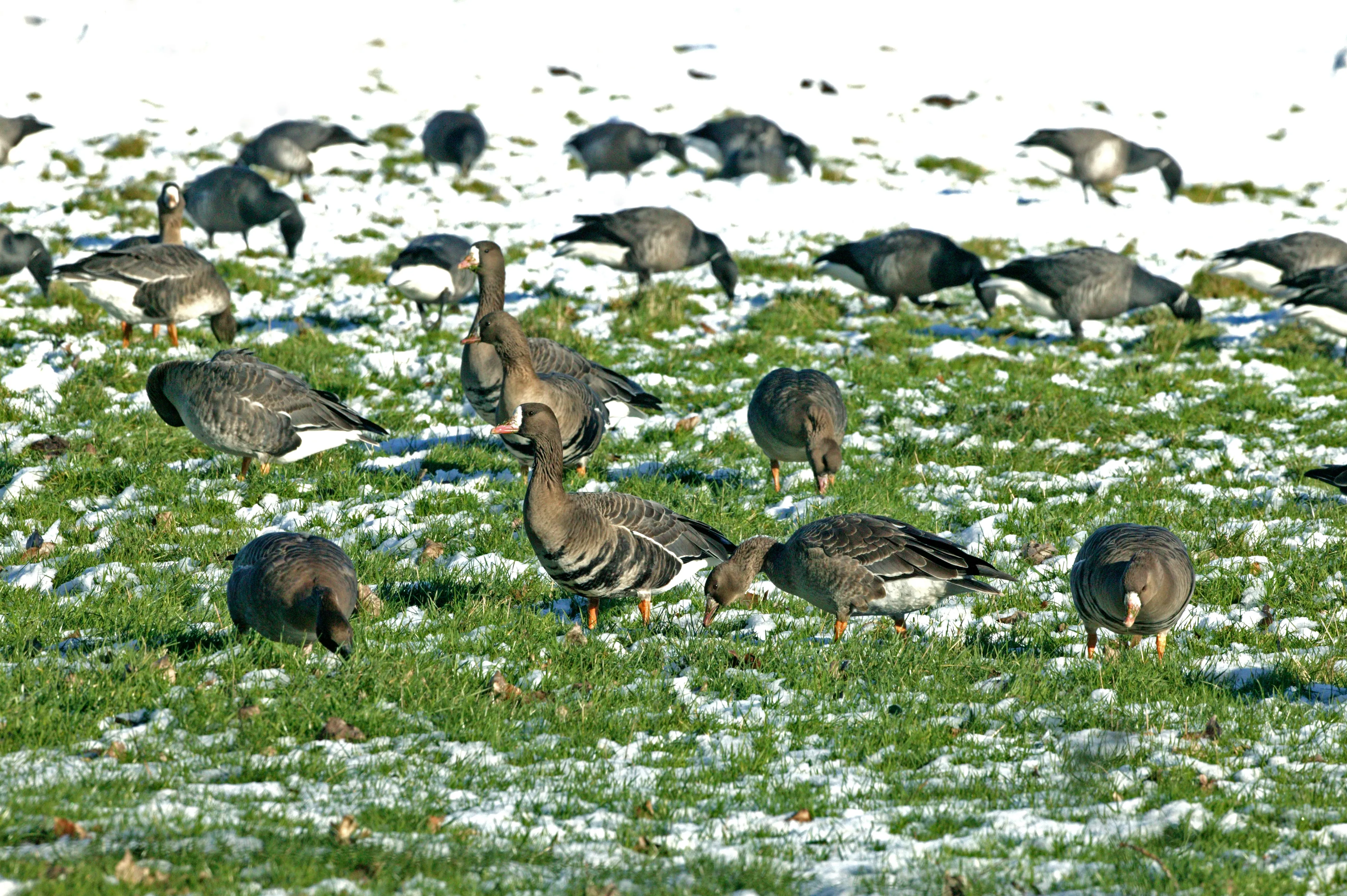
Many migrant waterbird species such as geese, ducks and waders breed within the Arctic but winter further south, including within the UK. These species are vulnerable to climate change impacts and habitat disturbance. A cost-effective and practical solution may therefore be to monitor such species on their wintering grounds ‘at a distance’ in the hope that changes in population abundance and demography can provide signals of environmental change.
This BTO-led study used data collected from long-term monitoring schemes in the UK and the Netherlands to examine changes in annual abundance and population-level reproduction (‘productivity’) of 19 species (70 biogeographical populations) of waterbirds within the East Atlantic Flyway, a key migration route of species from the Arctic stretching through northern Europe, to western and southern Africa. Species were grouped together by breeding and wintering location to form multi-species ‘indicators’. This allowed the common long-term patterns of population change to be better understood.
Species of wildfowl and wader were grouped by whether they bred in the Arctic (Canada, Greenland, high-Arctic Fennoscandia/Svalbard/Russia) or sub-Arctic (sub-Arctic Scandinavia/Russia, Iceland) regions, and which part of the flyway they predominantly used (eastern and western pathways). Changes in indicators were then assessed across more recent, and longer-term periods between the winters of 1975/76 and 2017/18. The indicators revealed that long-term increases in population size of waterbirds have slowed in recent years, and in many cases have declined over at least the last decade.
Population trends for species originating in arctic Russia using the eastern pathway decreased since the mid 2000s and more so in the most recent five-year period to 2016/17, partly driven by wildfowl species breeding in the High Arctic. Within the western pathway there were some declines in recent years from species breeding in sub-Arctic areas, but the indicator reverted positive again in 2012.
Patterns of productivity for wildfowl species within the western pathway showed a gradual decline since 1986/1987 whereas eastern productivity was more stable. Although understanding the specific factors driving changes in particular species populations was beyond the scope of the study, the findings match the current understanding of past and current demographic changes in waterbird populations. The patterns observed represent demographic responses to pressures operating throughout species annual cycles, including areas outside the Arctic. These indicators are therefore a proof of concept.
With improvements in mind, the indicators would benefit from broadening the geographic area of countries contributing wintering data, increasing the number of species included, and improving and expanding productivity measures beyond wildfowl. Multi-species indicators offer practical ‘ex situ’ solutions to monitoring changing Arctic conditions.
Countries outside the Arctic that host migratory species have an obligation to share information to help in Arctic conservation and biodiversity assessments. The indicators meet this need and serve to: (1) provide signals of potential changes to Arctic ecosystems and ecological conditions warranting further study, making them useful in assessing policy interventions such as effectiveness of climate change mitigation; and (2) initiate discussion over development for indicator improvement methodologically, statistically, and ecologically.
Abstract
Knowledge of the status of ecosystems is vital to help develop and implement conservation strategies. This is particularly relevant to the Arctic where the need for biodiversity conservation and monitoring has long been recognised, but where issues of local capacity and logistic barriers make surveys challenging. This paper demonstrates how long-term monitoring programmes outside the Arctic can contribute to developing composite trend indicators, using monitoring of annual abundance and population-level reproduction of species of migratory Arctic-breeding waterbirds on their temperate non-breeding areas. Using data from the UK and the Netherlands, countries with year-round waterbird monitoring schemes and supporting relevant shares of Arctic-breeding populations of waterbirds, we present example multi-species abundance and productivity indicators related to the migratory pathways used by different biogeographical populations of Arctic-breeding wildfowl and wader species in the East Atlantic Flyway. These composite trend indicators show that long-term increases in population size have slowed markedly in recent years and in several cases show declines over, at least, the last decade. These results constitute proof of concept. Some other non-Arctic countries located on the flyways of Arctic-breeding waterbirds also annually monitor abundance and breeding success, and we advocate that future development of “Arctic waterbird indicators” should be as inclusive of data as possible to derive the most robust outputs and help account for effects of current changes in non-breeding waterbird distributions. The incorporation of non-Arctic datasets into assessments of the status of Arctic biodiversity is recognised as highly desirable, because logistic constraints in monitoring within the Arctic region limit effective population-scale monitoring there, in effect enabling “monitoring at a distance”.
Staff author(s)






This work was funded by the UK’s WeBS; a partnership between BTO, RSPB, and JNCC. The UK’s GSMP was funded by the WWT, JNCC, and Scottish Natural Heritage (SNH). Waterbird and goose and swan monitoring in the Netherlands is coordinated by Sovon in association with Statistics Netherlands and funded by the Ministries of Agriculture, Nature and Food Safety and Infrastructure and Water Management and the 12 provinces. Additional funding support was provided by BTO.