Citation
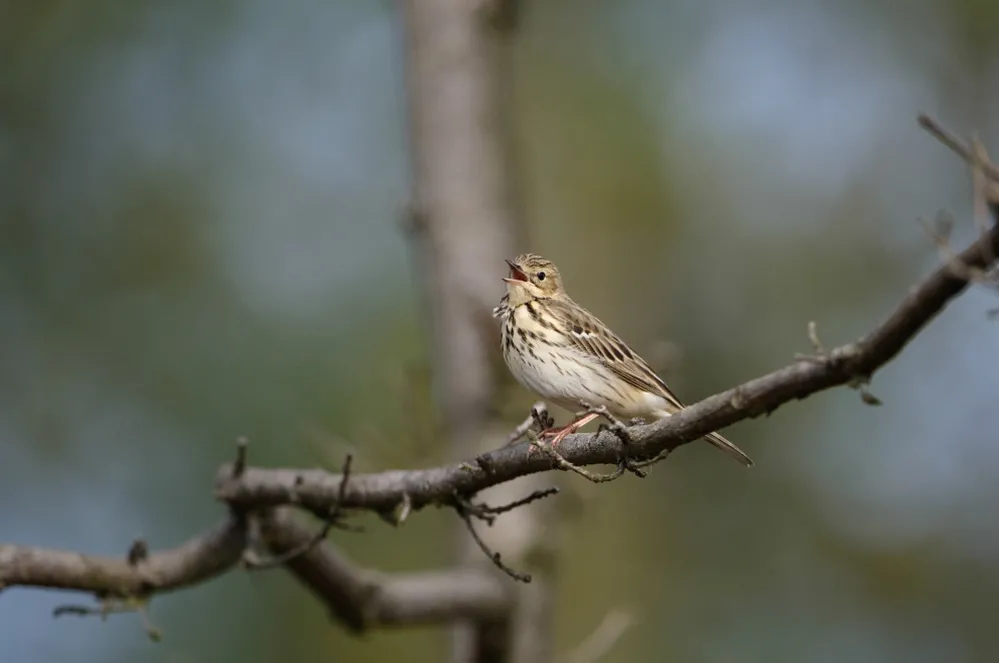
Overview
Soft trills in Tree Pipit songs were suggested to indicate male quality to females. This study found soft trill rates and regularity, but not duration, improve with the age of males, but this improvement is too low to make soft trills a reliable age or quality signal. Correspondingly, paired and unpaired males did not differ in trill characteristics.
Abstract
Birdsong may convey various information about the singer, including age or quality. In several passerine species, the production of trills (fast repetitions of notes) positively correlates with age and thus may serve as a quality signal. In this study, we investigated whether soft trills, a conserved part of the song of tree pipits, Anthus trivialis (Passeriformes: Motacillidae), improve with age in quality (quantified as trill rate and timing regularity) and whether successfully paired males differ in soft trill characteristics from single males. We studied two European populations, in Czechia and England, using both a longitudinal approach (comparing the performance of the same individuals between years) and a cross-sectional approach (comparing different age classes within a population). There was considerable variation in the rates of soft trills among individual males within the populations studied. Most males performed trills with a regular structure, but irregular trills were recorded in some males’ songs. The longitudinal analysis revealed that the majority of recorded returning males increased their soft trill rate with age, but the differences were usually relatively small, comparable to the within-individual variation. Improvement in the timing regularity of soft trills with age was also observed for most of the returning males that originally sang some irregular trills. When soft trills of 1 year old and older males from the U.K. population were compared in a cross-sectional analysis, no clear differences in trill rate but more regular trill delivery in older males were observed. Contrary to our hypothesis, trill characteristics of paired and unpaired males did not differ significantly. Our study adds to the few that have found ambiguous relationships between age and song structures potentially reflecting individual quality in passerine birds, and also points to discrepancies between results from longitudinal and cross-sectional analyses.
Staff author(s)

N.H.K.B. was supported by funding provided by Mark Constantine and in the field by Greg Conway and Justin Walker. Permission for undertaking the study in Thetford Forest was granted by Forestry England. Thanks to Neal-Armour-Chelu, Andy Palles-Clark, and the team of forest rangers.