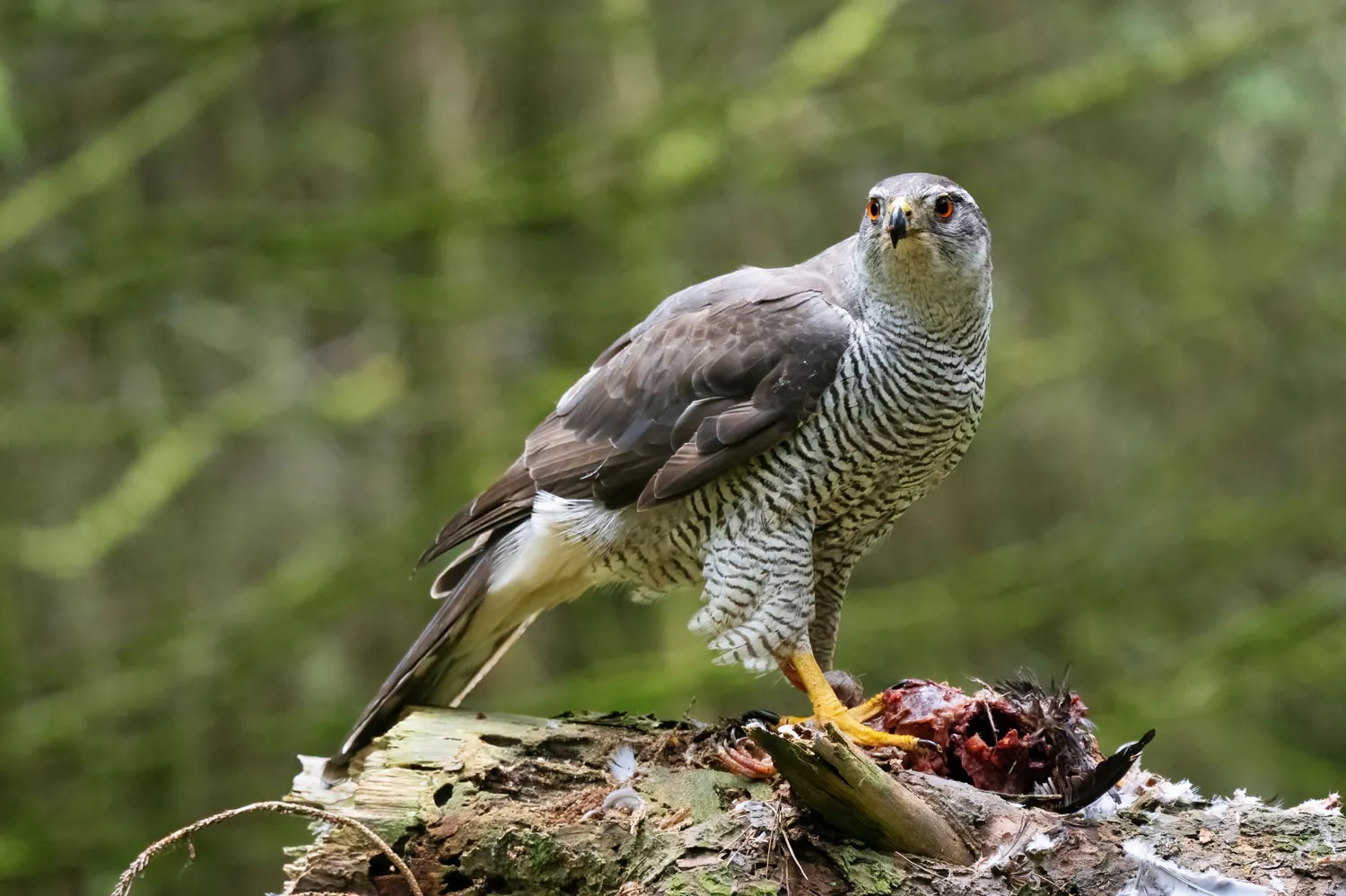
Goshawks are among our most impressive, elusive, and least understood birds of prey. Our research is uncovering how these scarce raptors are slowly spreading and adapting to potential new habitats.
Studies of the response of high-trophic-level predatory species to environmental gradients contribute to our understanding of adaptation, dependency and risk, both to the predator and its prey. Many such species are of high conservation concern because of a slow life history and a greater susceptibility to threats, not least in organised anthropogenic landscapes that have the propensity to modify or even distort predator–prey dynamics. There are, however, observational difficulties in studying species that are wide-ranging and furtive in
their behaviour.
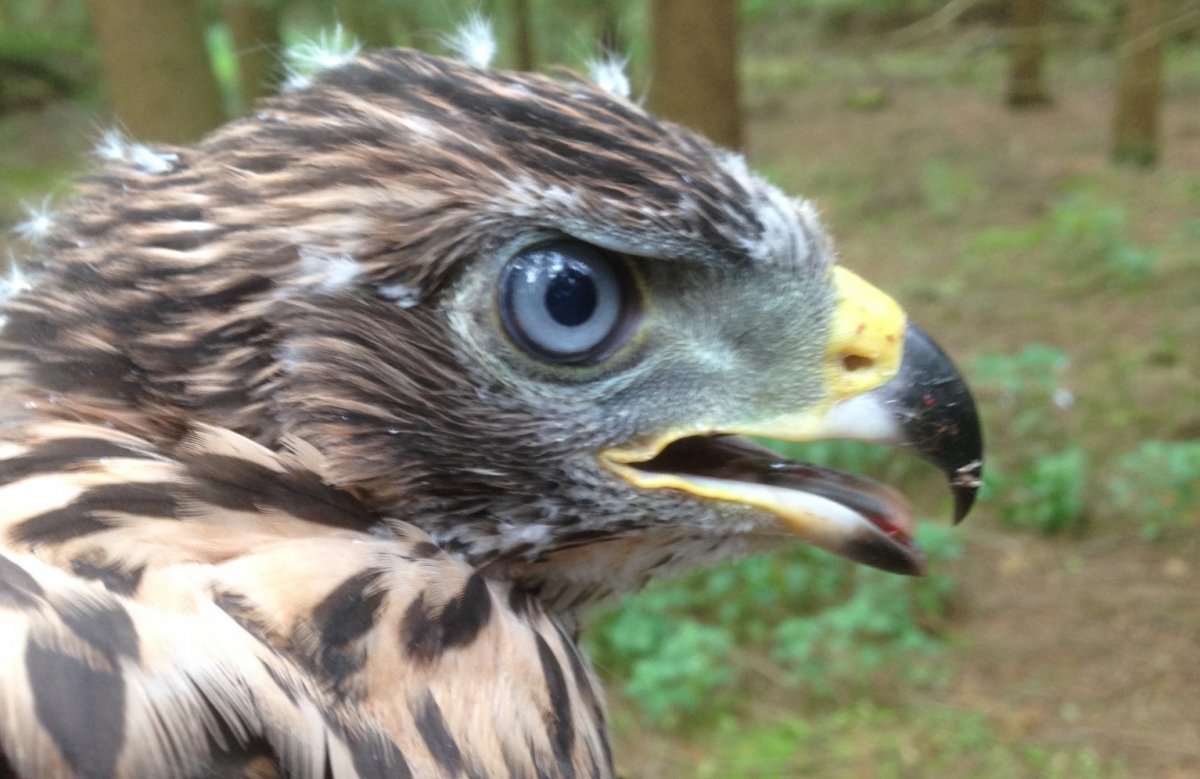
All the above characteristics are shared by the Eurasian Goshawk, a highly elusive species for which the movements and habitat associations are poorly quantified at large geographical scales. In Great Britain, this species is of further interest because the population is recovering from the historical impacts of persecution. In this study, we used state-of-the-art remote tracking methods to gather spatially accurate accumulations of data for reliable depictions of movement and habitat use during the early months of independence from the nest environment (termed for convenience ‘first-winter’). The data were taken from two regions of England (East Anglia and Gloucestershire) for good geographical representation of lowland habitats.
Young Goshawks exhibited strongly philopatric characteristics with low levels of natal dispersal once settled. They adopted sedentary and localised foraging patterns, averaging less than 5 km in diameter for approximately 90% of the time, located on the periphery of the breeding habitat and centred on farmland or farmland edge, unlike the more forest-centric adults. The use of farmland was especially the case for the first-winter males compared with females, which we speculate may be driven by competitive exclusion or hunting advantages. The results are discussed in the context of future population recovery and colonisation, while recognising existing and emerging threats, including diseases such as highly pathogenic avian influenza and trichomonosis. The study also serves as a methodological demonstration of the capacity for tracking technology to contribute more to our understanding of predators and, by extension, predation as a response to change (such as land-use practice), that can shape observed patterns of conflict.
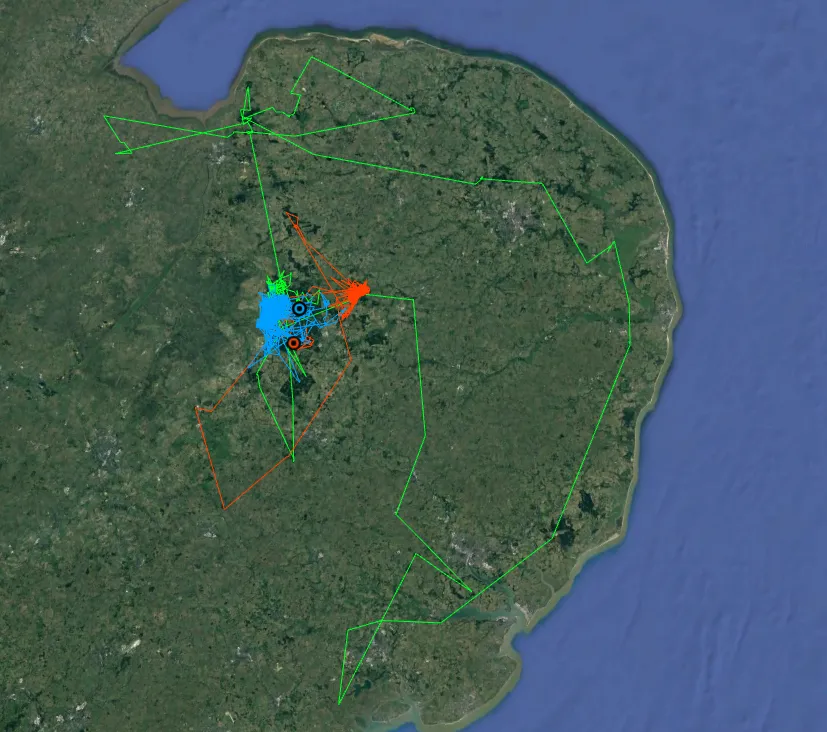
The tracks for three Breckland Goshawks are mapped below: two females (red and green), and a male (blue), as of the end of April 2018. All three were hatched in 2017. The green female took a ~20-day tour of East Anglia from 16th March before returning 'home'. Other females have shown similar patterns of behaviour.
Chick diet
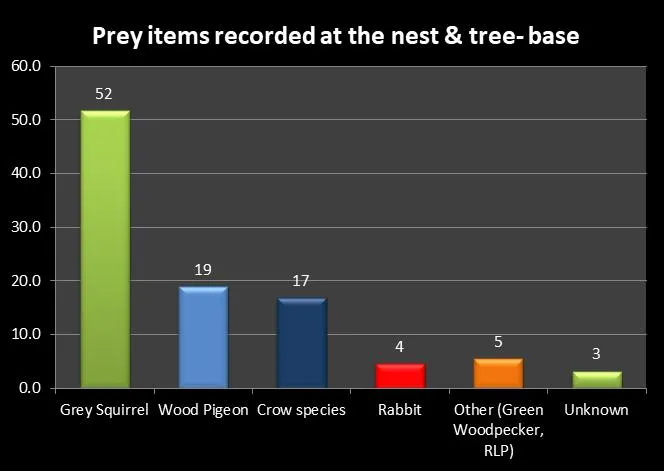
A brief nest camera study of the prey items being fed to chicks revealed that Grey Squirrels contributed most of the items, with Woodpigeons and corvids (all species) being common victims too. Woodpigeons were probably the most important prey species in terms of biomass. The diet however, was broad and probably reflects availability, with rabbits being prominent at one nest that was located within close proximity to an active rabbit colony (summarised in Fig. 1).
Acknowledgements
Funding support for this research was provided by Mark Constantine, Gloucestershire Raptor Monitoring Group, Richard Webb & Michael Wortley, The National Lottery Heritage Fund, and gifts in Wills to the British Trust for Ornithology. We would also like to thank the support of Forestry England for their cooperation and interest in this species throughout the project, and local recorders Bernard Pleasance and Simon Evans for their dedicated assistance and field input. Finally, we extend our special thanks to Dave Anderson for early advice, guidance and training. Tagging and Schedule 1 nest visits were carried out under strict licencing arrangements.


Publication details
This research has been published in a peer-reviewed scientific paper:
Henderson, I. G. et al. 2025. Post-fledging movements in an elusive raptor, the Eurasian Goshawk (Accipiter gentilis): Scale of dispersal, foraging range and habitat interactions in lowland England. Ibis. https://doi.org/10.1111/ibi.13403
The abstract for the published research paper is available to read from Ibis.