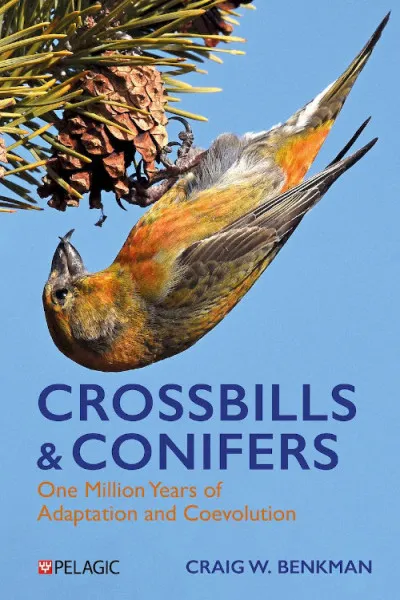
It’s always a thrill to see a Crossbill! I’ll never forget my first sighting of Common Crossbill (Loxia curvirostra), the species that we see most regularly in the UK. It was at Lawson’s Clump in Wareham Forest, Dorset. A flock of around 50 announced their presence with their loud, excitable calls, and they landed at the top of a tall conifer tree. There was a mixture of raspberry red males and bottle green females. It was fascinating to watch them as they fed on seeds from the conifer cones that this fascinating family of birds so relies upon.
So, onto this book! In a nutshell (or perhaps in this case, a conifer cone shell, if there is such a thing!) it covers in detail how the different species of crossbill around the world have adapted to feeding on the type of conifer cone that it feeds on. Of course, in order to do this, crossbills are the only species of finches that have crossed mandibles, hence the name. This book explains why having a crossed mandible helps these sturdy finches to prise apart conifer cones in order to feed on the seeds within them.
To help illustrate this point, I remember a few years ago when there was a significant irruption of crossbills to the UK. As well as good numbers of Common Crossbills in Thetford Forest near where I was living at the time, there were also small numbers of the more scarce Parrot Crossbill (L. pytyopsittacus) and Two-barred Crossbill (L. leucoptera).
This was a real treat, as it provided the rare opportunity to study these two species. Although I didn’t think too much of it at the time, in comparison to Common Crossbill, the ‘Parrots’ had larger beaks and the ‘Two-barreds’ had smaller beaks. Now that I have read this book, I have a better understanding of why this is likely to be! To put it very simply, there are many different types of conifer trees across Europe. Therefore, different species of crossbills have adapted so that their beaks are the right shape and size to feed on their favourite type of conifer cones!
This book is predominantly text, but there are several high quality images in it. If you are interested in finding out more about how crossbills, and other species for that matter, have adapted over the years to feed on their favourite foods, you need to read this book! As many of you will know, finches are a very well studied group of birds, mainly in relation to how they have evolved to fit their specific ecological niche. This book is a very welcome addition to that dynasty of research, as crossbills are such fascinating birds!
Reviewed by

- Author: Craig W. Benkman
- Publisher: Pelagic Publishing, Exeter
- Publication year: 2025
- ISBN: 9781784275679
- Format: Softback
- Page count: 210
- RRP: £30.00
- Available from: NHBS