Semipalmated Sandpiper
Introduction
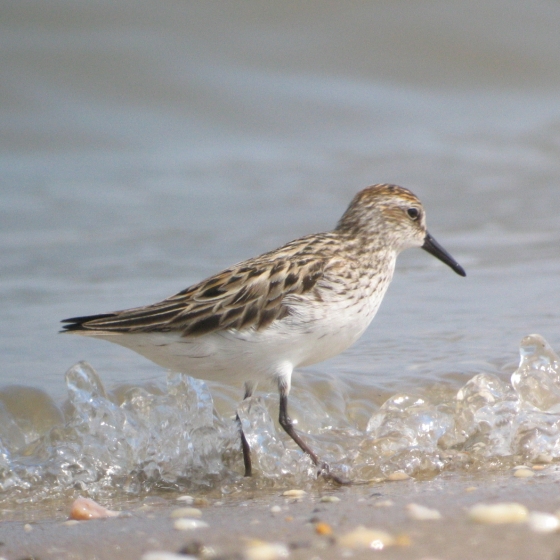
This small sandpiper is a rare visitor to Britain & Ireland from North America, with most records coming from the autumn period.
Key Stats







Status and Trends
Conservation Status
Population Size
Population Change
Population trends of this scarce species are not routinely monitored.
Distribution
This species is a rare vagrant and was recorded during Bird Atlas 2007–11 as shown on the map.
or view it on Bird Atlas Mapstore.
or view it on Bird Atlas Mapstore.
Distribution Change
This vagrant is too rarely reported to map distribution change.
Seasonality
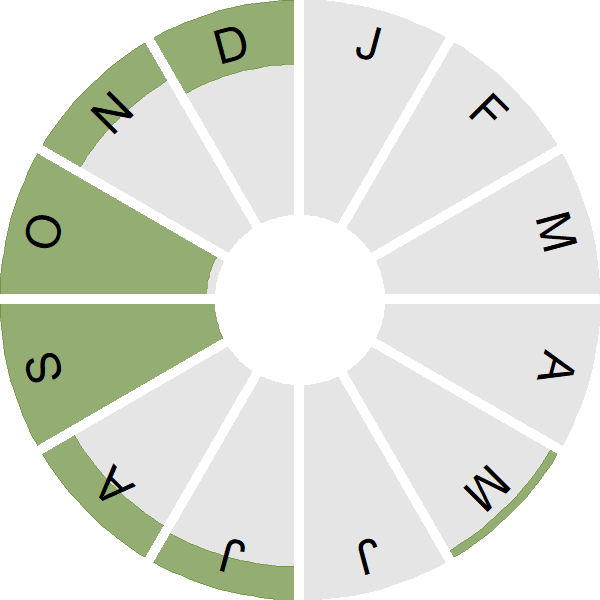
Semipalmated Sandpiper is a rare vagrant with most records in autumn and early winter.
Weekly pattern of occurrence
The graph shows when the species is present in the UK, with taller bars indicating a higher likelihood of encountering the species in appropriate regions and habitats.

Movement
Britain & Ireland movement
Biology
Survival and Longevity
Survival is shown as the proportion of birds surviving from one year to the next and is derived from bird ringing data. It can also be used to estimate how long birds typically live.
Classification, names and codes
Classification and Codes
- Order: Charadriiformes
- Family: Scolopacidae
- Scientific name: Calidris pusilla
- Authority: Linnaeus, 1766
- BTO 2-letter code: PZ
- BTO 5-letter code: SEMSA
- Euring code number: 4980
Alternate species names
- Catalan: territ semipalmat
- Czech: jespák srostloprstý
- Danish: Tyknæbbet Dværgryle
- Dutch: Grijze Strandloper
- Estonian: hallrisla e. hallrüdi
- Finnish: kanadansirri
- French: Bécasseau semipalmé
- German: Sandstrandläufer
- Hungarian: kis partfutó
- Icelandic: Fitjatíta
- Irish: Gobadáinín Mionbhosach
- Italian: Gambecchio semipalmato
- Latvian: smilšu šnibitis
- Lithuanian: tundrinis begikas
- Norwegian: Sandsnipe
- Polish: biegus tundrowy
- Portuguese: maçarico-rasteirinho / pilrito-rasteirinho
- Slovak: pobrežník piesocný
- Slovenian: krpljasti prodnik
- Spanish: Correlimos semipalmeado
- Swedish: sandsnäppa
- Welsh: Pibydd Llwyd
Research
Publications (1)
How important is it to standardise the measured mass of shorebirds weighed at varying intervals after capture?
Author:
Published: 2023
When ringing birds it is usually important to standardise measurements so that sources of error are minimised. For example, trainee ringers are taught how to measure wing lengths in the most repeatable fashion. Measuring bird weight is usually much more straightforward. One situation where this may not be the case is during canon netting when large numbers of birds can be caught at once, but are weighed gradually as the birds are processed, potentially leading to biases. This paper examines this phenomenon using captures of Knot, Turnstone, Dunlin and Semipalmated Sandpiper in Delaware Bay, USA. As these waders were caught whilst actively feeding on the eggs of Horseshoe Crabs, there was the possibility that birds weighed first could be heavier due to having a gut full of eggs, whilst those weighed last may have digested/voided their gut contents prior to being weighed and so weigh relatively less. For sample bird catches birds were weighed repeatedly, from immediately after capture to up to four hours after capture. The study found that birds rapidly lost up to 5% of their body weight in the first 30 minutes, with weight loss much reduced thereafter. This weight loss was strongly correlated to the number of droppings birds produced in the keeping pens, indicating the reduction was related to processing of gut contents. The paper shows how body weights can be standardised to that expected if each bird was weighed at 30 minutes after capture. For large catches this can increase the apparent mean weight for the sample by up to 2%. The paper also discusses the situations in which standardising body weight measurements for time from capture may be necessary.
01.04.23
Papers
More Evidence
More evidence from Conservation Evidence.com
Partners




Citing BirdFacts
If you wish to cite particular content in this page (e.g. a specific value) it is best to use the original sources as linked in the page. For a more general citation of the whole page please use: BTO (20XX) BirdFacts Species: profiles of birds occurring in the United Kingdom. BTO, Thetford (www.bto.org/birdfacts, accessed on xx/xx/xxxx).