House Martin
Introduction
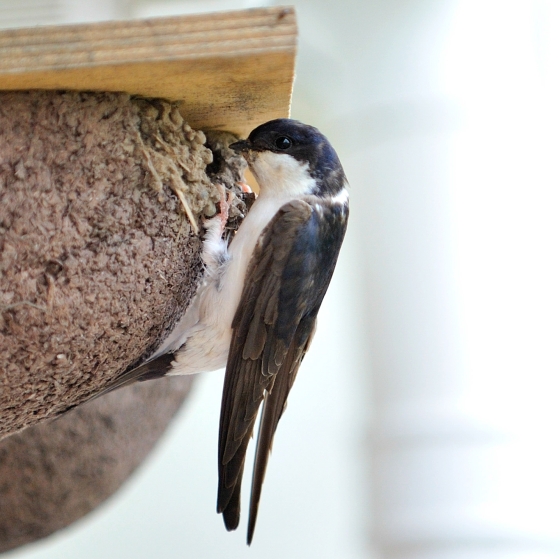
This small hirundine is a familiar bird due to its habit of nesting in small colonies under the eaves of our homes.
Migrating to the UK & Ireland in early spring, House Martins construct nest cups from mud, and lay two broods on average in a single summer. Birds, which have a distinctive white rump, can be seen anywhere throughout Britain & Ireland in the summer months. Flocks may be seen overhead in early autumn as they gregariously catch insects to fuel their return migration. Although House Martins migrate to Africa, the exact non-breeding range of House Martins that breed in the UK & Ireland is still not known.
Declines in House Martin numbers led to this species being added to the UK Red List in 2020. These declines have been most severe in the south and east of Britain. The reasons underpinning this decline are not well understood, although birds that build nests on PVC as opposed to brick, concrete or wood have much lower breeding success, with nests more likely to collapse on the PVC substrate.
- Our Trends Explorer gives you the latest insight into how this species' population is changing.
Key Stats









Identification
ID Videos
This section features BTO training videos headlining this species, or featuring it as a potential confusion species.
Hirundines & Swift
GBW: Swift, Swallow and House Martin
Songs and Calls
Song:
Call:
Flight call:
Status and Trends
Conservation Status
Population Change
The House Martin's loosely colonial nesting habits and its strong association with human settlements mean that it is extraordinarily difficult to monitor. Anecdotal evidence of decline is often unreliable, because demise of a colony may be balanced by single nests or small groups becoming established elsewhere. For these reasons, study areas should be large, covered thoroughly, and ideally randomly selected. A first national survey designed on these principles was undertaken by BTO in 2015 (see here ).
The available long-term data suggest a rapid decline, although the confidence intervals are wide and the BBS's first decade or so showed an increase. However the BBS map of change in relative density between 1994-96 and 2007-09 indicates that there were strong decreases over that period across southern and midland England and in Northern Ireland and increases in northern Britain and parts of the southwest. More recent BBS data confirm that the declines over the period 1995-2018 have mainly occurred in England and that numbers have increased in Scotland and Northern Ireland over the same period. The species was moved from the green to the amber list in 2002, because of moderate decline in the CBC trend for 1974-99, and is listed as of European concern following declines elsewhere in Europe (BirdLife International 2004). A decline has occurred across Europe since 1980 (PECBMS: PECBMS 2020a>).
Distribution
Breeding House Martins are widespread in Britain and Ireland with the exception of the highest parts of the Scottish Highlands, Shetland, the Outer Hebrides and some exposed parts of the west coasts of Scotland and Ireland. Densities are highest in the eastern half of Ireland. Abundance is especially low in some urban areas, including London, Birmingham, Dublin and Belfast, despite the species' reliance on buildings for nesting.
Occupied 10-km squares in UK
2007/08–10/11
or view it on Bird Atlas Mapstore.
2008–11
or view it on Bird Atlas Mapstore.
European Distribution Map
Distribution Change
Change in occupied 10-km squares in the UK
from 1981–84 to 2007–11
or view it on Bird Atlas Mapstore.
from 1968–72 to 2008–11
or view it on Bird Atlas Mapstore.
Seasonality
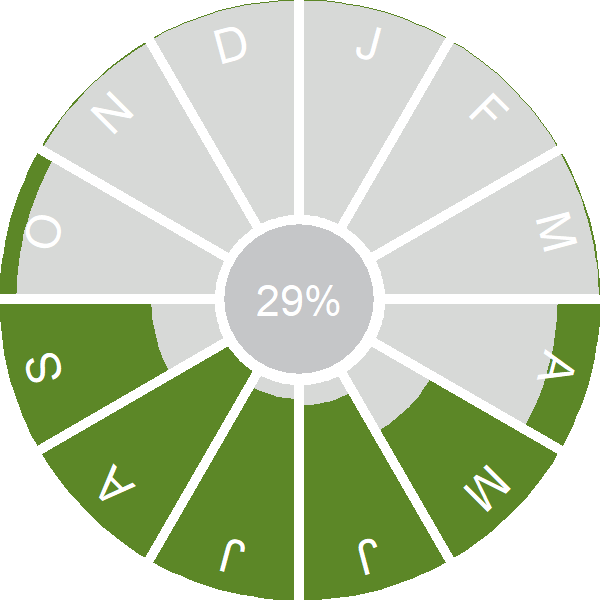
House Martin is a summer visitor, arriving through April and May and present until September/October.
Weekly pattern of occurrence
The graph shows when the species is present in the UK, with taller bars indicating a higher likelihood of encountering the species in appropriate regions and habitats.

Habitats
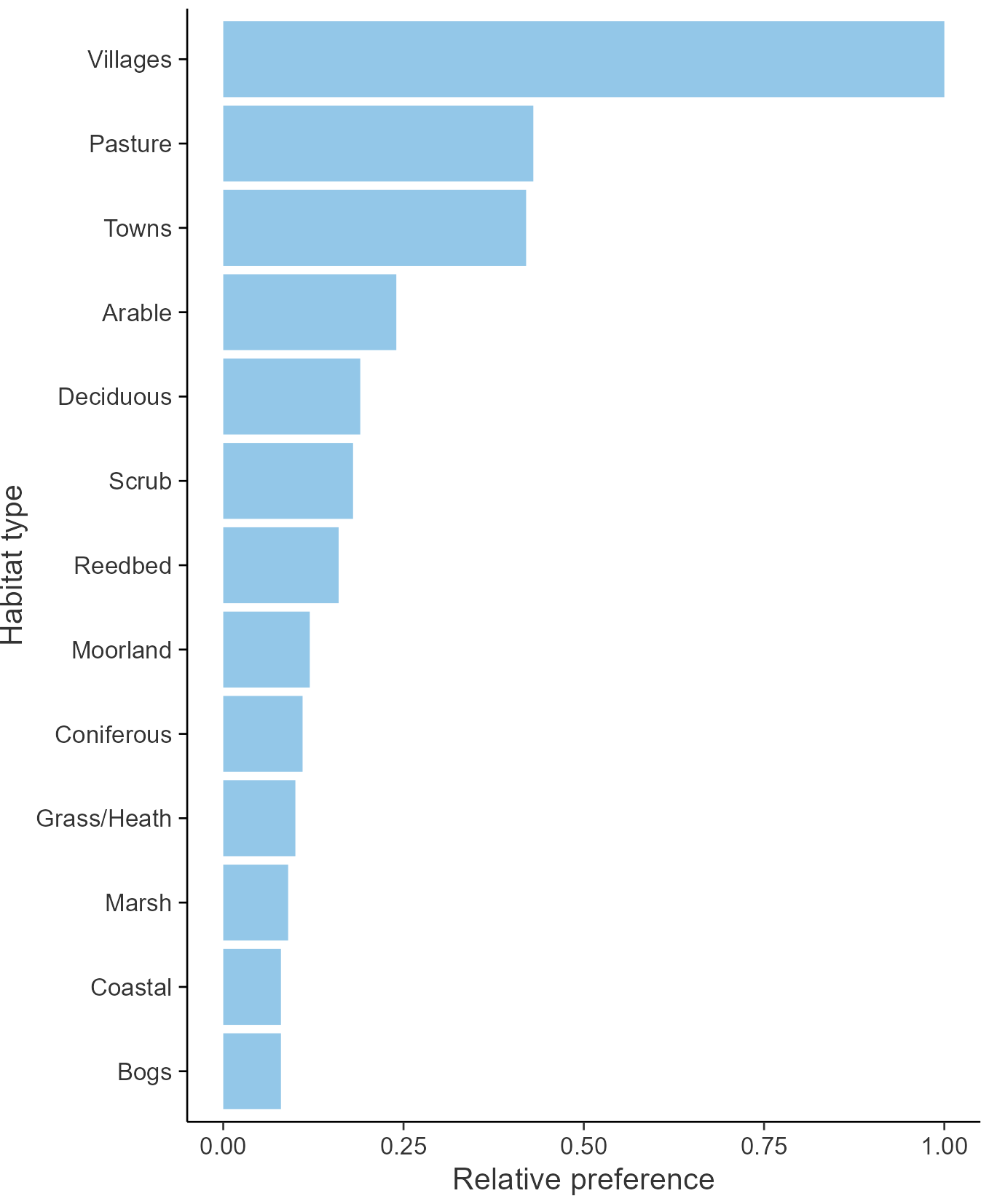
Breeding season habitats
Relative frequency by habitat
The graph shows the habitats occupied in the breeding season, with the most utilised habitats shown at the top. Bars of similar size indicate the species is equally likely to be recorded in those habitats.
Movement
Britain & Ireland movement
Foreign locations of birds ringed or recovered in Britain & Ireland
Dots show the foreign destinations of birds ringed in Britain & Ireland, and the origins of birds ringed overseas that were subsequently recaptured, resighted or found dead in Britain & Ireland. Dot colours indicate the time of year that the species was present at the location.
- Winter (Nov-Feb)
- Spring (Mar-Apr)
- Summer (May-Jul)
- Autumn (Aug-Oct)

European movements
EuroBirdPortal uses birdwatcher's records, such as those logged in BirdTrack to map the flows of birds as they arrive and depart Europe. See maps for this species here.
The Eurasian-African Migration Atlas shows movements of individual birds ringed or recovered in Europe. See maps for this species here.
Biology
Productivity and Nesting
Nesting timing
Egg measurements
Clutch Size
Survival and Longevity
Survival is shown as the proportion of birds surviving from one year to the next and is derived from bird ringing data. It can also be used to estimate how long birds typically live.
View number ringed each year in the Online Ringing Report.
Lifespan
Survival of adults
Survival of juveniles
Biometrics
Wing length and body weights are from live birds (source).
Wing length
Body weight
Ring Size
Classification, names and codes
Classification and Codes
- Order: Passeriformes
- Family: Hirundinidae
- Scientific name: Delichon urbicum
- Authority: Linnaeus, 1758
- BTO 2-letter code: HM
- BTO 5-letter code: HOUMA
- Euring code number: 10010
Alternate species names
- Catalan: oreneta cuablanca comuna
- Czech: jiricka obecná
- Danish: Bysvale
- Dutch: Huiszwaluw
- Estonian: räästapääsuke
- Finnish: räystäspääsky
- French: Hirondelle de fenêtre
- Gaelic: Gobhlan-taighe
- German: Mehlschwalbe
- Hungarian: molnárfecske
- Icelandic: Bæjasvala
- Irish: Gabhlán Binne
- Italian: Balestruccio
- Latvian: majas curkste
- Lithuanian: paprastoji langine kregžde
- Norwegian: Taksvale
- Polish: oknówka (zwyczajna)
- Portuguese: andorinha-dos-beirais
- Slovak: belorítka obycajná
- Slovenian: mestna lastovka
- Spanish: Avión común occidental
- Swedish: hussvala
- Welsh: Gwennol y Bondo
- English folkname(s): Window Swallow, Martlet
Research
Causes of Change and Solutions
Causes of change
The causes of the decline are currently unclear. A number of causes have been suggested but remain speculative and robust evidence to identify the main driver(s) of population change is lacking.
Further information on causes of change
Analysis of phenological data has found that the arrival date in the UK has advanced, between the 1960s and 2000s, by 16 days (Newson et al. 2016), although it is not currently known if and how this may affect breeding productivity for this species. Winter weather and food resources may be more limiting than conditions during the breeding season: annual survival rates from RAS sites in the UK for 1994-2004 were positively correlated with maximum monthly rainfall in West Africa. Some declines in survival rate are apparent over this period but they do not correspond well to the period of population decline (Robinson et al. 2008).
A number of breeding season factors have also been suggested as potential causes for the decline and for the contrasting trends between the north-west and south-east of the UK, but these are all speculative and robust evidence to identify one or more of these possible causes as a driver of population change is lacking. Previous research found that clutch sizes and the number of second broods varied by latitude and longitude (Moller 1984,Bryant 1975 ), and that breeding success is predominantly affected by foraging conditions (Bryant 1975, 1979,Poulin et al. 2010). Hence it is feasible that factors such as climate change and land use changes could have caused increases in breeding productivity in some parts of the UK and decreases elsewhere, causing the observed geographical variation in trends. However in the absence of demographic data it is not possible to confirm this. Competition with House Sparrow for nest sites has also been found to affect populations at local colonies (Tryjanowski & Kuczynski 1999). However, there is no evidence as yet to show that the overall proportion of usurped nests has changed over time and hence that House Sparrows could be having a population level effect.
Information about conservation actions
The main drivers of the decline for House Martin are not yet clear; hence, it is uncertain which conservation actions are most likely to directly benefit the species. However, it is known that House Martins usually prefer to use existing nests remaining from the previous year and will be more likely to raise two broods if they existing nests (e.g. Piersma 2013). Therefore, wherever possible, homeowners should leave existing nests in place over winter to enable them to be reoccupied the following spring.
Whilst research has not yet confirmed what factors are likely to be driving the decline and has therefore not tested possible solutions, there are some other actions which individuals and organisations can take as a precaution to address some of the potential factors whilst research is ongoing. Artificial nests will sometimes be used by House Martins and can therefore be provided alongside or to replace natural nests, particularly in cases where soffits and/or wall surfaces are replaced with PVC materials as anecdotal observation suggests such nests are more likely to collapse than those built on wood or brick surfaces. Another action which could be considered by site managers is the creation of 'House Martin towers' to provide potential nesting sites for House Martins on protected areas away from buildings. Such towers have been built for both House Martins and Swifts in several European countries.
Warmer, drier conditions as a result of climate change has also been suggested as a possible cause of the decline, and some homeowners have created muddy puddles during times of drought but the efficacy of this has not been tested.
Previous research suggests that breeding success may be predominantly affected by foraging conditions (Bryant 1975 , Bryant 1979; Poulin et al. 2010). Therefore, wider scale policies which aim to ensure habitat in the wider countryside supports invertebrates may also be important, e.g. reducing herbicide and pesticide use and creating natural habitat features.
Publications (5)
Birds of Conservation Concern Wales 4: the population status of birds in Wales
Author:
Published: 2022
The latest review of the conservation status of birds in Wales. The report assessed all 220 bird species which regularly occur in Wales. There are now 60 species of bird on the Red List, with 91 on the Amber List and just 69 - less than a third of the total number of species - on the Green List. The latest review of the conservation status of birds in Wales comes 20 years after the first, when the Red List was less than half the length it is today. The report assessed all 220 bird species which regularly occur in Wales. There are now 60 species of bird on the Red List in Wales, with 91 on the Amber List and 69 on the Green List. The Birds of Conservation Concern in Wales report assesses the status of each species against a set of objective criteria. Data sources include the BTO/JNCC/RSPB Breeding Bird Survey and the BTO/RSPB/JNCC Wetland Bird Survey, as well as Bird Atlases and other BTO-led monitoring schemes and citizen science initiatives. These are used to quantify the changing status of the species’ Welsh population. The UK, European and global conservation status of the species is also considered, placing the Welsh population into a wider context. The Red ListSwift, Greenfinch and Rook – familiar breeding species in steep decline across the UK – are among the new additions to the Welsh Red List, which now also includes Purple Sandpiper, on account of a rapidly shrinking Welsh wintering population, and Leach’s Petrel, an enigmatic seabird in decline across its global range. These species now sit alongside well-known conservation priorities, such as Curlew, Hen Harrier and Turtle Dove as birds at risk of being lost from Wales for good. Uplands and woodlands Many of the species on the Red List are found in upland and farmland habitats. Starling, Tree Sparrow, Yellow Wagtail and Yellowhammer can no longer be found in much of Wales, while iconic species of mountain and moorland, such as Ring Ouzel, Merlin and Black Grouse, remain in serious trouble. Wales is well known for its populations of woodland birds; however, many of these – including Lesser Spotted Woodpecker, Willow Warbler and Spotted Flycatcher – also feature on the Red List. Goldcrest, which has seen its Welsh population shrink alarmingly in recent decades, is another new addition. On the coast The assessment for Birds of Conservation Concern Wales 4 took place before the impacts of avian influenza could be taken into account. Breeding seabird species have been struggling in Wales for many years, however, and most were already of conservation concern before the outbreak of this disease. Kittiwake, Puffin, Black-headed Gull, and Common, Arctic and Sandwich Tern remain on the Red List. Wales holds internationally significant numbers of breeding seabirds, making the decline of these colonies a global concern. The Amber ListDeclines in Wheatear, Garden Warbler and House Martin - all migrants which breed in Europe and winter in sub-Saharan Africa - mean these species have moved from the Green List to the Amber List. Many other ‘Afro-Palearctic' migrant species are also in decline, but the potential reasons for this, such as habitat loss and reduced availability of invertebrate prey, are not well understood. Closer to home, the declines in the Welsh Chaffinch population, linked to the disease trichomonosis, have seen the species Amber-listed. A number of other species have been placed on the Amber List because of the wider importance of their Welsh populations, which in each case make up more than half the UK total. Wales is home to more than three-quarters of the UK’s Choughs, for example, so recent declines are cause for concern. The nation’s breeding populations of Manx Shearwater, Pied Flycatcher, Goshawk and Hawfinch also account for more than half the UK total, as does its wintering population of Spotted Redshank. It’s not all bad news, though: some species now on the Amber List have moved up from the Red List, indicating some positive change in their population trends. These include Common Sandpiper, Great Black-backed Gull, Bullfinch, Goldcrest and Pied Flycatcher. The Green ListWhile the report contains much cause for alarm, several conservation success stories shine through. Red Kite was almost lost as a British bird during the first half of the 20th century, when only a handful of pairs remained in remote Welsh valleys. Since then, a sustained conservation effort has brought the species back from the brink. Wales is now home to more than 2,500 pairs of Red Kite and the species has now been moved to the Green List, reflecting this incredible change in fortunes. Song Thrush, Reed Bunting, Long-tailed Tit, Redwing and Kingfisher are among the other species to have gone Green, providing much-needed hope that things can go up as well as down.
06.12.22
Reports Birds of Conservation Concern
The status of our bird populations: the fifth Birds of Conservation Concern in the United Kingdom, Channel Islands and Isle of Man and second IUCN Red List assessment of extinction risk for Great Britain
Author:
Published: 2021
Commonly referred to as the UK Red List for birds, this is the fifth review of the status of birds in the UK, Channel Islands and Isle of Man, published in December 2021 as Birds of Conservation Concern 5 (BOCC5). This updates the last assessment in 2015. Using standardised criteria, experts from a range of bird NGOs, including BTO, assessed 245 species with breeding, passage or wintering populations in the UK and assigned each to the Red, Amber or Green Lists of conservation concern. The same group of experts undertook a parallel exercise to assess the extinction risk of all bird species for Great Britain (the geographical area at which all other taxa are assessed) using the criteria and protocols established globally by the International Union for the Conservation of Nature (IUCN). This resulted in the assessment of 235 regularly occurring species (breeding or wintering or both), the total number assessed differing slightly from BOCC5 due to different rules on the inclusion of scarce breeders and colonisation patterns. The results of this second IUCN assessment (IUCN2) are provided in the same paper as BOCC5. Increasingly at risk This update shows that the UK’s bird species are increasingly at risk, with the Red List growing from 67 to 70. Eleven species were Red-listed for the first time, six due to worsening declines in breeding populations (Greenfinch, Swift, House Martin, Ptarmigan, Purple Sandpiper and Montagu’s Harrier), four due to worsening declines in non-breeding wintering populations (Bewick’s Swan, Goldeneye, Smew and Dunlin) and one (Leach’s Storm-petrel) because it is assessed according to IUCN criteria as Globally Vulnerable, and due to evidence of severe declines since 2000 based on new surveys on St Kilda, which holds more than 90% of the UK’s populations. The evidence for the changes in the other species come from the UK’s key monitoring schemes such as BTO/JNCC/RSPB Breeding Bird Survey (BBS) for terrestrial birds, the BTO/RSPB/JNCC Wetland Bird Survey (WeBS) for wintering populations and the Rare Breeding Bird Panel (RBBP) for scarce breeding species such as Purple Sandpiper. The IUCN assessment resulted in 108 (46%) of regularly occurring species being assessed as threatened with extinction in Great Britain, meaning that their population status was classed as Critically Endangered, Endangered, or Vulnerable, as opposed to Near Threatened or of Least Concern. Of those 108 species, 21 were considered Critically Endangered, 41 Endangered and 46 Vulnerable. There is considerable overlap between the lists but unlike the Red List in BOCC5, IUCN2 highlights the vulnerability of some stable but small and hence vulnerable populations as well as declines in species over much shorter recent time periods, as seen for Chaffinch and Swallow.
01.12.21
Reports Birds of Conservation Concern
Using citizen science to assess drivers of Common House Martin breeding performance
Author:
Published: 2020
House Martin numbers in the UK have declined by 39% over a 25 year period, but it is unclear why. This small hirundine is a summer visitor that spends the winter months in an unknown part of sub-Saharan Africa, returning to build their cup-shaped nests under the eaves of buildings during April and May. In the 2016 and 2017 breeding seasons, BTO ran the House Martin Nest Study which involved members of the public monitoring the breeding behaviour of House Martins nesting close to where they lived. The findings of this survey show that House Martins arrive earlier in the east of the UK and begin breeding earlier than birds nesting in the west, possibly a result of drier weather in the east. Birds using old nests from previous years or artificial nests also have greater breeding success than those that building nests from scratch. Furthermore, birds that build nests on PVC as opposed to brick, concrete or wood have much lower breeding success, with nests more likely to collapse on the PVC substrate. House Martins breeding in an agricultural environment are also less successful than those breeding in a suburban setting. The study also reported the first confirmed triple broods in the UK; whilst pairs of House Martins have been recorded undertaking three nesting attempts in a single summer further south in Europe, this had not previously been observed in the UK. The research, which identifies factors potentially influencing House Martin population trends, has direct conservation applications for this declining species. One simple recommendation from the study's results is to install artificial nesting cups to save birds around 10 days of nest building time when they return from migration, especially on buildings wtih plastic soffit. The results also suggest that old nests should not be cleared for similar reasons.
02.10.20
Papers
Identification of putative wintering areas and ecological determinants of population dynamics of Common House-Martin Delichon urbicum and Common Swift Apus apus breeding in Northern Italy
Author:
Published: 2011
To identify the causes of population decline in migratory birds, researchers must determine the relative influence of environmental changes on population dynamics while the birds are on breeding grounds, wintering grounds, and en route between the two. This is problematic when the wintering areas of specific populations are unknown. Here, we first identified the putative wintering areas of Common House-Martin (Delichon urbicum) and Common Swift (Apus apus) populations breeding in northern Italy as those areas, within the wintering ranges of these species, where the winter Normalized Difference Vegetation Index (NDVI), which may affect winter survival, best predicted annual variation in population indices observed in the breeding grounds in 1992–2009. In these analyses, we controlled for the potentially confounding effects of rainfall in the breeding grounds during the previous year, which may affect reproductive success; the North Atlantic Oscillation Index (NAO), which may account for climatic conditions faced by birds during migration; and the linear and squared term of year, which account for nonlinear population trends. The areas thus identified ranged from Guinea to Nigeria for the Common House-Martin, and were located in southern Ghana for the Common Swift. We then regressed annual population indices on mean NDVI values in the putative wintering areas and on the other variables, and used Bayesian model averaging (BMA) and hierarchical partitioning (HP) of variance to assess their relative contribution to population dynamics. We re-ran all the analyses using NDVI values at different spatial scales, and consistently found that our population of Common House-Martin was primarily affected by spring rainfall (43%–47.7% explained variance) and NDVI (24%–26.9%), while the Common Swift population was primarily affected by the NDVI (22.7%–34.8%). Although these results must be further validated, currently they are the only hypotheses about the wintering grounds of the Italian populations of these species, as no Common House-Martin and Common Swift ringed in Italy have been recovered in their wintering ranges. To identify the causes of population decline in migratory birds, researchers must determine the relative influence of environmental changes on population dynamics while the birds are on breeding grounds, wintering grounds, and en route between the two. This is problematic when the wintering areas of specific populations are unknown. Here, we first identified the putative wintering areas of Common House-Martin (Delichon urbicum) and Common Swift (Apus apus) populations breeding in northern Italy as those areas, within the wintering ranges of these species, where the winter Normalized Difference Vegetation Index (NDVI), which may affect winter survival, best predicted annual variation in population indices observed in the breeding grounds in 1992–2009. In these analyses, we controlled for the potentially confounding effects of rainfall in the breeding grounds during the previous year, which may affect reproductive success; the North Atlantic Oscillation Index (NAO), which may account for climatic conditions faced by birds during migration; and the linear and squared term of year, which account for nonlinear population trends. The areas thus identified ranged from Guinea to Nigeria for the Common House-Martin, and were located in southern Ghana for the Common Swift. We then regressed annual population indices on mean NDVI values in the putative wintering areas and on the other variables, and used Bayesian model averaging (BMA) and hierarchical partitioning (HP) of variance to assess their relative contribution to population dynamics. We re-ran all the analyses using NDVI values at different spatial scales, and consistently found that our population of Common House-Martin was primarily affected by spring rainfall (43%–47.7% explained variance) and NDVI (24%–26.9%), while the Common Swift population was primarily affected by the NDVI (22.7%–34.8%). Although these results must be further validated, currently they are the only hypotheses about the wintering grounds of the Italian populations of these species, as no Common House-Martin and Common Swift ringed in Italy have been recovered in their wintering ranges.
01.01.11
Papers
Guests of Summer
Author:
Published: Summer 2016
Guests of Summer provides a fascinating insight into the lives of one of our most enigmatic and enchanting small birds - the House Martin. The story unfolds in a small Dutch village where the author, Theunis Piersma, lives and looks at the historic and contemporary connectedness of lives, both of birds and people. Intrigued by the House Martins nesting on his house, Piersma starts to explore the lives of these wonderful summer visitors, weaving in a tapestry than connects Anglo-Saxon migrations, Shakespeare's writings, political upheaval in the Congo, climate change and the big and frightening downsides of ongoing agricultural intensification. He does this using our insectivores, the martins, swallows and swifts, as the most inspiring of 'canaries' in the global coal mine.
22.03.16
Books and guides
More Evidence
More evidence from Conservation Evidence.com
Partners




Citing BirdFacts
If you wish to cite particular content in this page (e.g. a specific value) it is best to use the original sources as linked in the page. For a more general citation of the whole page please use: BTO (20XX) BirdFacts Species: profiles of birds occurring in the United Kingdom. BTO, Thetford (www.bto.org/birdfacts, accessed on xx/xx/xxxx).