Greater Spotted Eagle
Introduction
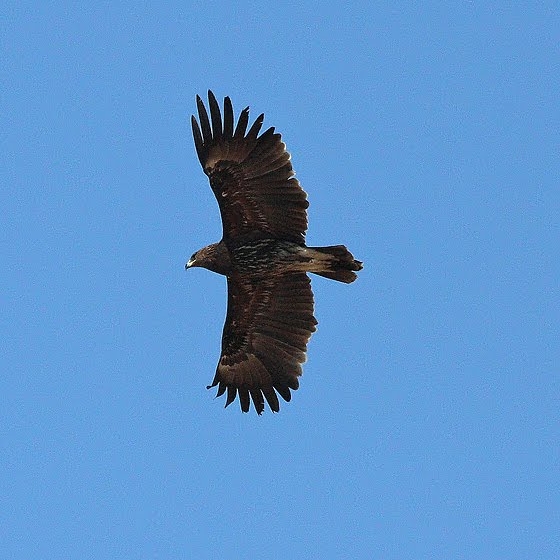
A small, dark eagle that breeds in wet forest in a relatively narrow latitudinal band (45°–64°N) from the Baltic east to China. A handful of records from Britain.
Key Stats







Status and Trends
Conservation Status
Population Size
Population Change
Population trends of this scarce species are not routinely monitored.
Distribution
This vagrant has not been recorded in the UK for many decades and as such cannot be mapped.
European Distribution Map
Distribution Change
This vagrant is too rarely reported to map distribution change.
Seasonality
This species has been too rarely reported to BirdTrack during 2011–22 to properly assess seasonality.
Movement
Britain & Ireland movement
European movements
EuroBirdPortal uses birdwatcher's records, such as those logged in BirdTrack to map the flows of birds as they arrive and depart Europe. See maps for this species here.
The Eurasian-African Migration Atlas shows movements of individual birds ringed or recovered in Europe. See maps for this species here.
Biology
Survival and Longevity
Survival is shown as the proportion of birds surviving from one year to the next and is derived from bird ringing data. It can also be used to estimate how long birds typically live.
Classification, names and codes
Classification and Codes
- Order: Accipitriformes
- Family: Accipitridae
- Scientific name: Clanga clanga
- Authority: Pallas, 1811
- BTO 5-letter code: SPOEA
- Euring code number: 2930
Alternate species names
- Catalan: àguila cridanera
- Czech: orel volavý
- Danish: Stor Skrigeørn
- Dutch: Bastaardarend
- Estonian: suur-konnakotkas
- Finnish: kiljukotka
- French: Aigle criard
- German: Schelladler
- Hungarian: fekete sas
- Icelandic: Gjallörn
- Irish: Iolar Breac
- Italian: Aquila anatraia maggiore
- Latvian: videjais erglis
- Lithuanian: didysis erelis reksnys
- Norwegian: Storskrikørn
- Polish: orlik grubodzioby
- Portuguese: águia-malhada
- Slovak: orol hrubozobý
- Slovenian: veliki klinkac
- Spanish: Águila moteada
- Swedish: större skrikörn
Research
Publications (2)
Active European warzone impacts raptor migration
Author:
Published: 2024
Collaborative research involving BTO examines the effects of the conflict in Ukraine on the migration of the endangered Greater Spotted Eagle.
20.05.24
Papers

Long-term effects of rewilding on species composition: 22 years of raptor monitoring in the Chernobyl Exclusion Zone
Author:
Published: 2022
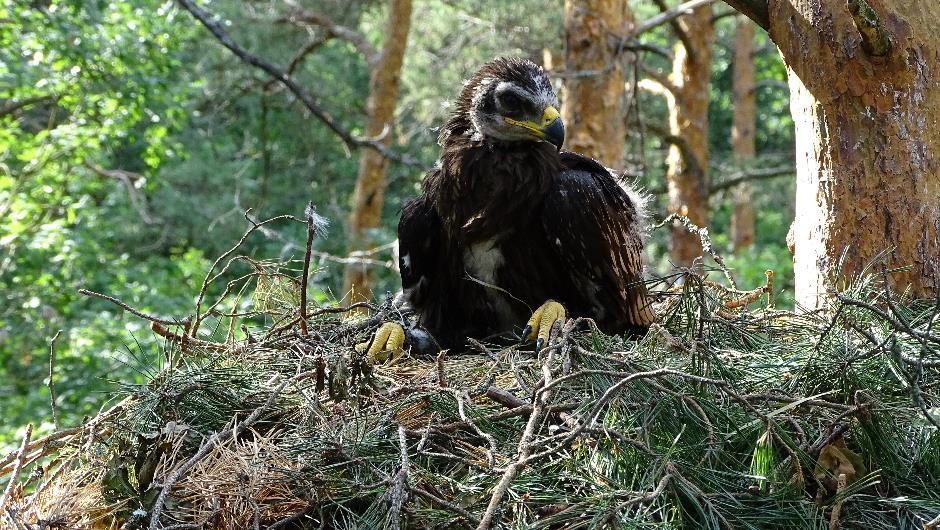
Researchers from BTO and the scientific department of Belarusian Chernobyl analysed 22 years of raptor population data from the Chernobyl Exclusion Zone (CEZ) and identified the impact of reduced human activity on some of Europe’s rarest birds of prey. Their findings demonstrate the power of rewilding for supporting biodiversity, including the conservation of vulnerable species. Over 2,000 km² of Belarus previously given over to intensive agriculture and dense settlements was affected by the 1986 reactor meltdown at the Chernobyl Nuclear Plant in Ukraine. Since then, this area has experienced little to no human disturbance, leading to decades of ‘passive rewilding’ where nature has been left to its own devices. This study explores the effects of this passive rewilding on the bird of prey community inhabiting the area; birds of prey sit at the top of the food chain and are thus excellent indicators of ecosystem health. The authors used a long-term dataset developed from periodic surveys of breeding birds of prey within a 147 km² study plot towards the edge of the Belarusian Chernobyl Exclusion Zone (CEZ). The researchers also used satellite imagery to analyse changes in land cover throughout this period, finding significant shifts in the area occupied by different types of habitat over time. Former agricultural land either became overgrown or rewetted, and the increase in waterlogged areas saw wetland specialists increase in abundance. Two wetland specialist that had been locally extinct in the area prior to the accident – Greater Spotted Eagle and White-tailed Eagle – both returned and increased in number. The study also followed the populations of 12 other raptor species from 1998 to 2019. Different species assemblages – the abundance and type of species present in an area – are associated with different habitats. Analysing the changes in abundance showed a decline in generalist predators, such as Montagu’s Harrier and Buzzard, which hunt over open fields and farmland and eat a variety of prey species, and an increase in specialists such as Greater Spotted Eagles and Hobby. Because some of the specialists are dependent on other important conservation species for food, for example Corncrake and Great Snipe, this change indicates a positive impact of rewilding on the ecosystem as a whole, not just the raptor populations, and shows rewilding’s potential value as a strategy to tackle biodiversity loss.
19.01.22
Papers
More Evidence
More evidence from Conservation Evidence.com
Partners




Citing BirdFacts
If you wish to cite particular content in this page (e.g. a specific value) it is best to use the original sources as linked in the page. For a more general citation of the whole page please use: BTO (20XX) BirdFacts Species: profiles of birds occurring in the United Kingdom. BTO, Thetford (www.bto.org/birdfacts, accessed on xx/xx/xxxx).