Common Sandpiper
Introduction
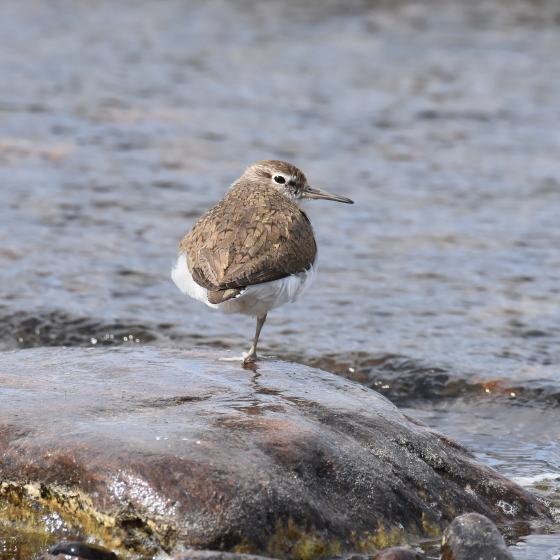
This small wader is most commonly encountered on upland rivers and lochs, and characteristically flicks its wings as it flies low over the water.
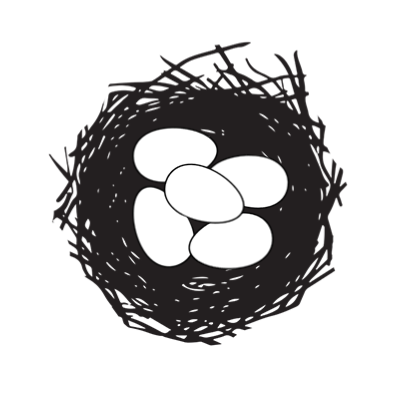
Brown above, with a well demarcated white breast, this handsome wader returns from its African wintering quarters in late April and pairs hold linear territories, defending them with noisy display flight. The species nests in vegetation by the water side, where, in common with most waders, it lays typically lays four eggs.
Numbers have declined steadily in recent years, for reasons that remain unclear, but may be linked to climate change increasing mortality in its wintering grounds.
- Our Trends Explorer gives you the latest insight into how this species' population is changing.
Key Stats









Identification
Songs and Calls
Song:
Call:
Alarm call:
Status and Trends
Conservation Status
Population Change
WBS/WBBS results for this species show a decline from 1985 onwards (after a more gradual increase) that has yet to be explained. This decline is also evident in BBS squares in England, although the BBS decline in Scotland has been shallower. Following declines during the 1990s in the large Swedish and Finnish populations, the European status of this species is no longer considered 'secure' (BirdLife International 2004). There has been a decline across Europe since 1980 (PECBMS: PECBMS 2020a>). The species was moved from the green to the amber list in 2009 on the strength of its declines in UK and across Europe.
Distribution
Common Sandpipers breed in the uplands of Wales, northern England, much of Scotland and western Ireland, with only small numbers outside these areas. Small numbers winter, mostly in southern parts of Ireland, England and Wales.
Occupied 10-km squares in UK
2007/08–10/11
or view it on Bird Atlas Mapstore.
2008–11
or view it on Bird Atlas Mapstore.
European Distribution Map
Distribution Change
Common Sandpiper breeding range has contracted by 20% across Britain & Ireland since the 1968–72 Breeding Atlas. Losses have been greatest in Ireland, central Wales and on lower ground adjacent to the uplands in England and Scotland.
Change in occupied 10-km squares in the UK
from 1981–84 to 2007–11
or view it on Bird Atlas Mapstore.
from 1968–72 to 2008–11
or view it on Bird Atlas Mapstore.
Seasonality
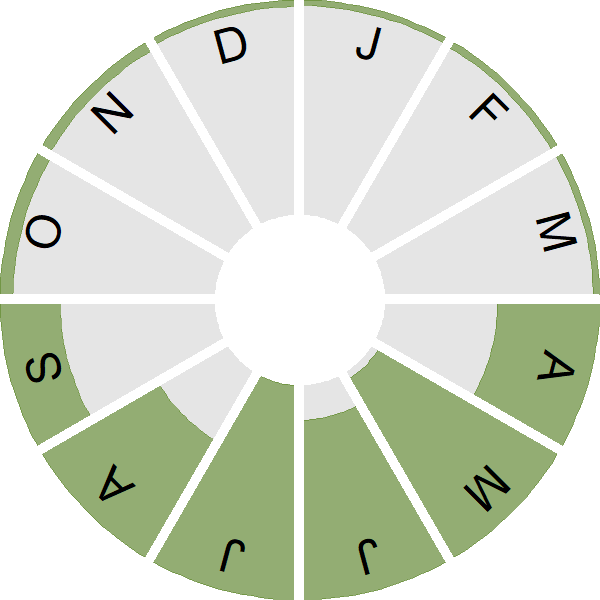
Common Sandpipers are very localised winter visitors but mostly summer visitors from April onwards. Arrivals merge into the autumn return passage which can begin from June.
Weekly pattern of occurrence
The graph shows when the species is present in the UK, with taller bars indicating a higher likelihood of encountering the species in appropriate regions and habitats.

Movement
Britain & Ireland movement
Foreign locations of birds ringed or recovered in Britain & Ireland
Dots show the foreign destinations of birds ringed in Britain & Ireland, and the origins of birds ringed overseas that were subsequently recaptured, resighted or found dead in Britain & Ireland. Dot colours indicate the time of year that the species was present at the location.
- Winter (Nov-Feb)
- Spring (Mar-Apr)
- Summer (May-Jul)
- Autumn (Aug-Oct)

European movements
EuroBirdPortal uses birdwatcher's records, such as those logged in BirdTrack to map the flows of birds as they arrive and depart Europe. See maps for this species here.
The Eurasian-African Migration Atlas shows movements of individual birds ringed or recovered in Europe. See maps for this species here.
Biology
Productivity and Nesting
Nesting timing
Egg measurements
Clutch Size
Survival and Longevity
Survival is shown as the proportion of birds surviving from one year to the next and is derived from bird ringing data. It can also be used to estimate how long birds typically live.
View number ringed each year in the Online Ringing Report.
Lifespan
Survival of adults
Survival of juveniles
Biometrics
Wing length and body weights are from live birds (source).
Wing length
Body weight
Ring Size
Classification, names and codes
Classification and Codes
- Order: Charadriiformes
- Family: Scolopacidae
- Scientific name: Actitis hypoleucos
- Authority: Linnaeus, 1758
- BTO 2-letter code: CS
- BTO 5-letter code: COMSA
- Euring code number: 5560
Alternate species names
- Catalan: xivitona comuna
- Czech: pisík obecný
- Danish: Mudderklire
- Dutch: Oeverloper
- Estonian: vihitaja e. jõgitilder
- Finnish: rantasipi
- French: Chevalier guignette
- Gaelic: Fìdhleir-bòrd-an-locha
- German: Flussuferläufer
- Hungarian: billegetocankó
- Icelandic: Lindastelkur
- Irish: Gobadán Coiteann
- Italian: Piro piro piccolo
- Latvian: upes tilbite
- Lithuanian: paprastasis krantinis tilvikas
- Norwegian: Strandsnipe
- Polish: brodziec piskliwy
- Portuguese: maçarico-das-rochas / maçarico-ribeirinho
- Slovak: kalužiacik malý
- Slovenian: mali martinec
- Spanish: Andarríos chico
- Swedish: drillsnäppa
- Welsh: Pibydd Dorlan
- English folkname(s): Sand Lark
Research
Causes of Change and Solutions
Causes of change
The drivers of the decline of this species are unclear; however it is unlikely to be caused by changes in the wintering area and hence probably relates to problems occurring during either the breeding season or on migration, or both.
Further information on causes of change
Poorer breeding success and reduced survival of first-year birds over the winter in West Africa were both suggested as possible reasons for the failure of the Peak District population to recover after a hard-weather event in 1989 (Holland & Yalden 2002). The reasons for poor recruitment to the breeding population are hard to assess in the absence of firm information on where British birds spend the winter (Dougall et al. 2010). However recent tracking of ten adult birds from Scotland identified coastal Guinea-Bissau as the most important wintering area and concluded that it was unlikely that habitat change in this area had been sufficient to cause the observed decline. The tracked birds did experience some unfavourable weather during northward migration but further work would be needed to confirm whether this could have affected population levels (Summers et al. 2019).
UK clutch sizes appear to have shown a slight decline from the 1960s to the 1990s, which has since been almost reversed, although this is based on a small sample.
Information about conservation actions
In one study in the Peak District, disturbance from anglers restricted the area available to sandpipers at the study site and hence reduced the breeding population (Yalden 1992). Whilst it remains unclear whether similar disturbance has been widespread enough to have contributed to the population declines, actions to prevent disturbance at key sites would be prudent.
In the absence of any evidence identifying other specific recommendations, actions to conserve existing habitats and water quality should also be considered.
Publications (4)
Birds of Conservation Concern Wales 4: the population status of birds in Wales
Author:
Published: 2022
The latest review of the conservation status of birds in Wales. The report assessed all 220 bird species which regularly occur in Wales. There are now 60 species of bird on the Red List, with 91 on the Amber List and just 69 - less than a third of the total number of species - on the Green List. The latest review of the conservation status of birds in Wales comes 20 years after the first, when the Red List was less than half the length it is today. The report assessed all 220 bird species which regularly occur in Wales. There are now 60 species of bird on the Red List in Wales, with 91 on the Amber List and 69 on the Green List. The Birds of Conservation Concern in Wales report assesses the status of each species against a set of objective criteria. Data sources include the BTO/JNCC/RSPB Breeding Bird Survey and the BTO/RSPB/JNCC Wetland Bird Survey, as well as Bird Atlases and other BTO-led monitoring schemes and citizen science initiatives. These are used to quantify the changing status of the species’ Welsh population. The UK, European and global conservation status of the species is also considered, placing the Welsh population into a wider context. The Red ListSwift, Greenfinch and Rook – familiar breeding species in steep decline across the UK – are among the new additions to the Welsh Red List, which now also includes Purple Sandpiper, on account of a rapidly shrinking Welsh wintering population, and Leach’s Petrel, an enigmatic seabird in decline across its global range. These species now sit alongside well-known conservation priorities, such as Curlew, Hen Harrier and Turtle Dove as birds at risk of being lost from Wales for good. Uplands and woodlands Many of the species on the Red List are found in upland and farmland habitats. Starling, Tree Sparrow, Yellow Wagtail and Yellowhammer can no longer be found in much of Wales, while iconic species of mountain and moorland, such as Ring Ouzel, Merlin and Black Grouse, remain in serious trouble. Wales is well known for its populations of woodland birds; however, many of these – including Lesser Spotted Woodpecker, Willow Warbler and Spotted Flycatcher – also feature on the Red List. Goldcrest, which has seen its Welsh population shrink alarmingly in recent decades, is another new addition. On the coast The assessment for Birds of Conservation Concern Wales 4 took place before the impacts of avian influenza could be taken into account. Breeding seabird species have been struggling in Wales for many years, however, and most were already of conservation concern before the outbreak of this disease. Kittiwake, Puffin, Black-headed Gull, and Common, Arctic and Sandwich Tern remain on the Red List. Wales holds internationally significant numbers of breeding seabirds, making the decline of these colonies a global concern. The Amber ListDeclines in Wheatear, Garden Warbler and House Martin - all migrants which breed in Europe and winter in sub-Saharan Africa - mean these species have moved from the Green List to the Amber List. Many other ‘Afro-Palearctic' migrant species are also in decline, but the potential reasons for this, such as habitat loss and reduced availability of invertebrate prey, are not well understood. Closer to home, the declines in the Welsh Chaffinch population, linked to the disease trichomonosis, have seen the species Amber-listed. A number of other species have been placed on the Amber List because of the wider importance of their Welsh populations, which in each case make up more than half the UK total. Wales is home to more than three-quarters of the UK’s Choughs, for example, so recent declines are cause for concern. The nation’s breeding populations of Manx Shearwater, Pied Flycatcher, Goshawk and Hawfinch also account for more than half the UK total, as does its wintering population of Spotted Redshank. It’s not all bad news, though: some species now on the Amber List have moved up from the Red List, indicating some positive change in their population trends. These include Common Sandpiper, Great Black-backed Gull, Bullfinch, Goldcrest and Pied Flycatcher. The Green ListWhile the report contains much cause for alarm, several conservation success stories shine through. Red Kite was almost lost as a British bird during the first half of the 20th century, when only a handful of pairs remained in remote Welsh valleys. Since then, a sustained conservation effort has brought the species back from the brink. Wales is now home to more than 2,500 pairs of Red Kite and the species has now been moved to the Green List, reflecting this incredible change in fortunes. Song Thrush, Reed Bunting, Long-tailed Tit, Redwing and Kingfisher are among the other species to have gone Green, providing much-needed hope that things can go up as well as down.
06.12.22
Reports Birds of Conservation Concern
Sensitivity mapping for breeding waders in Britain: towards producing zonal maps to guide wader conservation, forest expansion and other land-use changes. Report with specific data for Northumberland and north-east Cumbria
Author:
Published: 2021
Breeding waders in Britain are high profile species of conservation concern because of their declining populations and the international significance of some of their populations. Forest expansion is one of the most important, ongoing and large-scale changes in land use that can provide conservation and wider environmental benefits, but also adversely affect populations of breeding waders. We describe models to be used towards the development of tools to guide, inform and minimise conflict between wader conservation and forest expansion. Extensive data on breeding wader occurrence is typically available at spatial scales that are too coarse to best inform waderconservation and forestry stakeholders. Using statistical models (random forest regression trees) we model the predicted relative abundances of 10 species of breeding wader across Britain at 1-km square resolution. Bird data are taken from Bird Atlas 2007–11, which was a joint project between BTO, BirdWatch Ireland and the Scottish Ornithologists’ Club, and modelled with a range of environmental data sets.
09.12.21
BTO Research Reports
An assessment of the potential benefits of additional stratification of BBS squares by habitat and accessibility to enhance the monitoring of rare species and habitats.
Author:
Published: 2016
Every year, volunteers across the UK take part in the BTO/RSPB/JNCC Breeding Bird Survey (BBS), recording breeding birds in randomly selected 1-km squares (stratified regionally by observer availability) to robustly monitor population trends of some UK bird species. However, the chances of randomly selected squares containing rarer bird species and the habitats of interest that only cover a small proportion of the landscape are low, limiting our ability to monitor population changes. The work reported here examines options for increasing coverage of rare species and of assemblages occupying certain habitats of interest within the BBS framework, by including additional strata based on habitat type. It also assesses the benefits and risks of including an additional stratum based on accessibility to increase volunteer uptake in large regions with low observer density and many inaccessible areas. Volunteer recruitment is often difficult in these regions because randomly selected unmonitored BBS squares may require long drives, difficult walks and over-night camping.
23.03.16
BTO Research Reports
Breeding seasons of some British waders
Author:
Published: 1982
This report summarises the findings of an analysis of BTO Nest Record Scheme cards for eight species of wader, providing data on their breeding seasons.
01.11.82
BTO Research Reports
More Evidence
More evidence from Conservation Evidence.com
Partners




Citing BirdFacts
If you wish to cite particular content in this page (e.g. a specific value) it is best to use the original sources as linked in the page. For a more general citation of the whole page please use: BTO (20XX) BirdFacts Species: profiles of birds occurring in the United Kingdom. BTO, Thetford (www.bto.org/birdfacts, accessed on xx/xx/xxxx).