Many of the wild fruits and berries eaten by birds are dangerous for humans. Birds are able to consume them safely because they have evolved different metabolic tolerances to toxins and different digestive systems. This guide should not be used as advice about foraging or edibility.
- Learn more about fruit-eating behaviour in birds
How to identify berries and fruits
This guide will help you identify berries and fruits that birds may be feeding on in the UK by looking at leaf shape, fruit appearance, and time of year.
To identify a berry or fruit, look carefully at the colour and shape, and note any other features – whether the fruits are shiny or matte, and growing singly or in clusters, for example. When looking at the fruit colour, remember that many are green when unripe. Many black fruits also go through a red stage while they are ripening, and some red fruits turn brown or blackish if they rot, so check the fruit colour on a few different branches if possible.
Then take a look at the wider plant and note the leaf shape (although leaves may not be present in late autumn and winter), and whether there are any thorns.
Black | Red | Orange | Blue | White
Black fruits and berries
The dark colour of black fruits and berries indicates that they are rich in anthocyanins – a group of purple, blue, red and black pigments with beneficial antioxidant properties. Black fruits are favourites for many bird species because of their high nutrient content, and are often the first berries to be eaten once ripe.
Bramble (Blackberry)
Rubus fruticosus agg.
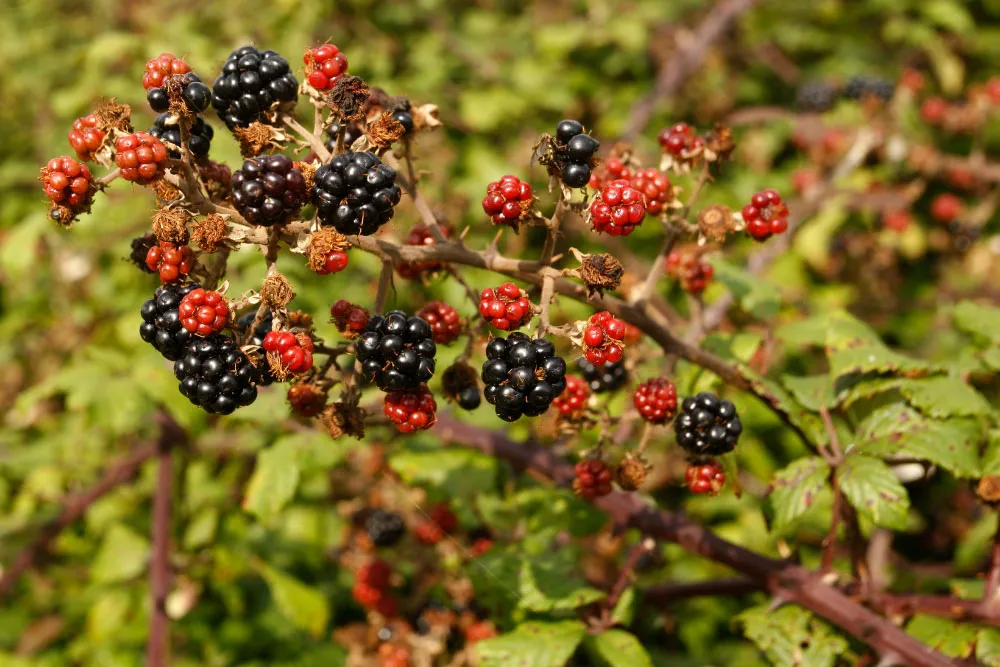
The familiar blackberry fruit grows on low-growing, thorny bramble briars which twine through hedges, woodland and gardens. In more open areas, these briars may grow into a substantial ‘patch’.
The fruits are green when unripe, changing to red and finally shiny black when fully ripe in late summer and autumn. Each fruit is made of many lobes and grows at the end of a short, thorny stem. There are more than 300 bramble species or microspecies in the UK, leading to many subtle differences in blackberry shape, size and taste.
Bramble fruits are favoured by: Blackbirds, Robins, Wrens, Blackcaps, Song Thrushes, Starlings, Chaffinches, and other thrushes, finches and warblers.
Burnet Rose
Rosa spinosissima / pimpinellifolia

The only wild rose in the UK to produce black rosehips, Burnet Rose (also known as Scotch Rose) grows mainly on sea cliffs, in dunes and in other coastal habitats. In northern England and parts of Scotland, it can be found inland in heathland and limestone areas.
Burnet Rose hips are the size and shape of a large blueberry, and can be matt or glossy black. They grow singly on the plant, which has very spiny stems.
Rose-hips are favoured by: Song Thrushes, Fieldfares, Redwings, Blackbirds and Greenfinches.
Can be dangerous to humans: seeds inside the hip can cause itchiness, nausea and vomiting.
Buckthorn
Rhamnus cathartica

Buckthorn, also known as Purging Buckthorn, is a deciduous native hedgerow plant, most common in England and Wales. Its slightly glossy leaves have serrated edges and are widest near the base. They also have distinctive veins that curve in parallel with the leaf edge.
The small berries are green at first, ripening to a shiny black in autumn. Each berry grows on its own stalk, and berries are arranged in whorls around and along the spiny branches. This helps to distinguish Buckthorn from Elder and Dogwood, which have clusters of black fruit at the end of branches.
Buckthorn berries are favoured by: Song Thrushes, Mistle Thrushes, Fieldfares, Blackbirds, and Waxwings.
Dangerous to humans: can cause stomach cramping and may have a laxative effect.
Dogwood
Cornus sanguinea

The native Dogwood is a common deciduous shrub on chalky soil, especially in southern England, and grows in hedgerows, woodland edges and sometimes in gardens. It has large, oval leaves that are widest in the middle.
Its fruits are small and purplish-black, and grow on stalks in clusters at the end of twigs, so it can be confused with Elder. However, Dogwood fruits are less shiny, and the leaves are oval-shaped instead of being divided into leaflets. Dogwood also has distinctive bare red twigs in winter.
Dogwood fruits are favoured by: Fieldfares, Redwings, Blackbirds, Starlings and sometimes Robins.
Dangerous to humans: can cause vomiting and nausea.
Elder
Sambucus nigra

Elder is a small native tree, common in hedgerows, woodland edges and gardens. The leaves are distinctive: they are made up of 5–7 leaflets and smell unpleasant when they are bruised.
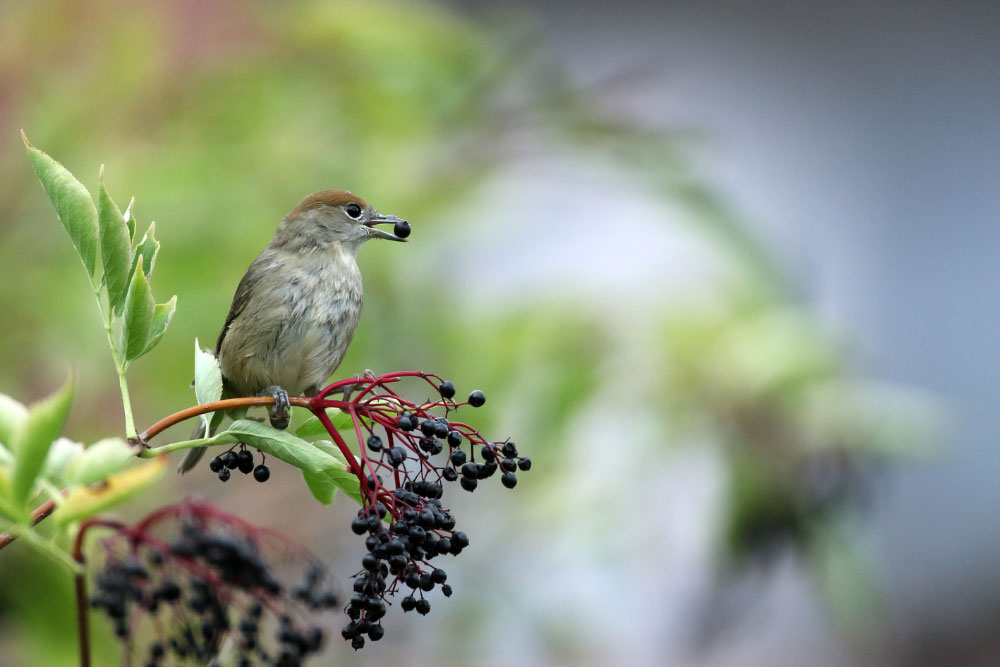
Its tiny purple-black berries ripen in late summer and grow on an umbrella-like cluster of reddish stems. The stems of these clusters are more branched than those of Dogwood, and the berries are much shinier.
Because the berries ripen at the start of the fruiting season when many birds are preparing to migrate south for the winter, they are an important fuel source for many of the UK’s summer bird species, like Blackcaps and Lesser Whitethroats.
Elderberries are favoured by: Sylvia warblers (e.g. Garden Warblers, Whitethroats and Blackcaps), Blackbirds, thrushes and Starlings.
Ivy
Hedera helix

Ivy is a well-known evergreen climbing plant, very common in gardens, hedgerows and woodlands. Leaves of mature ivy plants (those that are old enough to bear fruit) are glossy green and slightly heart-shaped.
Ivy berries have a distinctive flat-topped shape and grow in closely-packed clusters. They are initially green but turn a dull, brownish black as they ripen. Ivy berries are often one of the last available food sources in mid winter and early spring, making them a vital source of energy and nutrients for birds.
Ivy berries are favoured by: Robins, Blackbirds, Song Thrushes, Mistle Thrushes, Redwings, Starlings, Woodpigeons, Waxwings and wintering Blackcaps.
Dangerous to humans: can cause nausea and vomiting, possibly convulsions in large amounts.
Wild Privet
Ligustrum vulgare
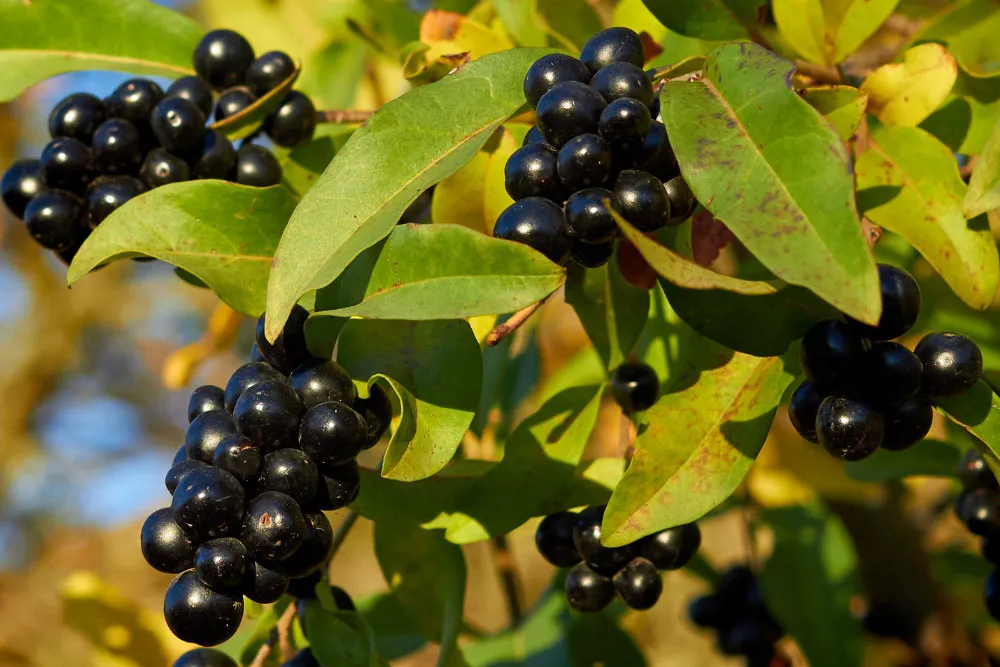
Wild Privet is a native shrub which is commonly grown as a heavily clipped hedging plant in gardens. It grows wild in woodlands and on banks. Its small leaves often remain all year round, although they may fall in very cold weather.
The fruits are small and black, ripening in autumn and winter, and they grow in pyramidal clusters on thornless branches. This helps to distinguish Privet fruits from those of Dogwood and Elder, which grow in umbrella-shaped clusters. The fruits are not poisonous to birds, but seem to be less appealing than many other food sources – in milder winters, the fruits may remain uneaten on the plant until early spring.
Wild Privet berries are favoured by: Blackbirds, Robins and sometimes Waxwings.
Dangerous to humans: can cause nausea and vomiting; in larger quantities, can cause neurological symptoms and death.
Black | Red | Orange | Blue | White
Red fruits and berries
Like black fruits, red fruits also contain high concentrations of anthocyanins – a group of purple, blue, red and black pigments with beneficial antioxidant properties. There are more red wild fruits in the UK than any other colour, and most of them are eaten by a range of bird species for their energy and nutrient content.
Cotoneaster
Various Cotoneaster species
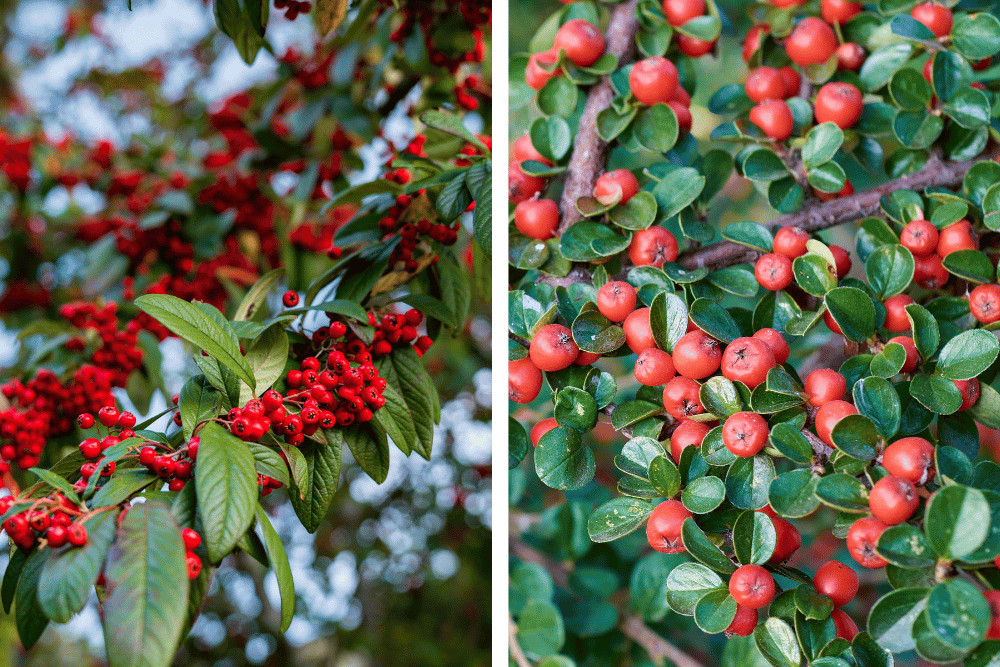
Cotoneaster species are non-native shrubs and small trees, commonly grown in gardens and with an increasing number of ‘escapes’ (plants that have spread from gardens into wild habitats). The size and shape of Cotoneaster leaves vary depending on the specific species, and some species are deciduous.
The fruits are small and abundant, and grow on spineless branches. They ripen to a bright, shiny red in late autumn and early winter. They are unstalked, which is a helpful ID feature that distinguishes them from hawthorn and Rowan.
Cotoneaster fruits are favoured by: Blackbirds, Blackcaps, Robins, Chaffinches, Waxwings and sometimes tits (especially Great Tits and Blue Tits).
Dangerous to humans: can cause nausea, vomiting, and diarrhoea.
Guelder-rose
Viburnum opulus

Guelder-rose is a small native deciduous shrub that favours damp soils, often in woodland or at woodland edges. In autumn, it is best identified by its wrinkly leaves, which have three ragged lobes and are slightly hairy on the underside.
Guelder-rose berries grow in long-stalked, pendulous clusters at the end of branches. They ripen in autumn, becoming slightly translucent and a bright, shiny red. Although Guelder-rose is not as abundant as other red-fruited plants like hawthorn, its fruits are popular with birds and are often eaten as soon as they are ripe.
Guelder-rose berries are favoured by: Bullfinches and Mistle Thrushes.
Dangerous to humans: can cause nausea and vomiting.
Hawthorn (May)
Crataegus monogyna and Crataegus laevigata

Common Hawthorn (C. monogyna) is a native deciduous species often used for hedging. It is found across the UK in scrub, woodland edges and open areas where it grows into a small tree. It is extremely spiny, with small, lobed leaves, which helps distinguish it from Rowan and Cotoneaster. Midland Hawthorn (C. laevigata) is very similar, but grows mainly in central and southern England.
Hawthorn fruits (sometimes called haws) ripen in autumn. They grow on stalks, clustered along the branches, and are bright red, although they age to a duller, browner colour. In some years, there can be so many fruits that hawthorn trees appear red from a distance. Because of their abundance, haws are a vital source of food during the winter months for many bird species.
Hawthorn fruits are favoured by: Mistle Thrushes, Song Thrushes, Fieldfares, Blackbirds, Redwings, Bullfinches, Robins, and sometimes Starlings and Hawfinches.
Dangerous to humans: can cause nausea and vomiting.
Holly
Ilex aquifolium

Holly is a well-known, native evergreen tree. It is common in gardens and grows in hedgerows and woodland, often in the darkest areas where few other fruiting trees can thrive. It has hard, shiny, dark green leaves, which are usually (but not always) extremely prickly.
Holly berries are small and red, and held in bunches close to the stem. They ripen in autumn and, if not eaten, often remain on the tree until early spring. This makes them a significant food source in late winter, when other fruits have often been eaten.
Holly berries are one of the favourite winter foods for Mistle Thrushes, which are known for aggressively defending ‘their’ fruit tree against other birds to preserve the food source for longer.
Hollyberries are favoured by: Song Thrushes, Mistle Thrushes, Redwings, Fieldfares, Blackbirds, Blackcaps and Woodpigeons.
Dangerous to humans: can cause nausea and vomiting.
Honeysuckle (Woodbine)
Lonicera periclymenum

A scented native climber, Honeysuckle twines through scrub and hedgerows, and grows as a straggling plant in woodland. It is usually deciduous. Many cultivars (cultivated varieties) and non-native honeysuckle species are also grown in gardens, some of which keep their leaves in mild winters.
Honeysuckle berries grow in small, distinctive clusters at the end of stems, and are red and sticky. They ripen in late summer, making them a valuable source of food when other fruits are less abundant.
Honeysuckle berries are favoured by: Blackbirds, Robins, Blackcaps, and sometimes other warblers.
Dangerous to humans: causes gastric issues, possibly heart problems in larger amounts.
Roses
Various Rosa species
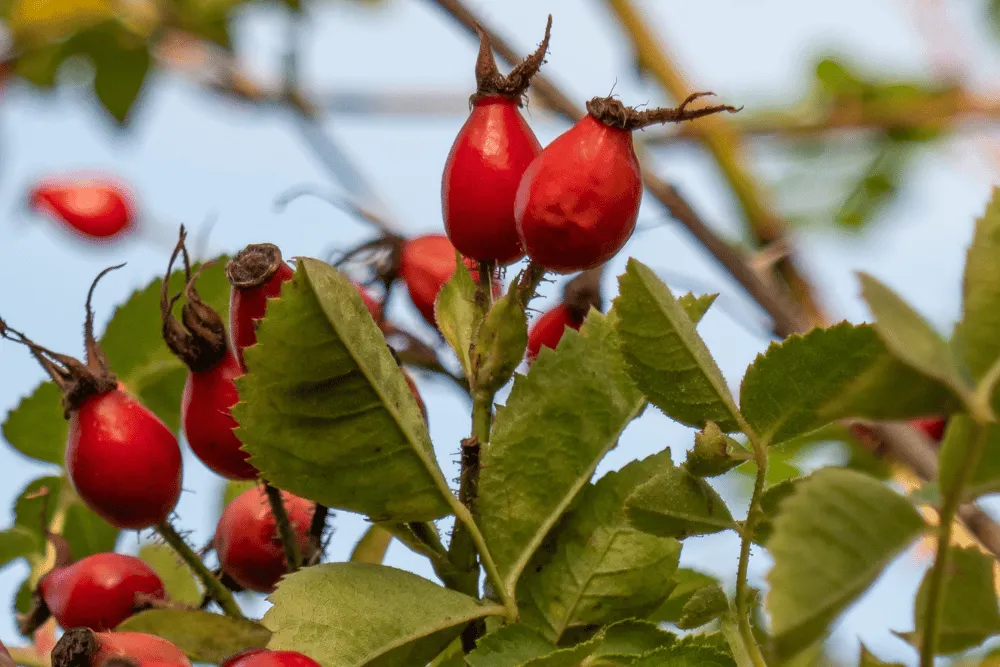
There are many species of native wild roses in the UK, including Dog-rose, Sweet-briar, and Burnet Rose. Rose fruits are called hips, and start to develop as soon as the rose bloom has been pollinated, growing on spiny or thorned stems. Most rose hips are red, although Burnet Rose produces purplish-black hips. Depending on the species, hips can grow in bunches or singly, and can be round, pointed, or slightly flattened. The invasive Japanese Rose is particularly noticeable in late summer due to its large, bright red, abundant hips.
Rose-hips are favoured by: Song Thrushes, Fieldfares, Redwings, Blackbirds and Greenfinches.
Can be dangerous to humans: seeds inside the hip can cause itchiness, nausea and vomiting.
Rowan (Mountain Ash)
Sorbus aucuparia

Rowan, also known as Mountain Ash, is a slender, thornless deciduous tree. It is most common in upland deciduous woodland, rocky river gorges and hillsides, and open heaths, although it also grows in open lowland woodlands, hedgerows and gardens. At higher altitudes, it can be much shorter than those growing in more sheltered positions. Rowan has large leaves that are divided into many small, slender leaflets, which helps to distinguish it from hawthorn and Cotoneaster.
Rowan fruits grow in heavy clusters at the end of branches and ripen to a bright red in autumn (although some species grown in ornamental settings have orange or even yellow fruits). Like hawthorn, Rowan is a major food source for migrating birds and winter residents.
Rowan fruits are favoured by: Mistle Thrushes, Fieldfares, Blackbirds, Waxwings, Starlings and sometimes Robins and finches.
Can be dangerous to humans: can cause nausea and vomiting.
Whitebeams and other Sorbus species
Various Sorbus species

The genus Sorbus includes Rowan (S. aucuparia), Wild Service-tree (S. torminalis) and Whitebeams such as Rock Whitebeam (S. rupicola) – but there are actually 43 native Sorbus species in the UK, many of which are extremely tricky to distinguish from each other.
Sorbus leaves can be highly divided, like Rowan, or oval and furry, like Rock Whitebeam. Most have scarlet or brownish berries, which are popular with birds when ripe, although they can be extremely bitter.
In addition to the native species, many non-native Sorbus are grown as ornamental trees. These often have orange or yellow berries, which are also popular with birds.
Whitebeam fruits are favoured by: Blackbirds, Redwings and sometimes Mistle and Song Thrushes, and finches.
Can be dangerous to humans: can cause nausea and vomiting.
Yew
Taxus baccata

Yew is a large, evergreen tree with glossy, dark green, needle-like leaves. It is well-known as a churchyard tree, but grows naturally in ancient woodlands on chalky soils in southern Britain.
Yew fruits are pale red and fleshy, and grow singly or in small clusters across the tree. They contain a single dark seed which is visible at either ‘end’ of the fruit. The fleshy part of the fruit is edible, but the seeds contain the toxic alkaloid taxine and are extremely poisonous to birds and to humans. They pass undigested through birds’ guts because of their tough, waxy coating, which makes yew fruits safe for birds to eat.
Yewberries have various folk names across the UK, including Snotty Gogs and Snottleberries.
Yew fruits are favoured by: Mistle Thrushes, Song Thrushes, Blackbirds, Starlings, and sometimes Waxwings, Greenfinches and Hawfinches.
Dangerous to humans: even a few fruits containing the seeds can cause death.
Black | Red | Orange | Blue | White
Orange fruits and berries
Few native plant species in the UK have orange fruits or berries. Pyracantha – a familiar shrub with orange berries that Blackbirds love – is actually a non-native ornamental plant, and in urban and suburban areas is encountered more often than other orange-fruited species like Sea-buckthorn and Spindle.
Pyracantha (Firethorn)
Various Pyracantha species and cultivars

Pyracantha or Firethorn is a popular evergreen garden shrub which occasionally ‘escapes’ into the wild. It is common in hedges and urban areas.
Pyracantha has long, sharp thorns and small, oval green leaves. In late autumn and winter, it becomes absolutely covered with small, long-stemmed berries. Many cultivars (cultivated varieties) grown in gardens were developed from Pyracantha angustifolia, which has orange berries, although some cultivars developed from Pyracantha coccinea have reddish berries. Because of the abundance of berries on a single plant, Pyracantha is an extremely attractive food source for birds.
Pyracantha is favoured by: Blackbirds, Robins and Waxwings.
Can be dangerous to humans: thorns cause painful, swollen and itchy wounds, and the fruits can cause nausea and vomiting.
Sea-buckthorn
Hippophae rhamnoides

Sea-buckthorn is a native shrub that grows on sand dunes along the east coast of England. It is also a popular species in urban developments by the sea because of its high salt-spray tolerance. In some areas, it has become invasive.
It has narrow, grey-green leaves, which make the shrub appear silvery from a distance, and thorny, arching stems. Sea-buckthorn berries are pale to bright orange and ripen in late autumn, growing in tight clusters along the branches. They provide an abundant food source for migratory birds arriving along the UK’s eastern coastline after crossing the North Sea.
Sea Buckthorn berries are favoured by: Waxwings, Redwings, Fieldfares, Blackbirds, and Jackdaws.
Spindle
Euonymus europaeus

Spindle is a small native tree common in hedges and woodlands on chalky soil, especially in southern Britain. It has oval, slightly pointed green leaves which turn bright orange before falling in autumn.
Spindle fruits are very distinctive: each fruit is made up of a bright pink, four-part capsule that contains bright orange berries. The appeal of Spindle fruits varies between bird species and is affected by the availability of other foods.
Spindle fruits are favoured by: Song Thrushes, Blackbirds, Robins, and tits (especially Great Tits and Blue Tits).
Dangerous to humans: can cause vomiting and diarrhoea; in large quantities, can cause death.
Black | Red | Orange | Blue | White
Blue fruits and berries
Blue fruits such as Sloes (the fruits of Blackthorn) and Bilberries (wild blueberries) actually have dark red and purple anthocyanin pigments in their skin – the same pigments that make fruits such as Elderberries appear black, or Rowan fruits appear red. So why do Sloes and Bilberries appear blue?
The skin of these fruits is covered in a very thin wax layer comprised of randomly arranged crystal structures. These crystals scatter blue light and UV light, which makes them appear blue to humans (who can see the blue light) and to birds (which can see UV light). Studies have shown that birds preferentially select UV-refracting fruits, which suggests that birds associate the fruits’ blue appearance with high energy and nutrient content.
Bilberry
Vaccinium myrtillus

Bilberry (also known by many other names, including Blaeberry, Whinberry and Whortleberry) is a small shrubby plant that grows in heathland, moorland and woodland, usually on acidic soils. It has small, oval green leaves that often have a red or orange tinge, and turn flaming red in autumn.
Bilberry is closely related to Blueberry, and its fruits look very similar but are much smaller. They grow singly on stalks and have a deep blue or purplish skin with pink flesh inside. The fruits may be very abundant but because of their small size, they are often tricky to spot.
Bilberries are favoured by: grouse, Ptarmigans and Redwings.
Blackthorn (Sloe)
Prunus spinosa

Blackthorn is a very thorny shrub or small tree, common in hedgerows, woodland edges and scrubby areas. It has small, oval leaves and long, sharp spines at the end of stems.
Blackthorn fruits (often called Sloes) ripen in autumn and may remain on the tree until winter. They are marble-sized and slightly oval, deep blue or purple, with a distinctive white ‘bloom’. In structure, they are very similar to a small plum, containing a single ‘stone’ (seed). However, they are very bitter-tasting.
Blackthorn fruits are favoured by: Blackbirds, Fieldfares, Redwings, Mistle Thrushes, and Waxwings.
Black | Red | Orange | Blue | White
White fruits and berries
The most commonly encountered plant with white fruits in the UK is Snowberry, a non-native and sometimes invasive shrub used in gardens and for providing cover for gamebirds. Mistletoe is far less often encountered but is a firm favourite of several bird species, especially Mistle Thrush.
Mistletoe
Viscum album

Mistletoe is an obligate hemiparasitic plant, which means it requires a host tree to survive. It forms round clusters of leaves and berries on apple and poplar trees, usually in open, sunny locations. It has oval, long-stalked leaves and characteristic forked branches.
Mistletoe berries are bright white and ripen in late winter and early spring. Because the berries ripen so late in the fruiting season, they are a critical source of food for birds when other resources are scarce. Its berries are the favourite winter food source for Mistle Thrushes (and the Mistle Thrush’s namesake), which are known for aggressively defending ‘their’ fruit tree against other birds to preserve the food source for longer.
Mistletoe berries are favoured by: Mistle Thrushes, Blackcaps and Waxwings.
Dangerous to humans: can cause nausea and vomiting, heart issues and neurological issues.
Snowberry
Various Symphoricarpos species and cultivars

Snowberry is a dense, deciduous shrub commonly grown in gardens and parks. It is not native to the UK and can be invasive in some areas where it ‘escapes’ from cultivation. Its leaves are oval and have slightly wrinkled edges. It has large, white berries that grow in tight clusters in winter.
Snowberries are favoured by: Pheasants, grouse and Quail.
Dangerous to humans: can cause nausea and vomiting, and dizziness.
Find out more
- Learn more about fruit-eating behaviour in birds.
- Browse our guidance on choosing fruiting plants to attract birds to your garden.
Further information about the identification, distribution and ecology of wild fruiting plants can be found on the Botanical Society of Britain and Ireland (BSBI) website or in the Plant Atlas 2020.