Read reviews of the books we hold in the Chris Mead Library, written by our in-house experts. A selection of book reviews also features in our members’ magazine, BTO News.
Featured review
All the Birds of the World
Lynx have had a long-term project to produce an exhaustive guide to the birds of the world. It started out with the 17 volumes of the Handbook of the Birds of the World (1992–2013) which has family and species accounts for all birds. This was followed by the two volumes of the Illustrated Checklist of the Birds of the World (2014–2016). They have now published the third and final stage of this avian odyssey with this current book.

Search filters
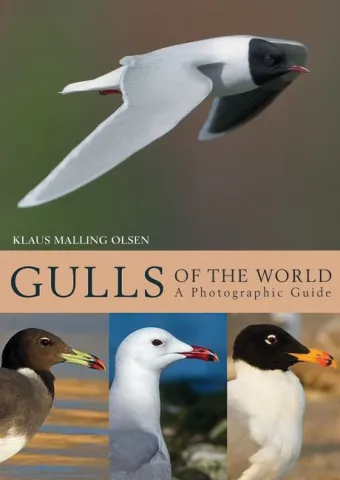
Gulls of the World: a photographic guide
Author: Klaus Malling Olsen
Publisher: Bloomsbury
Published: 2018
This book was originally reviewed by Brian Small on behalf of British Birds. The review can be read on the BB website: https://britishbirds.co.uk/article/gulls-of-the-world-a-photographic-guide/ Is there space on your shelf for another book on gulls? For any ‘gull freak’ the answer will always be ‘yes’, but for more ‘normal’ birders what does this guide offer that others have not? My most-thumbed (gull) books are Gulls of Europe, Asia & North America, by the same author and illustrated by Hans Larsson; Gulls of the Americas, by Howell & Dunn; and, of course, Gulls: a guide to identification, by Peter Grant. There are classic papers too: Lars Jonsson’s article in Alula on Yellow-legged Larus michahellis and Caspian Gulls L. cachinnansas well as his ‘fuscus’ [Lesser Black-backed Gull L. fuscus] paper in Birding World; and the BB papers by Martin Garner and David Quinn on Yellow-legged and Caspian Gulls. There are other articles, and other books; will this new addition become equally well used? In many ways it is unfair to compare this guide to the gulls of the world with those detailed papers, as they have the capacity to deal with the intricacies of gull ageing and identification that a guide of this kind cannot. Indeed, the author professes it to be a ‘companion guide’ to (his own) Gulls of Europe, Asia & North America and to offer a ‘more concise’ view of gull identification. In this respect he has succeeded; while at the same time acknowledging that the minutiae of difficult gull identification are better served by the ‘overwhelming’ plethora of images on the internet, for example at www.gull-research.org, and by detailed papers on individual species. Following a 12-page introductory section on various elements and difficulties of gull identification, the new book moves you swiftly on to the main species accounts. These vary in length according to identification difficulty and where the plumage is most complicated. There are 1–4 pages of dense text, including a map, followed by a series of photographs showing the development of the plumage through a number of age stages and some individual variation (and occasional hybrids/intergrades). There are just eight images for Dolphin Gull Leucophaeus scoresbii, but over 30 images to help us navigate the intricacies of Iceland Gull L. glaucoides, Herring Gull L. argentatus and American Herring Gull L. smithsonianus. Individual species texts deal with ‘Identification’ (which actually is a detailed description of plumages), ‘Moult notes’, ‘Geographical variation’, ‘Hybridisation’, ‘Status, habitat and distribution’, ‘Similar species’ (which has a better discussion of identification than ‘Identification’, as it compares the discussed species with others) and ‘References’. I have to admit that I find it hard to gain a true impression from the detailed written descriptions of gull plumages, especially juvenile, without photographs or artwork. Here’s a description of a juvenile gull: ‘Head and breast muddy brown, streaked or mottled, often with more solid eye-mask. Underbody whitish with greyish brown mottling or spotting along the flanks. Central belly and undertail-coverts whitish with dark markings normally restricted to fine spots or arrow shapes along sides of undertail coverts…’. It could be any one of umpteen species (it’s actually a Caspian Gull). However, as this is a ‘photographic guide’ the focus of attention is on the images. Virtually all of the images are good, well-chosen to illustrate a point and are accompanied by text. I have two comments: firstly, the annotations could have been more detailed – in many instances there is the space – and have pointed out more of the key features; secondly, I think that in quite a few cases the reproduction is a touch too dark or contrasting, with heavy shadow or very dark background. For example, in my copy I find that the mantle tone of ‘Heuglin’s Gull’ L. fuscus heugliniis a shade too dark. A simple header at the top of each page might have been a good idea too, to save you paging back and forth to find out which species you’re looking at. The taxonomy chosen, in my opinion, takes a sensible and proactive view: ‘Mew Gull’ L. (canus)brachyrhynchusis treated as separate from Common Gull, ‘Thayer’s Gull’ L. (glaucoides) thayeri (of particular personal interest) is not lumped with Iceland Gull, nor is Heuglin’s lumped with Lesser Black-backed. Distinct (sub-) species such as ‘Steppe Gull’ L. (fuscus) barabensis, ‘Azores Gull’ L. (michahellis) atlantis, etc., are described in separate accounts, with a strong series of images. I enjoyed this book (the more I use it the more I like it) and, despite a few personal misgivings about one or two elements, I am confident it will find a prominent place on my bookshelf; I am quite sure I shall go back to it time and again.
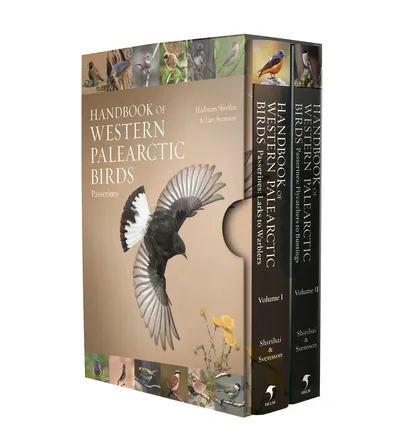
Handbook of Western Palearctic Birds: Passerines
Author: Hadoram Shirihai & Lars Svensson
Publisher: Christopher Helm, London
Published: 2021
Many ornithologists already have the multi-volume Birds of the Western Palearctic or the Concise BWP on their shelves. This new work covers almost the same ground geographically, though adding Iran and all of Arabia and following national boundaries across Africa, but it differs in concentrating on specific and racial identification, ageing and sexing. It is a massive step forward in these areas from the days of BWP, as would be expected from two of the foremost experts in these fields. Breeding and behaviour are not included: this is not a comprehensive ‘handbook’ in the tradition of Witherby and BWP. With the help of more than 5,000 superbly presented photos and 400 maps, however, we can find the very latest information on plumages, moults, calls and measurements – and how to clinch a difficult identification. The authors encourage the use of moult patterns to age birds in the field or from photographs, while the biometric information is clearly aimed more at ringers and museum workers. The photos and maps are all of very high quality and make these books fascinating to browse. Among the highlights for me are the inclusion of marginal species of which I was unaware, like Amethyst Starling, and vagrants such as Chestnut Bunting and Black-naped Monarch. A few established introductions, such as Red Avadavat, are helpfully included but not others – Red-billed Leiothrix, for example. In their ordering of families, the authors reject all recent scientific advances and revert to the work of Voous in the 1970s, on the grounds that our knowledge of avian evolution is still incomplete. This puts, for example, wagtails into the first volume and corvids into the second, which many BTO members would no longer expect. In contrast to this conservative approach, they have independently reassessed species boundaries and the divisions between races, recognising no previous authority. This a step back from the global unity of taxonomic opinion that most birdwatchers eagerly await. I will certainly be consulting this book next time I encounter a passerine I can’t confidently identify. These pages comprise all the options, along with priceless hints and caveats and are – though apparently some photos have been miscaptioned – as comprehensive and authoritative as anyone could wish. Two non-passerine volumes are planned to follow at intervals of three to four years.
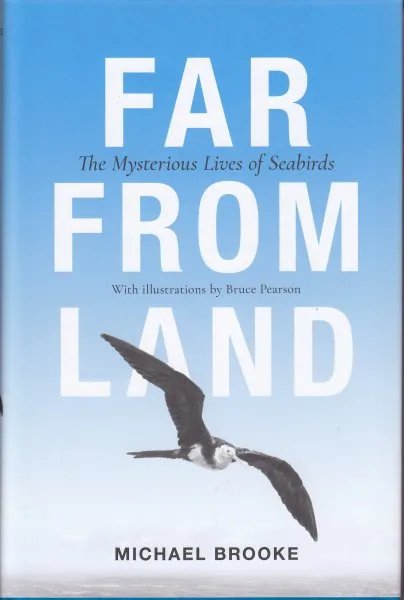
Far From Land
Author: Michael Brooke & Bruce Pearson
Publisher: Princeton University Press, Woodstock
Published: 2018
Michael Brooke’s Far From Land; the Mysterious Lives of Seabirds takes the reader on a magical tour of every ocean and some of the remotest locations on the planet through the lives of seabirds. Michael Brooke’s passion for seabirds shines through from every page of this book. As a seabird biologist, he has spent his career studying this enigmatic group of birds. Out of necessity, his, and many other seabird researchers’, studies have mostly been conducted on land, leaving large gaps in our knowledge about where seabirds go when they leave our shores, how they migrate, how they cope with inclement weather conditions at sea, how they locate their food and so on. Over the past 20 years, these questions, and many more, have started to be answered thanks to modern electronic tracking devices; in this book, Brooke reveals what these emerging technologies have uncovered about the lives of seabirds when at sea. The book starts by introducing the reader to the seabird families of the world as well as to the various electronic devices that have provided so much previously unobtainable information. The book then charts the progression of seabirds from fledging, through immaturity to adulthood, revealing what we now know, thanks to electronic devices, about their wanderings as unencumbered juveniles, their migrations as adult birds, the restrictions placed on them when breeding, their abilities to flourish in (what we would consider to be) inhospitable oceanic conditions and their various feeding strategies. The final chapter looks at interactions between humans and birds, historically, currently and into the future. The book contains a series of colour plates along with black and white photographs. Each chapter is also beautifully illustrated by Bruce Pearson, the renowned wildlife artist. Stunning as the photographs and drawings are, I did occasionally find myself wishing for a splash of colour to truly appreciate the beauty of the Red-necked Phalarope or the absurdity of Red-footed Booby feet. Throughout, the text is personalised by the inclusion of anecdotes from Brooke’s days spent researching seabirds as well as occasional, sometimes random, often humorous, asides (we learn, for instance, that Finsbury Park is the London underground station used by supporters of Arsenal Football Club when heading to a home game and that Sooty Shearwaters can fly almost as quickly as Usain Bolt can run a 100m race). This book will appeal to anyone with an interest in seabirds and tracking technologies. It provides a detailed and thoroughly referenced review of the knowledge these technologies have imparted, yet is written in an easily accessible, highly readable, style. At times, it does career though numerous different species to illustrate a point, which can be a little confusing, although understandable in the context. The book is packed with fascinating discoveries and revelations – just how and why penguins leap so suddenly from the water onto an ice shelf being one of my personal favourites. What we have learned to date from these relatively new technologies is astonishing; researchers are now able to tell, remotely, where a bird is, whether it is flying or swimming, how deep it is diving, whether (and when) it is eating and so on. The potential for future discoveries as technologies advance is truly exciting and I cannot wait for the sequel to this book in 20 years’ time. I would highly recommend Far From Land to anyone with an interest in the subject.
The Ascent of Birds: How Modern Science is Revealing their Story
Author: John Reilly
Publisher: Pelagic Publishing, Exeter
Published: 2018
If, like me, you are continually perplexed by the seemingly random re-ordering of birds on the British List every year, then this is the book for you. Any list of species needs to be ordered in some way, and all modern lists try to reflect the order in which species diverged, from earliest to most recent. Until the ground-breaking work of Charles Sibley in the mid 1980’s, a relatively stable consensus had emerged based largely on anatomical and physical characteristics. Unfortunately, these turn out not to be terribly helpful, distantly related species may look similar because they occupy similar habitats, and closely related ones may diverge markedly to fill unoccupied niches. The rapid advancement in molecular techniques is now providing, in ever finer detail, a picture of the true relationships, based on genetic differences. In 27 chapters, each based around a particular bird group, this book follows these relationships and the evolutionary adaptations that have led groups to diverge in different ways. The author was a medical scientist during his working life and this shows: physiological and biochemical adaptations are well covered, ecological ones perhaps a little less so. Although he doesn’t shy away from details (concentration is required in one or two places), the writing is engaging and the story never less than fascinating, so I found it hard to put down. Is this the last word on the topic? Undoubtedly not. Two initiatives: the Birds 10,000 Genomes (B10K, https://10k.genomics.cn) and the just launched OpenWings (blog.openwings.org) projects aim to sequence all or part of the genomes of every bird species in the same manner over the next few years; more surprises undoubtedly await. In the meantime though, this ranks among the best popular science books and provides a great guide to our current understanding of where, and how, birds evolved.
Flight Lines: Tracking the wonders of bird migration
Author: Mike Toms
Publisher: British Trust for Ornithology
Published: 2017
This book, a joint project between BTO and the Society of Wildlife Artists (SWLA), explores Afro-Palaearctic migration in a unique and engaging way. Compiling BTO data and using a series of artworks and photographs to beautifully illustrate, it provides a fascinating insight into all aspects of the journeys of migrant birds from Europe to Africa and back again. Whilst being in depth and detailed, the content is clear and easy to understand, making this BTO research accessible to a wider audience. It covers a wide range of factors that influence migration; from food availability and climate change, to land use and hunting, as well as the challenges that the birds face along the way. The more I read, the more in awe I became of what our migratory birds achieve year on year. Whilst the science in this book is incredibly interesting and enlightening, it is the art that brings it to life. The range of unique artistic styles, with a variety of media from watercolour sketches to screen prints, all beautifully capture the character of the migrant birds and their journeys. Depicting the birds, their habitats and the researchers at work, the artwork really aids in the communication of the science. Art and science go hand in hand, and this book is a perfect example. It helps in the understanding of this ecological research, creating a personal connection and allowing more people to engage with it. Something that the book is perhaps lacking, which would further help in the understanding of the text, are maps to illustrate the migration routes described, reinforcing the information. This book also illustrates how BTO’s work is helping to improve our understanding of this feat of nature, highlighting the importance of the variety of methods of data collection that the BTO draws on. Data from BTO research, other research projects across Europe and Africa, tracking devices, bird ringing, citizen science projects like BirdTrack, and BTO volunteer surveys like the Nest Record Scheme and Common Birds Census, are compiled to build an overall picture of Afro-Palaearctic migration and all of its complexities. Hence it is clear just how important this work is to inform conservation decisions on a continental scale. Whilst making it clear that there are many barriers to conserving our migrants, this book also instils hope for the future, describing opportunities for further research and potential solutions. This book is an excellent, engaging read for anyone wishing to find out more about our summer migrants and the work of BTO, seamlessly bringing together art and science.
Farming and Birds
Author: Ian Newton
Publisher: William Collins, London
Published: 2017
Land-use in rural Britain has experienced many changes over the centuries but since 1950 it has undergone an astonishingly rapid and virtually universal transformation. The management of arable crops and grassland is utterly different to 80 years ago and yields have massively increased. Key drivers of this ‘agricultural revolution’ include supremely efficient mechanisation and huge reliance on agrochemicals. Over this period, populations of birds and other wildlife on farmland have fallen dramatically – a familiar story to many readers of BTO News. This book is a masterly and wide-ranging account of the consequences for bird populations of these recent shifts in British farming practices. Ian Newton’s perspective on one of the greatest environmental issues of modern times is especially valuable, having personally researched birds throughout the decades when agricultural intensification was at its height. He is careful not to blame the farmers who have essentially been implementing government policy. Nonetheless, the point is made that virtually all aspects of the numerous and complex changes that have occurred in lowland agriculture have been harmful to wild plants and animals. It has proved difficult to disentangle the ecological effects of one particular change from another – for example to determine the relative effects of increasing use of pesticides, the simplification of crop rotations and the shift to autumn sowing. Despite these technical challenges, the evidence is overwhelming that the declines in birds and other wildlife have been driven predominantly by the intensification of lowland agriculture. Put simply, ever more production has been squeezed out of the land, leaving dwindling opportunities and resources for wildlife. The situation differs in the uplands where hill farming does not rely on agrochemicals but grazing pressure, mainly by sheep, has large impacts on vegetation and habitat quality for birds. Although farming practices have fundamentally driven most of the observed declines in farmland wildlife, predation by increasing numbers of corvids and mammalian predators, has probably increased in importance, especially for ground-nesting birds, and may now inhibit recovery of some species. The colossal amount of research on the environmental impacts of agriculture and on approaches to softening these impacts is synthesised in an accessible way, with helpful conclusions throughout. Several chapters make it abundantly clear how land management has influenced huge declines in food for birds, especially invertebrates and seeds. However, one chapter above all others makes a sobering read – chapter 8 lays out the full implications of the ongoing massive reliance on pesticides, bringing the issue right up to date with a discussion of neonicotinoids. Two chapters are devoted to agri-environment schemes which have delivered some positive outcomes, as have local conservation initiatives, but the declines have continued and much of the countryside still supports a diminished wildlife. The restoration challenges are immense and essentially are ones of scale. This book should become a classic account of how land-use policy can have profound and rapid effects on the other species with which we share the land. It deserves to be widely read, including, one hopes, by the policy makers of the future.
Curlew Calling: an Anthology of Poetry, Nature Writing and Images in Celebration of Curlew
Author: Karen Lloyd
Publisher: Numenius Press
Published: 2017
Mark Cocker points out in his foreword to this thought-provoking anthology the significance of biodiversity loss for our cultural heritage. Birds in particular have long been embodied in the arts; Vaughan Williams, Shakespeare and Yeats have all drawn on avian inspiration. Curlew Calling brings together poetry, prose and artwork to highlight not only the plight of these waders but also to remind us of their contribution to our lives. This iconic bird is etched into our personal histories, for many its arrival heralds the seasons, and is an indication of the health of the countryside. Given the decline of these instantly recognisable birds, many of the pieces in the anthology are quite sobering, lamenting their loss. In particular, the poems ‘Real’ and ‘Shropshire Curlew’ are almost chilling in charting the disappearance of the birds, and the very real prospect of the once familiar call being unknown to future generations. The prose extracts often describe people’s own Curlew experiences, lending a personal touch to the anthology, and highlight the bird’s evocative capacity perfectly summed up in the piece ‘The Power of Curlews’. The artworks by members of the Society of Wildlife Artists are charming additions to the anthology, complementing the writings well, showcasing an array of compositions and media. The common theme throughout the work is the threat to these birds; even if not explicit in a particular excerpt, one cannot help but read each against this backdrop. This lends quite a haunting feel to the whole collection, which seems appropriate for work pertaining to a bird itself often described as ghostly. However, an underlying message percolating through the anthology is that of hope; although these and other birds emblematic of our countryside are in peril, it is not too late. Vital research into the causes and prevention of further declines is being carried out, to which sales of this book directly contribute. This anthology would be a wonderful addition to the shelves of not only birders, but anyone with an interest in conservation or natural history. By dipping into this collection of work, the reader can conjure up an image or revisit a memory of this icon of our landscape; an icon which we must ensure is not consigned to the history books.
Australian Bird Guide
Author: Peter Menkhorst, Danny Rogers, Rohan Clarke, Jeff Davies, Peter Marsack & Kim Franklin
Publisher: Christopher Helm, London
Published: 2017
I was fortunate recently to visit Australia with my family. When a Brisbane-based friend heard we were coming over he advised me to wait before buying a new field guide, as this one was due to be published. This was excellent advice as the new ABG – nine years in the making - is a first-rate field guide, one of the best I’ve seen. The ABG includes all extant species from Australia, including the offshore political dependencies (but not the Australian Antarctic Territory), totalling about 930 species and containing many recent taxonomic changes (following the IOC checklist). About 160 vagrants are covered in great detail which, although perhaps less valuable for a visiting Brit, will be welcomed by keen Australian birders. Inevitably, a substantial chunk of the book is dedicated to pelagic seabirds, crucial given the importance of this group in Australian waters. There is an extensive introduction with some good notes on ‘Birding in Australia’, including tips on ‘ethical birding’; a well-balanced discussion on fieldcraft techniques such as playback in the modern era. There is also an interesting essay on the evolution and classification of Australian birds. The text is well-written and extensive and the artwork ranges from good to excellent. To be honest, I seldom referred to the identification notes in the text as the paintings were clear, realistic and helpfully annotated. The most useful text element for a visitor is actually the short section under ‘notes’ mentioning habitat and behaviour; indeed a little more along these lines would have been welcome. Distribution maps are also important when visiting a county. To the extent I could assess it, these seemed mostly very good, a nice feature being differential shading to show subspecies. One minor issue that could be fixed is where, occasionally, two species are shown per map where they have small and non-overlapping ranges; these can be confusing when the map legend lists an eastern species before a western counterpart rather than vice versa (e.g. White-lined / Kimberley Honeyeater). The maps are clearly up to the minute (showing some recent discoveries of Night Parrot). The only time I found them wanting was when I found a Dusky Moorhen in Kakadu where it is not mapped as occurring, although online resources suggest this wasn’t an especially unusual find there. Should you buy this book if you’ve already got an Australian field guide? Yes, I’d suggest it would be a shame not to. The only (inevitable) downside is its size; it’s a big beast of a book so if you’re planning to do long hikes then maybe go for a smaller guide (or maybe an app version might follow?) Otherwise, it’s worth the extra sweating! Highly recommended.

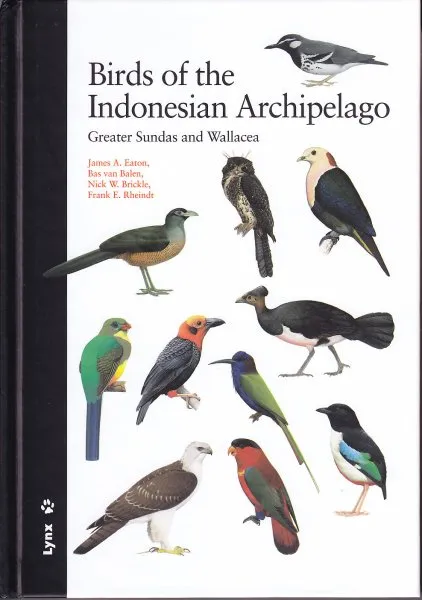
Birds of the Indonesian Archipelago: Greater Sundas and Wallacea
Author: James A Eaton, Bas van Balen, Nick W Brickle & Frank E Rheindt
Publisher: Lynx Edicions, Barcelona
Published: 2016
I visited Sumatra last year, armed with a fairly dated “A field guide to the birds of Borneo, Sumatra, Java and Bali” by MacKinnon and Phillipps, and although I did get by with this guide, I felt an improvement was urgently needed. I was therefore delighted to see this latest offering, Birds of the Indonesian Archipelago: Greater Sundas and Wallacea which is a landmark modern and easy to use publication, birds of this incredibly species rich region, covering all 1,417 species, including 601 endemics, known to occur across the Indonesian archipelago. This guide covers a region that spans an arc of more than 16,000 islands that stretch almost 5,000 km along the Equator, one of the most biodiverse regions on Earth. This field guide is remarkably compact considering the number of species covered, and whilst it may not easily fit in a pocket, it is certainly not too large or heavy to carry in a rucksack in the field - though I am not sure how water resistant it would be in the event of a downpour. However, the font is rather small which may be a problem for some. Anyone who has ever visited this, or indeed any rainforest region will understand the frustration in trying to identify birds from field guides; the plates full of side-on profiles of birds, whereas for the majority, all you see of them is their belly and undertail as you crane your neck to look up into the canopy, I felt a book just showing this angle would be more useful! Joking aside, the plates are superb throughout, with a list of 27 esteemed and highly talented artists to thank including such well-known names as Richard Allen, Hilary Burn, Alan Harris and Jan Wilczur to name but a few contributing. A major plus in this book is the inclusion of distribution maps which both MacKinnon & Phillipps and Craig Robson’s Birds of Southeast Asia lacked. Even better, these maps are placed by the species allowing quick reference to confirm their presence or absence when faced with similar-looking species rather than the species plates being separate from the descriptions and having to find the relevant page and read through the distribution range to see if the area you are in was included. Without going into specific detail, the taxonomy of the species may take some getting used to, especially when trying to enter any records against existing taxonomic lists in BirdTrack or Bubo.org with various species’ names or taxonomic groups being different. Overall though, Birds of the Indonesian Archipelago: Greater Sundas and Wallacea is a superb field guide, and will become the region’s standard field guide for many years to come.