Read reviews of the books we hold in the Chris Mead Library, written by our in-house experts. A selection of book reviews also features in our members’ magazine, BTO News.
Featured review
All the Birds of the World
Lynx have had a long-term project to produce an exhaustive guide to the birds of the world. It started out with the 17 volumes of the Handbook of the Birds of the World (1992–2013) which has family and species accounts for all birds. This was followed by the two volumes of the Illustrated Checklist of the Birds of the World (2014–2016). They have now published the third and final stage of this avian odyssey with this current book.

Search settings
Goshawk Summer: A New Forest Season Unlike Any Other
Author: James Aldred
Publisher: Elliot & Thompson, London
Published: 2021
Award-winning documentary film-maker James Aldred spent the spring and summer of 2020 filming Goshawks in the New Forest, his childhood home. This book, presented in an extended diary form, catalogues the author’s time with the Goshawks and many of the Forest’s other inhabitants. The text is punchy, with short, sometimes staccato sentences and delivers a very personal take on these magnificent birds, and much else besides. The diary format means that the text jumps around a bit, presenting the reader with short accounts of other encounters – a swan on the A36, an active Buzzard nest down the slope from where he is filming – so don’t expect a developing central narrative. Having said that, this is still an interesting read, full of closely observed detail of Goshawk behaviour and the world of the wildlife film-maker. This detail reveals an intimacy, formed between the photographer and his subject, which comes across in the text and transports the reader to the hide and the unfolding drama of this Goshawk breeding attempt. This intimacy is perhaps most evident in a passage describing how the author exits the hide at the end of a filming session. Aided by a colleague who walks in below, he has to judge the sitting bird’s response and you can feel the tension growing as he plans his exit under the bird’s fierce glare. It is a wonderful moment, and one of many throughout this engaging book.

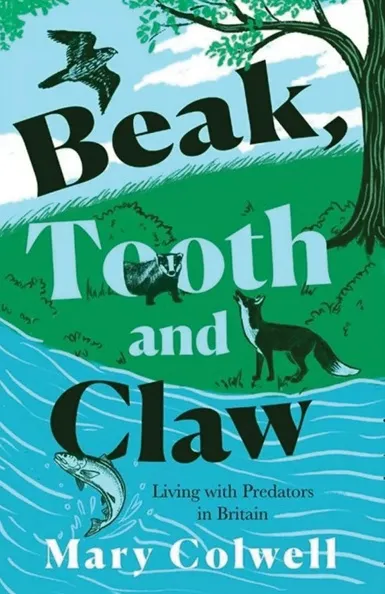
Beak, Tooth & Claw: Living with Predators in Britain
Author: Mary Colwell
Publisher: William Collins, London
Published: 2021
If you firmly believe that no fox should ever be shot or equally firmly believe that foxes should always be controlled then you may think that this is not a book for you. This is a book full of nuance. Mary Colwell explores predation by talking to people who are actively involved in land management and conservation. She encourages the reader to learn from people trying to face complex conservation challenges which don’t have simple solutions. Beak, Tooth & Claw starts with our cave-dwelling ancestors. This seems strange but it’s the only way of getting back to a time when our ancestors lived with predators – some of which could eat them – and did not have the tools to control their numbers. ‘Civilisation’ has lifted us above the animals and conferred an ability to try to be both masters and stewards of all that we survey. As one might expect of a maker of documentaries, Mary researches her material thoroughly, by talking to witnesses and exploring the evidence that they present. Like a war correspondent, she joins a marksman attempting to deal with a fox insurgency and accompanies a gamekeeper as he checks his Larsen traps and shoots decoyed crows. There are some stranger encounters too, as with a man who has tried to live like a badger and a couple who train corvids for film roles. Alongside these interviews, she describes the recovery of the UK badger population and the control of 3,000 Ravens in Scotland over a four-year period. It’s an interesting mix. I came out of the book feeling that we humans are the problem, as we farm intensively and leave little space for nature to function naturally, feed Red Kites in our gardens, rear an excess of pheasant poults and espouse views of individual species based on characters created by Beatrix Potter. Beak, Tooth & Claw made me question what I thought that I knew about species ranging from seals to wolves. One thing that is clear is that we need to talk more about predation and to be upfront when control is the only way to meet conservation goals. As it says in a BTO report that is quoted in the book, "A polarised and adversarial approach to our understanding of predation only serves to perpetuate the problems".
A Bird a Day
Author: Dominic Couzens
Publisher: Batsford, London
Published: 2020
This is a beautifully illustrated and very enjoyable book by well-known author and naturalist Dominic Couzens. The title says it all - the book goes through a calendar year showcasing 366 (it accounts for a Leap Year) species of birds from all across the world representing a dazzling array of birds from a similar range of habitats. Birds are featured at a relevant time of year - Snowy Owls are discussed in the depths of January, perhaps more familiar species like Great-crested Grebes and their courtship rituals feature in late March, and on the very day the book arrived I opened it to that date to find an account about the Redwing - birds I could see on the holly berries in the garden! I found this mix of the familiar and the exotic a nice touch. It’s always nice to get to know your local bird life a little better but also to think, as I sit looking out at a dark November evening, that on the other side of the world King Penguins are just settling down to breed. There are cultural references galore - the year starts discussing the mythology surrounding Red-crowned Cranes in Japan and approaching the year end the book celebrates that most festive of birds - the European Robin on Christmas Day. The illustrations are eye-catching and a really nice mix of razor sharp photos, beautiful illustrations from centuries-old books, images of nests or eggs, and even some amusing modern day references to ‘Woody Woodpecker’ (Acorn Woodpecker) and of course the Greater Roadrunner (meep meep!). It’s not all whimsical and pleasant though - modern conservation concerns are covered and dealt with, as is Man’s exploitation of birds. Just look to 9th September and the account of Ortolan Bunting. The image used says it all… Species account are short, but for me this adds to the appeal. This is a book you’ll find yourself dipping in and out of, rather than necessarily sitting down and reading. As such it is a perfect book to have close to hand somewhere about the house, so you could grab it and find out about the current day’s bird and almost certainly be drawn into a couple of other accounts. This is a book that will appeal to birders and non-birders alike, and I’ve really enjoyed leafing through it, getting to know a little bit more about birds from sub-Saharan Africa, soaring over high Andean peaks, or lurking in the bottom of the garden. I’m hoping I’ll find this in my stocking on Christmas (or European Robin?) Day.

Farming with Nature: Promoting Biodiversity Across Europe Through Partridge Conservation
Author: Jen Brewin, Francis Buner & Julie Ewald
Publisher: Game & Wildlife Conservation Trust, Fordingbridge
Published: 2020
This book sets out an approach for successfully combining a viable farming business with increasing biodiversity and other public goods. It draws on scientific research and demonstration projects from across Europe and outlines habitat measures designed to benefit the Grey Partridge. The reason the Grey Partridge is the focus of this book is because it is an indicator species for a healthy farmed habitat. As such, there are several sections about other species that will benefit from the Grey Partridge conservation such as Skylarks, Harvest Mice and Butterflies, which is most relevant in modern conservation. This book is aimed for famers, habitat managers and policy makers who wish to encourage partridge conservation. Therefore, it talks a lot about case examples and how specifically to encourage this bird on the ground, such as which specific plants to grow for food and shelter in winter. Therefore, this book is perhaps less relevant for anyone who is interested in general information about partridges and their natural history. The book is full of photographs, illustrations and figures and is very short, so can be read in just an hour or two, making it a good 'go-to' book for those who don't have time to pour over endless papers. Because of this, it is a good reference book, easy to flick through to the relevant pages if you are using it to draw a habitat management plan.

Hats: a Very UNnatural History
Author: Malcolm Smith
Publisher: Michigan State University Press, Michigan
Published: 2020
The vivid plumage used on the hat on the cover of this book is a reminder of the main reason birds are featured in a book on hats. Covering the history of hats from their earliest evidence at the end of the Stone Age through the peak of the fur and feather trade to modern hat styles, this book cleverly introduces us to the consequences of extravagant tastes in materials and fashions. I picked up this book intrigued as to what facts I might glean from its pages and found myself both fascinated and horrified by the scale of the feather trade that boomed in the 'Western world' that drove many species to be hunted to extinction. I knew this had happened but reading the numbers and weights of plumage and pelts auctioned in the major cities really put things into scale and made me wonder if it might be possible to examine the former population numbers of different species back before such trades put them into endangered numbers. The chapters follow a wide set of topics to take you through this journey, from the earliest hats and the fur trade to specifics of the European and North American markets and fashions ending with 20th Century outcomes. One chapter that might have information that is new to most readers is that called 'Ladies with influence'. This recounts the usually untold histories of how woman founded both the RSPB and Audubon Society with the aim to prevent the mass persecution of birds (and mammals) for the hat trade. Modern conservation efforts are then neatly discussed in the penultimate chapter pointing out where some species have been able to revive their population numbers but that fragmentation of populations means there are still many that have a long way to go. Modern fashions and principles may mean that fewer hats are made with real plumage and furs but there is still a long way to go to recover from the historic damages done. This book is perfect for both the budding historian of either conservation ecology or fashion history, providing many insights into the conflicting natures of the fashion trade and the superiority of natural feathers and fur over artificial substitutes.

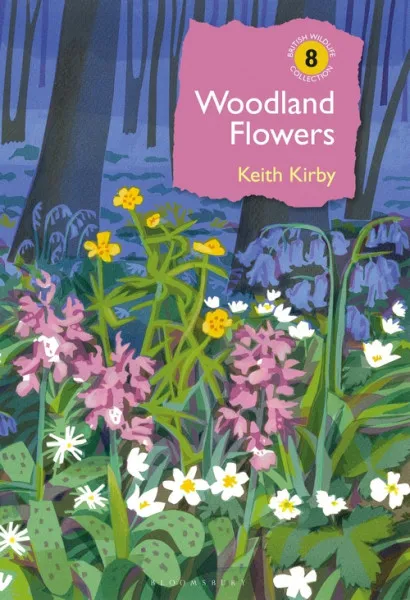
Woodland Flowers: Colourful Past, Uncertain Future
Author: Keith Kirby
Publisher: Bloomsbury, London
Published: 2020
This is a book for anyone curious about the lives of our woodland plants, and the processes and pressures that affect them. Keith Kirby’s career as a woodland ecologist gave him vast experience of woods and their conservation throughout Britain. This is the eighth title in the British Wildlife Collection series that already has a reputation for finely produced, informative, readable books. Keith Kirby’s book is a thought provoking, personal and richly illustrated contribution to it. The breadth of the book is somewhat greater than the title might imply. It is far more than a natural history of flowering plants. Although it focuses on plants of the woodland floor and climbers, there is much information about the trees themselves. Two chapters describe types of British woodland and their characteristic plants including the trees. The book is essentially a grand tour through the many ideas and issues relevant to understanding why, in Britain, we have the woods and woodland flora that we do. To give an indication of the scope, there are chapters dealing with the history of woodland botanising, past woodland management, what goes on below the ground, impacts of storms, grazing animals, the nature of primeval forests, the European context, newly created woodland, and human recreation. I liked the frequent use of concise illustrated essays focusing on a carefully selected plants that inform the reader about a particular concept or idea. Perhaps surprisingly, no single chapter is devoted to climate change though it features strongly in a chapter primarily devoted to atmospheric pollution. Keith Kirby points out that there is little evidence that the distributions of woodland plants, unlike those of birds, have started to change. Perhaps this is because the microclimates are more stable inside woodland than in more open habitats, or that many plants are relatively long-lived and have the reserves to tide them over unfavourable periods. Nonetheless, in the longer term, changes are to be expected. We could see species that are currently restricted to southern England expanding northwards, and non-native species of southern climates escaping from gardens into woodland. There is a discussion of ‘nativeness’ in an earlier chapter. Given the high probability of many introductions by humans of plants in past millennia, and the fact that garden escapes can obscure natural distributions, this topic is far more complex for plants than it is for birds. Whilst recognising that many woods have undergone damaging changes in recent decades, including the replacement of broadleaves by conifers and massive increases in grazing pressure, an optimistic outlook is adopted. Woodland flowers have fared much better than those of farmland over the last 60 years and Keith Kirby is hopeful that recent plantings will eventually give new opportunities.
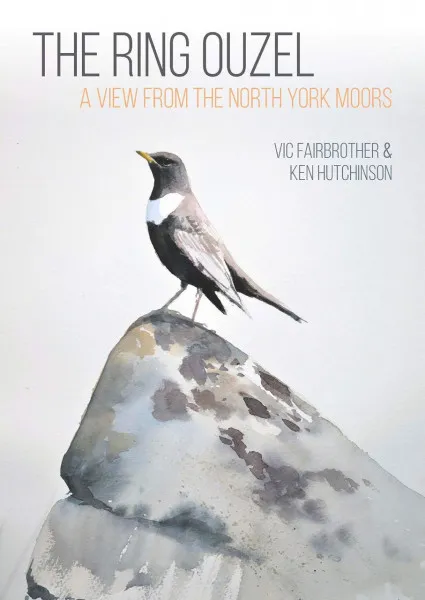
The Ring Ouzel: a View from the North York Moors
Author: Vic Fairbrother, Ken Hutchinson, Jonathan Pomroy (Illustrator) & Chris Rollie (Fwd)
Publisher: Whittles Publishing, Dunbeath
Published: 2020
In my career as a field ornithologist, I would rate one of the best projects I ever worked on as the season I spent assisting on the long-running Ring Ouzel (Turdus torquatus) monitoring project at Glen Clunie in Aberdeenshire. That project initiated my passion for the mountain blackbird and having the opportunity to spend hours among the heather and crags peering into the intricacies of Ring Ouzel life taught me so much about interpreting the behaviour of individual birds. From being a part of that project, I was able to join the Ring Ouzel Study Group; a motley band of dedicated fieldworkers and conservationists from all over the UK that meet once a year (in normal times) to talk about all things related to the moon-chested beauties, one of our least-studied Red-listed species. It was at the last group meeting that I met the authors of this new book, Vic Fairbrother and Ken Hutchinson, and since getting a taster of their remarkable fieldwork achievements in their update at the group’s meeting, I have been waiting in anticipation for their book to be published. First and foremost, The Ring Ouzel: A view from the North York Moors is a thorough compendium of two decades worth of careful field study of a single species. But it is also a love letter to the landscapes and wildlife of Yorkshire, and the authors’ affection for these shines through. The book consists of 19 chapters, starting with a general introduction to Ring Ouzels and the current knowledge base we have about their status in the UK, and a summary of the main Ring Ouzel study areas. The major focus of the book is the authors’ study site at Rosedale in the North York Moors, and each chapter is devoted to one aspect of the Ring Ouzel annual cycle. Starting with their arrival in spring from their wintering grounds, through to breeding history at particular locations through Rosedale, and their breeding behaviour through egg, chick and fledging stages, detailed descriptions of each of these life stages are compared and contrasted with what is known about Ring Ouzel ecology elsewhere using field notes and observations from the Rosedale study site. The book also includes a very interesting chapter on Ring Ouzel communication and song which will be useful for upland ecologists in an age where sound recording is becoming more commonplace. Chapters on predation and shared habitats neatly show the interactions Ring Ouzels have with other species in the moorland ecosystem. The final chapter discusses the multitude of conservation issues that Ring Ouzels face and work that is ongoing to further study and protect them. I really enjoyed the use of transcribed field notes and diary accounts throughout the text, as they allow the reader to be there in the field with the authors to experience the finding of a nest, a particular quirk of behaviour of one of the birds, or a change in the weather. If nothing else the book shows the value in taking brief but detailed notes in the field. A real highlight is the use of evocative watercolour plates of Ring Ouzels; a difficult subject to photograph, the paintings really show the subtleties of their character and behaviour, and they complement the photographs used in the book beautifully. A criticism though, is the use of website addresses in the main text. These work well as handy links to further reading and references when used in a digital format like a PDF, but in a book they are jarring, and would have been better consigned simply to a references section or as footnotes. In all this is a beautifully presented book, a treasure trove of knowledge and a great examination of Ring Ouzel ecology. It is a comprehensive endorsement of single-species studies and will be a useful touchstone for the future monitoring and conservation of one of our most vulnerable thrushes.
The Kestrel: Ecology, Behaviour and Conservation of an Open-land Predator
Author: David Costantini & Giacomo Dell'Omo
Publisher: Cambridge University Press, Cambridge
Published: 2020
The Kestrel is probably not a book for those with a passing interest in kestrels, but would be a useful addition to the library of anyone who has a keen research interest in this widespread but declining falcon. The book, published by Cambridge University Press, looks at some of the not-inconsiderable volume of research that has been published on kestrels over the past 30 years in particular, since the publication of the Poyser monograph of the same title by Andrew Village in 1990. It focusses on aspects of the ecology, behaviour, and biology of kestrels but also explores the latest research on movement and conservation. I should say too that this book does not aim to be a complete update to Village’s Monograph, which it definitely isn’t, but more of a companion piece focussing on synthesising updates on specific aspect of kestrel research. Focussing primarily on the Common Kestrel, the book also provides insights into some of the other kestrel species currently recognised, comparing and contrasting research findings, although the coverage of these other species is uneven with most reference made to the American Kestrel and Lesser Kestrel. The book itself contains a good number of maps, photographs, graphs and tables; these are all in black and white, although a small number are replicated in colour plates. The distribution maps were very difficult to read due to colour choices but that’s a small criticism. Each of the 10 chapters provides a short introduction to the subjects covered and then summarises the main findings and gaps in knowledge at the end. Chapter contents include evolution, feeding ecology, habitat use, breeding ecology, physiology, immunology, toxicology, movement ecology, conservation and population dynamics. The scope of the book can mean it is sometimes challenging to pull out information most relevant to kestrels in the UK (if that’s your interest!) as although most of the research comes from Europe, there can be large variations in the ecology of kestrels in southern Europe and those in the north or north-west, let alone in the rest of the Common Kestrels range... I don’t think this is a failing necessarily, as in a book of this length it is probably inevitable when synthesising research across so many different ecological regions, but it may be worth noting. The authors also acknowledge that many of the studies only cover quite discreet areas, but hope that the results from these studies might stimulate others to conduct similar studies in other parts of the Common Kestrel's range. If I had to find fault it would be that at times I would get to the end of a section or chapter and feel like the main conclusion was that there was no conclusion and that more work needed to be done. This is the reality of research, but I think more in the way of a discussion on some of the findings would have made some sections more absorbing. Overall this would seem like a expansive summary of published kestrel research bringing us right up to date. It might not be the most accessible book on kestrels out there, but this is not its purpose. The book does a commendable job of synthesising the latest information and providing plenty of references to follow up on if more detail is required. It should prove useful in helping identify research topics for any budding researchers out there or for anyone with a deep interest in these fantastic birds.

Pembrokeshire
Author: Jonathan Mullard
Publisher: William Collins, London
Published: 2020
Like the author, I too spent many a childhood holiday in Pembrokeshire. In those days the five hour drive from the mountains of Snowdonia to the Mediterranean-like coast of Pembrokeshire was well worth it, especially the boat trips to Caldey to see my first Grey Seals. Now in later life I visit Pembrokeshire again mainly to the coast and Islands for the bird life - little realising what other treasures the county has to offer. I am fortunate in having a number of friends in the area who never fail to remind me that there is an awful lot more to Pembrokeshire than birds. Jonathan Mullard has reinforced this and has opened my eyes to what a diverse place Pembrokeshire is. His broad knowledge of natural history and meticulous research really broadened my view of the county and when next I visit there will be a lot more to see than birds. The historical research I find fascinating, especially the islands. How the military presence has preserved so much, and how the climate differs between north and south. The diversity of the sea life, explained by the sea floor geology and tides, bought back memories of watching Jacques Cousteau, such was the readability of the book. As a regular contributor to the Pembrokeshire Bird Conference every November, I can now look forwards to discussing some of the more 'off grid' sites, as well as having a better understanding of some of the more popular sites. Anybody who visits the county ether as a birder or an all-round naturalist will find lots in this volume to educate them and a few new species and places to visit.
