As part of our Strategy’s Embracing Everyone Action Area and Becoming (More) Inclusive work, we have created a questionnaire to help us learn more about our BTO community, which is open to responses from 30th January to 8th March 2026. By finding out more about our community we hope that together we can inspire more people to take part in BTO’s work. Below you will find FAQs about this questionnaire in written or video format, a glossary of related definitions and acronyms, and the results will be updated in due course. Make sure to watch the special thank you video at the end too!
Community questionnaire
Protecting your privacy
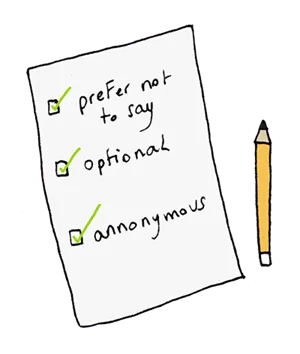
All submissions are anonymous. We are not collecting names or email addresses. We request that you avoid including information in the free text boxes that could identify any individual, including yourself.
Whilst a unique combination of answers may identify an individual, raw data will be held in line with GDPR principles and accessible to the research group only, and only the analysed results will be shared more widely (with staff, our Board of Trustees, and externally with our community and with funders).
- Please contact the Data Protection team (data.protection@bto.org) if you have any questions or concerns.
- Please contact the People team (peopleteam@bto.org) if you have any questions about the questionnaire.
FAQs
Please see our Introduction and FAQs video on YouTube if you prefer.
1. What is the purpose of the questionnaire?
For several years, we have focused on gaining a deeper understanding of our staff and volunteers, including by conducting similar questionnaires internally. This has helped us understand our work and volunteer force and how it is evolving.
We would now like a better picture of our wider BTO community. We plan to repeat this questionnaire in the coming years and see how our community is building as new people are inspired to join us. We are interested in enhancing our engagement with both new and existing audiences.
This will help us to ensure the sustainability of data collection and give as many people as possible the opportunity to interact with our work and the natural world. We believe this benefits people
and birds.
2. Why am I not receiving this questionnaire?
If you haven’t received an email from us, this is probably because you take part in Cudyll Cymru and/or GBW - thank you! Cudyll Cymru participants received this questionnaire in November 2025, and GBW participants received a similar survey in July 2025.
3. Who is conducting this work?
BTO. The key contacts at BTO are Sian Knott, Anna Dupont-Crabtree, Dawn Balmer, Ellie Leech, Callum Macgregor and Ailidh Barnes.
4. Do I have to take part?
No. Taking part is completely voluntary.
5. How long will it take to complete?
10-15 minutes.
6. How long will the questionnaire be live?
From Friday 30th January until Sunday 8th March.
7. What platform are you using?
Google Forms. Visit Google to find out more about how Google uses cookies.
8. Is there a minimum age to participate?
Due to data processing and parental consent rules, we ask that you only complete this survey if you are aged 16 years or above. This does not reflect the huge importance young people have in the BTO - we are working in lots of different ways to engage younger people. Find out more about our youth engagement work.
9. What will happen if I take part?

- You will be asked to complete the anonymous questionnaire (via a Google Form).
- Your responses will be combined with all other responses and a report of results will be produced. We look forward to sharing some headlines from this questionnaire with our community.
- We plan to repeat this questionnaire in the coming years and see how our community is building as new people are inspired to join us.
- Once you have completed the questionnaire, please watch the special message to thank you for your time and help.
10. Are there any negative consequences of taking part or not taking part?
The research team has carried out an ethics review for this study and can reasonably foresee no negative consequences. We have provided detailed information here to help you make an informed choice. We hope you will enjoy some positives from participating, we look forward to sharing some headlines from the questionnaire so you can learn more about the community you are a part of!
11. Why should I take part?
Analysis of the results will help us to understand our community better, enhance our engagement with them, and help us to inspire new people to take part in wildlife monitoring and learn more about birds. We believe a growing community is better for birds and people.
12. What kind of questions will I be asked?
The questions range from asking you about your motivations, the ways you are involved with BTO, and your knowledge and experience. We would also like to build a picture of the make-up of our community, so you will be asked about your age, gender, and other characteristics.
This will help us to understand more about our community and the opportunities to engage new people. We are hoping to get as many responses as possible as we want everyone to be a part of this journey!
13. Why are you asking about my background, identity and religion?
We're committed to creating a community where everyone feels welcomed, valued and supported. By asking about your background, identity, and religion, we can better understand who we're currently reaching and identify where we might improve our outreach and engagement efforts, whilst continuing to engage our existing audiences.
By repeating this survey in the future, we can measure the effectiveness of our outreach and engagement. We recognise that questions about identity can feel personal, and we want you to know that sharing this information is entirely optional—please only answer what you feel comfortable with. All responses are completely anonymous and will only be used to help us understand our community better.
- Find out more about how we are upholding our commitment to create a welcoming community.
14. What will happen to the information I provide?
The information you provide will be captured electronically by BTO. Only the research team will have access to the raw data. The data will be stored securely to support analysis. BTO will store the raw questionnaire results for up to seven years before deleting them.
15. How is my data protected?
BTO has carried out a Data Protection Impact Assessment to ensure the careful management of personal data. We have designed the questionnaire to be anonymous, and the data that is collected will be stored securely.
We are collecting this data under the legal basis of ‘legitimate interest’. By completing the questionnaire, you are consenting to this processing of your data and confirming that you are at least 16 years of age.
Please note that, due to the anonymous set up of the questionnaire, we do not anticipate being able to identify individual responses, so you will not be able to modify your response after submission, and we are unable to delete your response if you wish to retract it.
Only BTO will use the name and email address you have provided when registering for schemes and membership to contact you with a link to this survey and subsequent findings. See our Privacy Policy for more information.
If you have any concerns about how your personal data is being used, please contact BTO’s Data Protection Officer in the first instance (email: data.protection@bto.org). You have the right to complain to the Information Commissioner’s Office. You also have the right to an effective judicial remedy against decisions of the Information Commissioner’s Office.
Results
We will update this page in due course after the questionnaire has been completed and the results have been reviewed.
- In the meantime, you can find out more about our Strategy’s Embracing Everyone Action Area, our commitment to equity, diversity and inclusion, and our Becoming More Inclusive Framework.
Glossary
Definitions
To identify as
This is a turn of phrase some people like to use to describe their gender or sexuality. It is useful because the way someone identifies as may not be what others see them as. It allows for more nuance than just saying “I am” or asking someone “Are you...?”
Gender
This refers to a person’s innate sense of their own identity, which may or may not correspond to the sex assigned at birth. Gender identity does not necessarily represent a binary choice, some people may identify as non-binary, genderfluid etc., or agender (see below).
Non-binary
A term for people whose gender doesn’t sit comfortably with ‘man’ or ‘woman’. Non-binary identities are varied and can include people who identify with some aspects of binary identities, while others reject them entirely.
Agender
A person who does not identify with any gender and who does not have a felt sense of gender identity.
Self-describe
This gives the option for people to describe how they identify themselves.
Bisexual
This refers to someone who is attracted to more than one gender.
Asexual
This refers to complete or partial lack of sexual attraction or lack of interest in sexual activity with bothers.
Pansexual
This refers to a person who’s attraction towards others doesn’t regard sex or gender.
Disability
You’re disabled under the Equality Act 2010 if you have a physical or mental impairment that has a ‘substantial’ and ‘long-term’ negative effect on your ability to do normal daily activities.
Neurodifferences
This describes the differences among various neuro-identities (sometimes also referred to as learning difficulties or neurodivergence). While all brains are different, some people with broadly similar ways of thinking, communicating and processing information can have a sense of shared identity and experience (e.g. Autism, Dyspraxia, Dyslexia, ADHD, etc). For some people, the spark to such an identity comes through receiving a specific medical diagnosis or diagnoses.
Acronyms
BTO-related acronyms
- BBS: Breeding Bird Survey
- GBW: Garden BirdWatch
- SMP: Seabird Monitoring Programme
- WBBS: Waterways Breeding Bird Survey
- WeBS: Wetland Bird Survey
- RIN: Ringing Committee
- RNC: Regional Network Committee
- RN: Regional Network
Education-related acronyms
- GCSE: General Certificate of Secondary Education
- CSE: Certificate of Secondary Education
- BTEC: Business and Technology Education Council
- NVQ: National Vocational Qualification
- HNC: Higher National Certificate
- HND: Higher National Diploma
- PGCE: Postgraduate Certificate in Education
- PhD: Doctor of Philosophy (denotes the highest academic degree one can earn in a field of study)
Thank you!
Thank you for taking the time to read about our work and contribute to the questionnaire. Make sure to watch our special thank you video (on YouTube) from Dawn Balmer (Head of Surveys), Alicia Hayden (BTO Youth Advisory Panel Member), Peter Kirmond (Ringing Committee Member), and Juliet Vickery (CEO).