Birds and fruiting plants have a strong and often mutually beneficial relationship, with birds taking advantage of the nutritious food source and plants utilising the birds to spread their seeds. Learn about this behaviour, when it occurs, which species you’re most likely to see feeding on fruits, and which berries and fruit birds like to eat.
Also see our related content about choosing fruiting garden plants to support birds, and tips for identifying common berries and fruits found in the UK countryside.
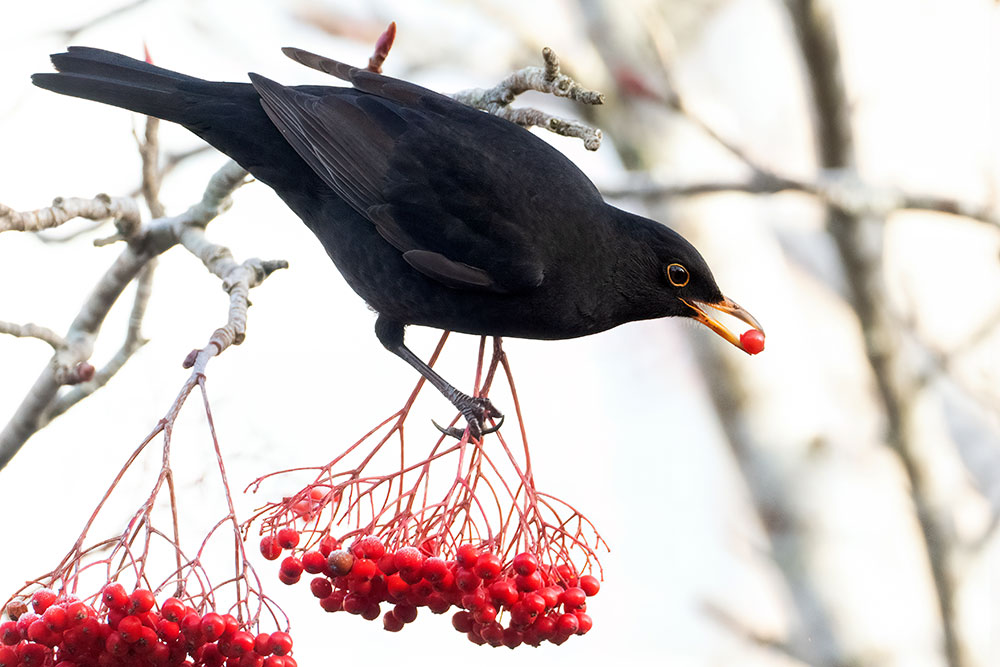
The relationship between birds and fruiting plants
The relationship between birds and fruits is an evolutionary arms race, with birds seeking the maximum nutritional benefit, and plants seeking both to attract seed-dispersing birds, and to dissuade seed-predating birds.
Timing
During late summer, autumn and winter, fruits like berries, hips and haws make up a large component of many birds’ diets. They are nutritious, high in energy, and ripen when other sources of food, like invertebrates, are less abundant. But why have plants evolved to invest resources into growing such attractive fruits, if they are simply to be eaten?
Mutual benefit
Growing fleshy fruits is one of many strategies employed by plants to ensure their seeds are dispersed over a wide area, so young plants can grow with access to enough water, light and nutrients. The fruits are an attractive source of food for birds and other wildlife, and a good source of nutrients. When a bird eats a fruit, it will also eat the fruit’s seeds. The seeds have tough external coats which protect them from digestion as they pass through the birds’ digestive tract, and are deposited elsewhere with a helping of fertiliser in the form of guano (bird poo). This interaction helps both the plant and the bird – the plant’s seeds are dispersed, and the birds get a tasty, high-energy snack.
Reward signals
Evidence suggests that birds actively select fruits with a high anthocyanin content. As well as being important pigments in ripe fruits, anthocyanins are well-known antioxidants. It seems that plants use these anthocyanin pigments as an ‘honest’ signal of the high nutritional rewards on offer. As an ‘honest’ signal, higher anthocyanin pigments really do correspond to higher nutritional value (rather than being false advertising), and birds learn to preferentially select them.
Avian cheats
It’s not always this straightforward, though. Some bird species eat only the pulp (flesh) of the fruit, and discard the seed – these are known as pulp predators. Others eat and digest the seed – these are seed predators. Some bird species will consume different parts of different types of fruits, too. Over time, plants evolve to counter these avian cheats – for example, through the incorporation of toxic compounds into the seed coat or its lining, to discourage birds from digesting the seed.
When do birds eat fruits and berries?
Different fruits become available at particular times of the year, but most ripen in late summer, autumn or winter. This makes them a valuable food source for birds because other sources of food (like invertebrates) are less abundant, especially in winter. Invertebrates living in the soil may also be inaccessible to foraging birds when the ground is frozen.
The fruiting ‘season’
In the UK, blackberries may ripen as early as August, while fruits of the Wild Service-tree do not ripen until November. Fruiting season can vary across even closely related plants. Whitebeam and Rowan are in the same genus (group) of trees as Wild Service-tree, but ripen in September and late July, respectively. Also, plants in the northerly part of their British range tend to have fruit that ripens earlier than seen in the same species further south.
Some fruits remain on the plant for several weeks or even months – perhaps because they are long-lasting, or because they are only taken after more popular fruits are exhausted. Holly has a particularly long fruiting season: the first berries become available during September, and the fruits may remain on the tree until the following July. This is partly because Holly berries are particularly durable, but Holly trees are often guarded fiercely by Mistle Thrushes, which prevents other birds from feeding on the fruits.
Feeding on fruit in winter
Because the fruiting season lasts many months, and because birds feed on fruits whenever they are available, you may see this behaviour in UK bird species throughout much of the year. However, it is usually most noticeable in the colder months.
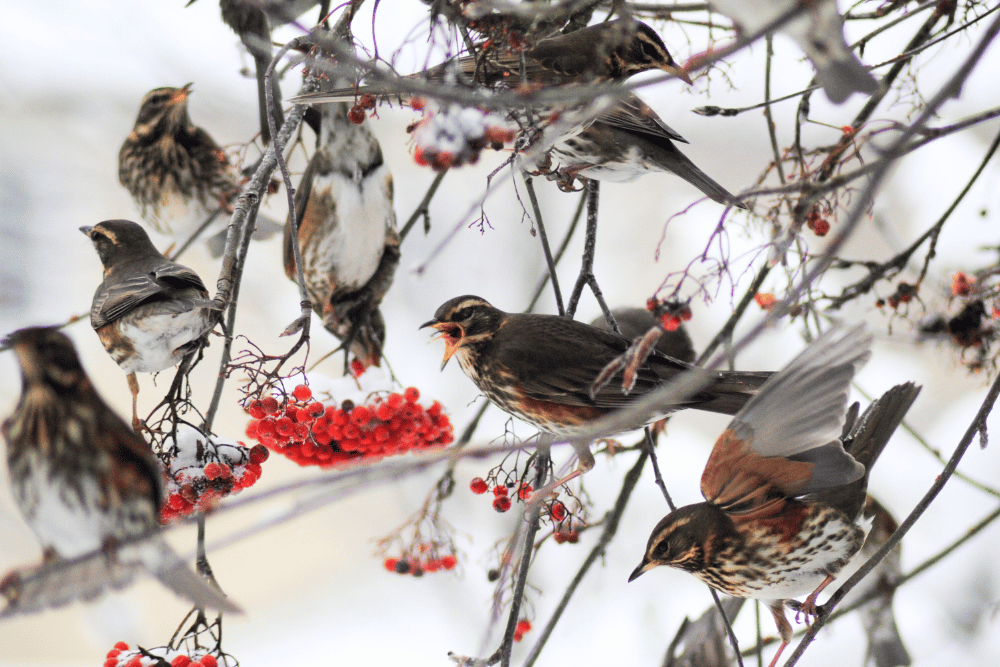
Fruits are often the most abundant and accessible food source in winter, meaning that the foraging birds you see will be focusing on fruits (instead of spreading their attention across several different food sources). Large flocks of birds – especially migrating thrushes – tend to gather in hedgerows, fruiting trees and scrub to feed on fruits too, which makes the behaviour particularly visible.
Which birds feed on fruits and berries?
Many UK bird species feed on fruits, especially woodland and hedgerow birds. Woodpigeons, Blackcaps and Starlings are frequent fruit-feeders, as are Waxwings and members of the thrush family: Blackbirds, Fieldfares, Redwings, Mistle Thrushes or Song Thrushes.
Woodpigeon
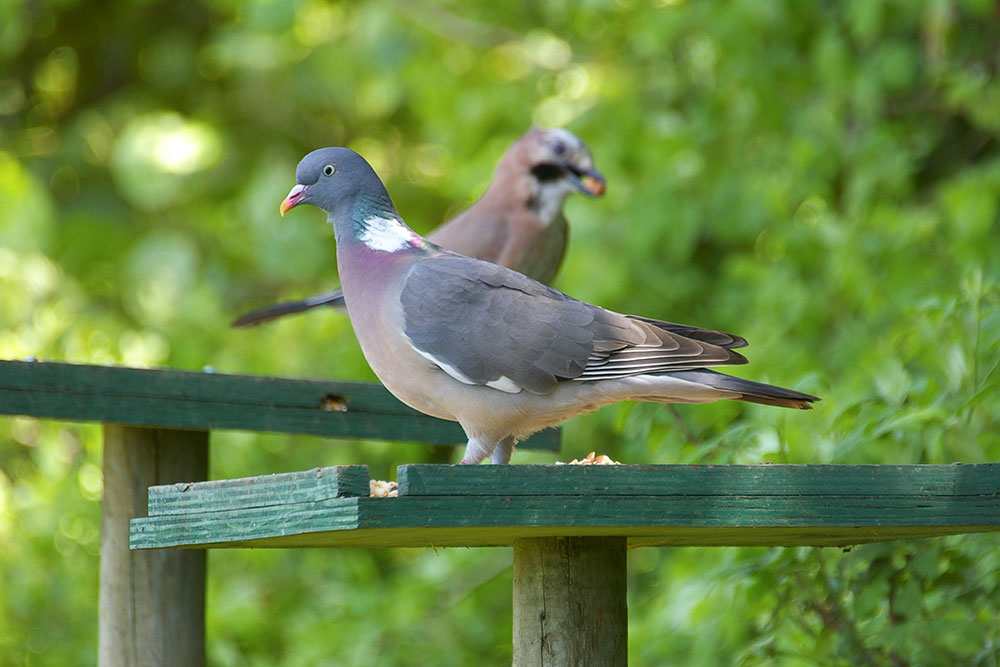 Woodpigeons are large birds, with peachy chests, warm brown-grey wings and a grey head. Adult birds have a distinctive neck patch of iridescent green and white, which is absent in juveniles.
Woodpigeons are much bigger than Feral Pigeons, Collared Doves and Stock Doves, and when walking on the ground, they appear heavy and lumbering. However, they are surprisingly agile and will often hang upside down on branches to reach berries and fruit! Woodpigeons are common visitors to gardens, and are also frequent in hedgerows, arable fields and woodland areas.
Blackcap
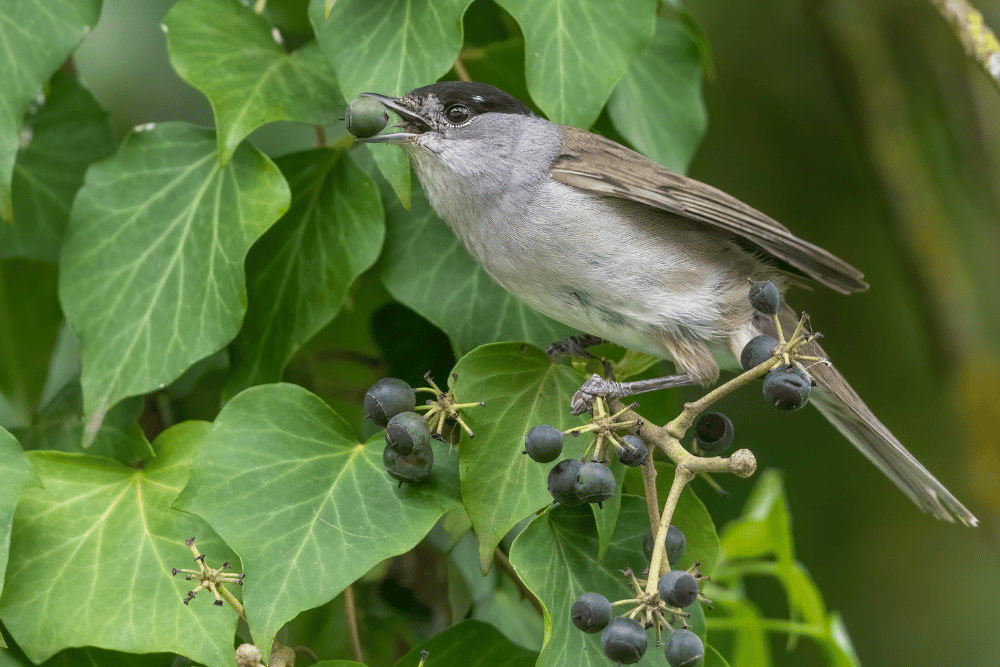 Blackcaps are large warblers with a pale grey chest, brown wings and tail, and either a black cap (in males) or a rich brown cap (in females and juveniles). They are regular summer visitors to the UK, but increasing numbers spend winter here too.
In the colder months, Blackcaps are most often seen in gardens, where they feed on the fruits of garden plants like Ivy, Holly and Elder as well as windfall apples and pears. You are most likely to see them feeding singly or in pairs rather than in large flocks.
Starling
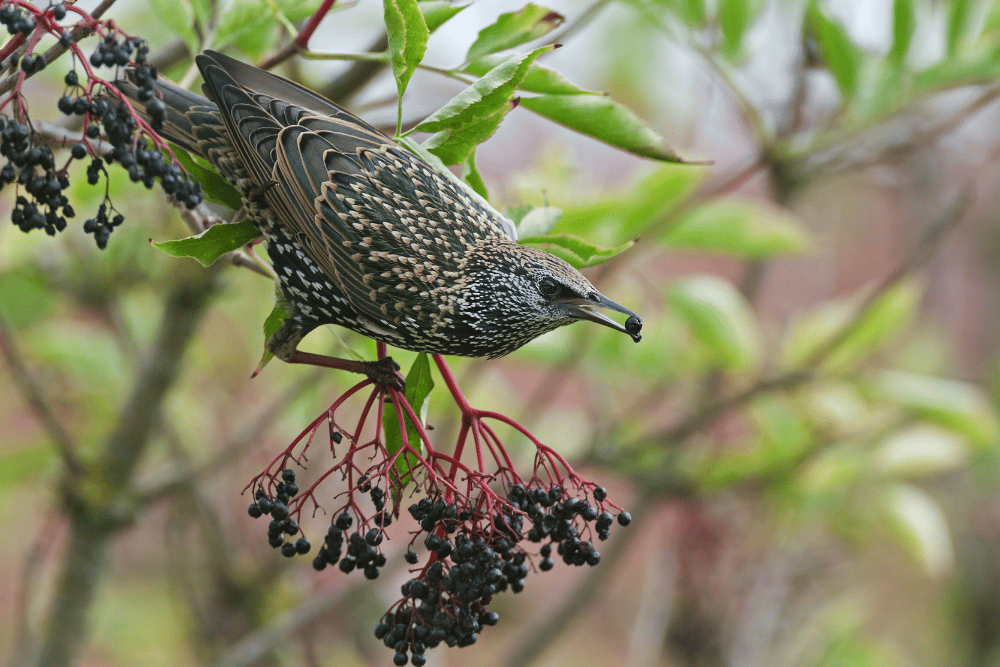 When seen at close quarters, Starlings have intricately-marked plumage, with dark, glossy feathers that are specked with silver and gold spots in winter. They are sociable and characterful, form large, noisy flocks and squabbling and chattering almost constantly.
Starlings are relatively common garden visitors in winter, and also frequent scrub, hedgerows and farmland to feed. They are often seen foraging in Elder and Cotoneaster, as well as Hawthorn and Rowan. Large flocks of Starlings can strip trees bare of berries in a single visit.
Waxwing
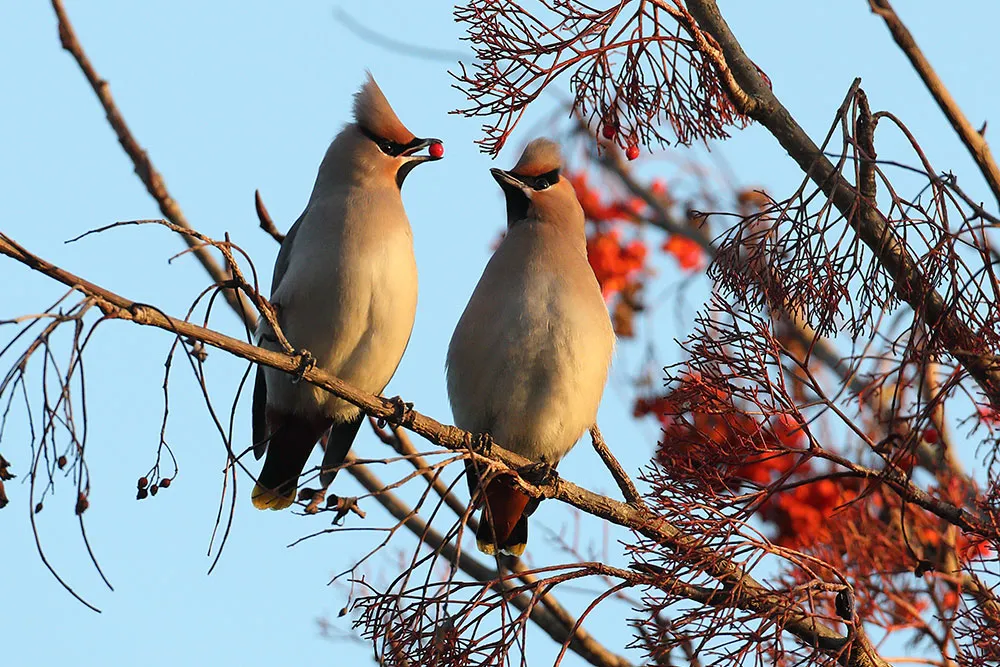 Unlike thrush species, which can often be confused with each other, Waxwings are unmistakable with a good view. They have a distinctive black eye mask, a pointed crest and red, yellow and white markings on their wings.
Waxwings are winter visitors to the UK, and arrive in varying numbers each year. They are social and vocal, often forming large flocks, and feed on a huge range of fruits from Rowan and Whitebeam to Spindle and Sea Buckthorn.
Blackbird
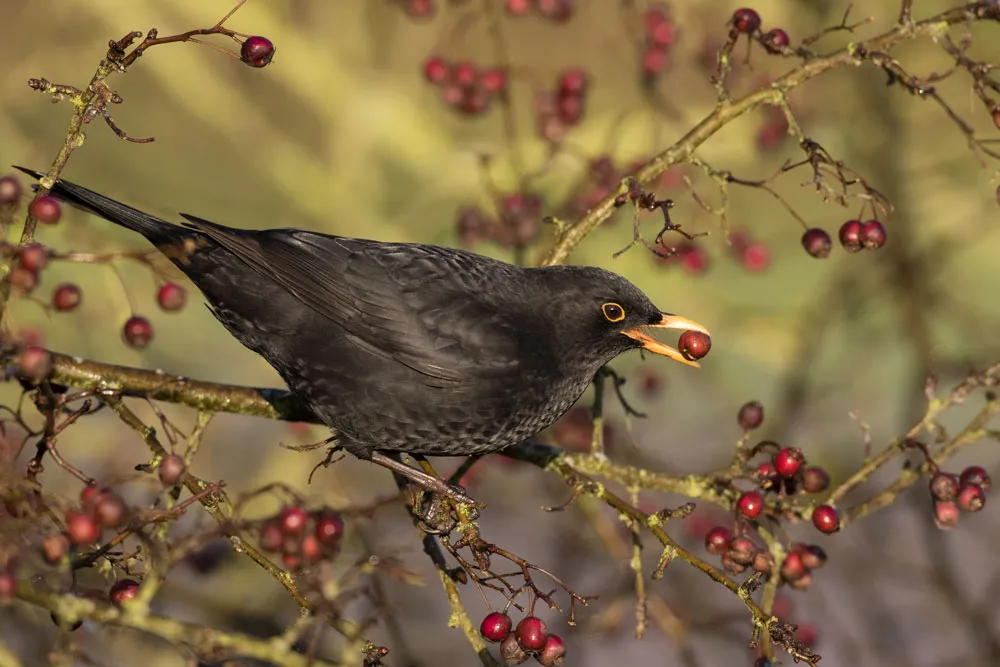 Blackbirds are the most well-known of all UK thrush species. Males are striking black with a yellow bill and eye-ring; females are dark brown.
Blackbirds are very territorial and are usually seen singly in spring and summer, but they form small foraging groups in winter, especially in cold weather. They often feed on hawthorn fruits alongside Mistle Thrushes, Fieldfares and Redwing in hedgerows, scrub and open woodland, and commonly on Pyracantha (Firethorn) fruits in urban areas.
Fieldfare
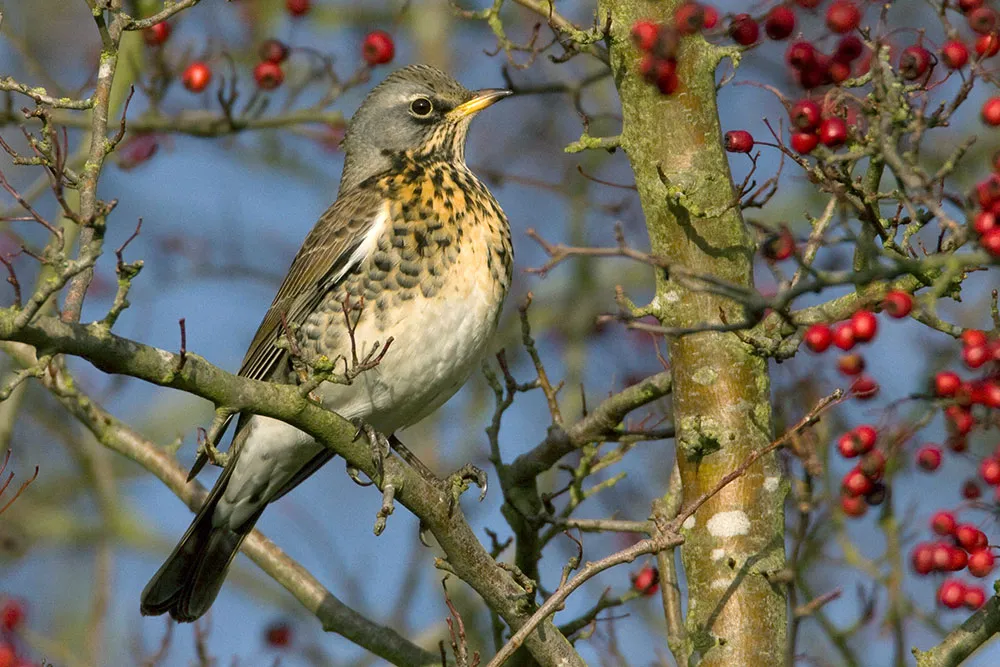 Fieldfares are sociable and noticeably vocal thrushes, and often form large, noisy foraging flocks with Redwings. These mixed flocks commonly feed on hawthorn and Rowan fruits, especially when the ground is frozen, and they cannot feed on invertebrates in the soil.
‘Falls’ of migrating Fieldfares and Redwings – groups of birds grounded by bad weather, such as fog or rain – will also take refuge in Holly and Yew trees and refuel on fruit. Fieldfares have a greyish head and rump, and a ‘chack-chack-chack’ call, which helps to distinguish them from Redwings.
Redwing
 Redwings form large flocks, often mixing with their larger relative, Fieldfares. They have a cream stripe above the eye and rusty flanks, and a distinctive high-pitched ‘zeep’ call, features which help to separate them from other thrushes.
Like Fieldfares, Redwings commonly feed on hawthorn and Rowan fruits in scrub and hedgerows, but will eat other fruits if they are available, including Holly and Yew.
Mistle Thrush
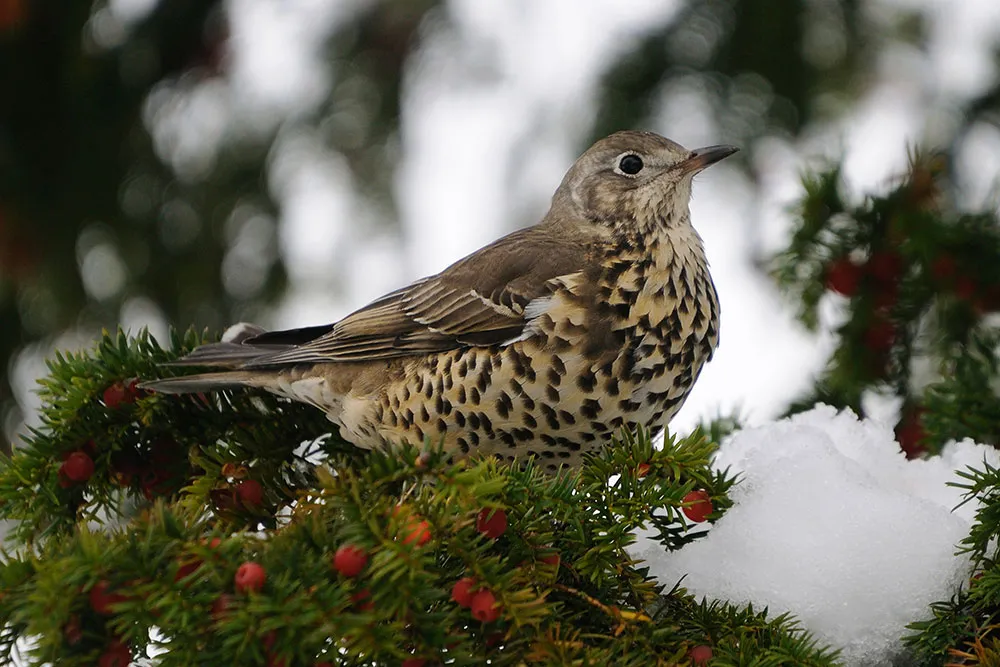 Mistle Thrushes are the biggest winter thrush in the UK. They have an upright and slender silhouette, and appear greyish-brown from a distance. They often form small groups in winter, although they also forage singly and can be seen in larger mixed flocks alongside Redwing and Fieldfare.
Mistle Thrushes can be fierce defenders of the fruiting trees they find, especially Mistletoe (their namesake) and Holly. This defence preserves the food source for longer, ensuring resources last as much of winter as possible. In milder years, when food is less scarce, Mistle Thrushes are less aggressively territorial and will forage in small groups; in colder years, their defence is more determined, although they may be overwhelmed by large flocks of other hungry birds.
Song Thrush
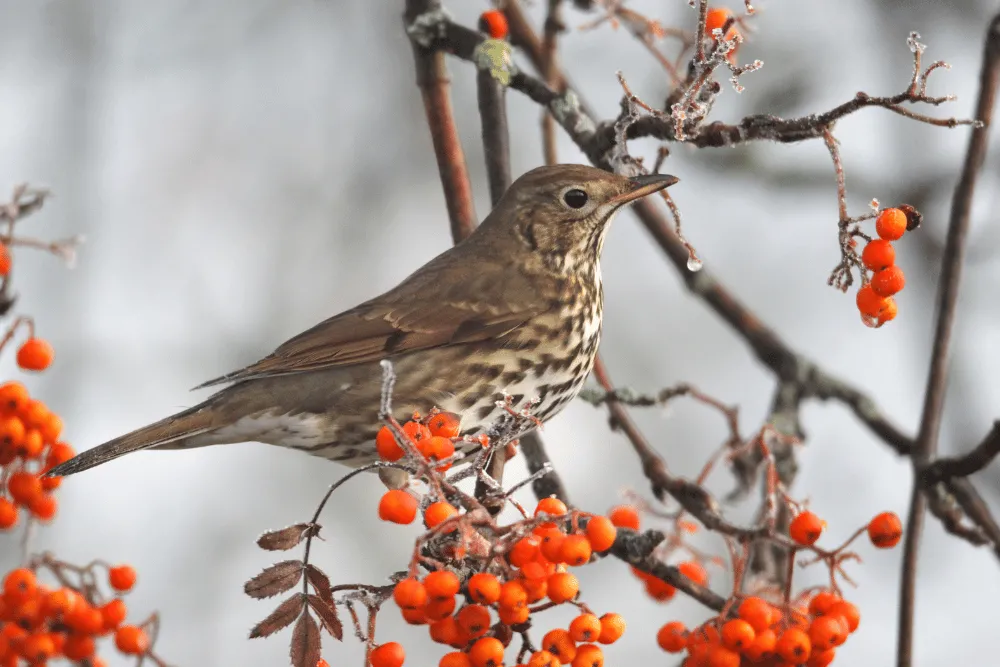 Song Thrushes are small and dumpy with a round silhouette. They are a much warmer brown than the Mistle Thrush, and are not commonly seen in the large mixed flocks of thrushes that feed on hawthorn fruits in late autumn and winter. Instead, they are more often seen singly in woodland and scrub, foraging for fruits in Holly, Yew, or Rowan trees, and Ivy.
- Brush up on your winter thrush ID with our bird ID videos: learn more about Redwing and Fieldfare or Song Thrush and Mistle Thrush.
Which fruits do birds eat?
Birds’ preferences for fruits and berries can vary by region and by year – it is affected by the weather, the availability of other food sources, and the specific bird population in the area. Some species, like Waxwing, eat a variety of fruits, whereas others are more picky and might only eat certain fruits and berries when other food sources are depleted.
The birds’ preferences can also vary by habitat and individual bird behaviour. For example, birds in urban areas might eat fruits and berries from garden plants that are not as common in wild areas. A good example of this is Pyracantha (commonly known as Firethorn), a non-native garden shrub which has bright red or orange berries that are a favourite of urban Blackbirds. However, Blackbirds in rural areas will encounter fewer of these shrubs and so will seek out other fruits, like hawthorn.
Additionally, birds may eat these berries at different times of the year, depending on ripening times or the bird’s migratory or breeding patterns. For example, Redwing and Fieldfare from Fennoscandia migrate to the UK in varying numbers each winter. If fruits are abundant in Fennoscandia, fewer birds tend to migrate because they already have sufficient resources. If it has been a poor fruiting year, however, large numbers will fly across the North Sea to the UK in late autumn. When they arrive, hawthorn haws are usually the most abundant ripe fruit and form the majority of their diet.
Plants bearing fruits commonly eaten by birds
- Bramble (blackberry)
- Blackthorn (Sloes)
- Buckthorn (also known as Purging Buckthorn)
- Cotoneaster
- Dogwood
- Elder
- Hawthorn and Midland Hawthorn
- Holly
- Ivy
- Wild Privet
- Pyracantha (Firethorn)
- Wild roses
- Rowan
- Sea Buckthorn
- Spindle
- Yew