Please see our guidance for fieldworkers for information about insurance, access permission, safeguarding, managing disease transmission between sites, and general advice about health and safety.
Also see our survey essentials for information about where to find help and support, familiarising yourself with your survey, using auto-ID tools, and BTO breeding status and 2-letter species codes.
Guidance for fieldworkers
- The term fieldwork covers all types of ornithological survey and research work undertaken on behalf of the BTO, including counting, nest recording and ringing.
This guidance identifies some key issues that volunteers should consider before and while undertaking fieldwork in the UK including: the BTO Fieldwork Hazard Checklist, insurance, land access permission, under-18s and safeguarding, general health and safety advice and health and safety advice regarding avian influenza (bird flu).
Insurance – public liability
BTO carries insurance for liabilities to third parties for loss, damage or injury, and can provide written confirmation for any landowner requesting it.
- Read our confirmation of Public and Employer’s Liability Insurance for more information.
Important note: claims under this policy depend on a legal liability for the BTO being established, so it may not cover you in a personal capacity. You are not covered by the BTO’s employer’s liability insurance.
Access permission
Always obtain permission from the relevant landowner or tenant to enter any private land not subject to open access legislation before commencing fieldwork, and do not continue fieldwork if access permission is later revoked.
A letter confirming your participation in BTO fieldwork can be provided by the survey organiser on request; we are not able to release these personal details without confirmation that you are happy for us to do so, so please do not ask landowners to contact us directly.
You may not need permission to count birds on Open Access land (in Scotland, please consult section 3.64 of the Scottish Outdoor Access Code), but it is courteous to contact the landowner and explain what you are doing and why, when it is practical to do so. Doing so may help alleviate any concerns the landowner might have and enable you to build a good relationship with them, both of which may help facilitate conservation efforts on that land.
You must abide by the official access codes
- England – right of way and open access land
- Scottish Outdoor Access Code
- Wales – Permissive and Open Access Land
- Northern Ireland – Access to the Countryside
Guidance for ringers outside and inside Scotland
- Ringers must obtain permission to ring on Open Access land outside Scotland.
- Within Scotland, the situation with respect to Open Access land is less clear-cut so please consult and adhere to BTO's guidance.
Safeguarding
Our Safeguarding Policy sets out our approach and commitment to protecting children and vulnerable adults who engage with BTO from harm and abuse, and you should ensure that you are familiar with this document if interacting with these groups. You can also read the safeguarding protocols that are specific to the Ringing Scheme on our Safeguarding in ringing page.
All volunteers must inform the BTO if they are under 18 years of age. Parents or guardians of the under-18 will be asked to sign a Parental Consent Form (.doc) stating that they agree to their child undertaking the activities and have made them aware of the associated risks.
- To obtain a paper copy of the Parental Consent Form, contact the Volunteer H&S Officer at BTO on 01842 750050 or email peopleteam@bto.org.
- We have also put together some specific guidance for undertaking fieldwork with children and young people (PDF).
Managing disease transmission between sites
Invasive species are easily spread on damp equipment and clothing, and can be small and hard to spot.
Removing plant materials and mud from your clothes and kit before leaving a site, either manually or by washing, will help to reduce the risks of transmission, both of these organisms and any pathogens, such as HPAI, contained in the substrate.
Use of disinfectant chemicals, where possible, will further decrease risks of disease transmission between sites, and is mandated for those involved in some bird ringing activities, where the probability of encountering the pathogen is highest, via the BTO HPAI Bird Ringing Framework.
- For more information, see the Check, Clean, Dry: guidance for managing disease and invasive species transmission.
Health and safety – general advice
As a BTO volunteer, you are under no obligation to participate in a survey or scheme, nor to visit a particular site through participation in that survey or scheme, even if local survey organisers or BTO staff have suggested or requested that you do so.
Health and safety responsibility
Volunteers are responsible for their own health and safety, and should not put themselves in a position that could place them, or others, in danger. You should never undertake any work if you have concerns about your own or others' health and safety. If you have any such concerns, you should stop fieldwork immediately.
- The BTO Fieldwork Hazard Checklist, provided below, details some suggestions you might want to adopt in order to manage your own health and safety; the format is intended for easy translation to Risk Assessments, should these be required.
- If you have any health and safety concerns about taking part in a survey, you should contact the relevant Survey Organiser or healthandsafety@bto.org.
Whilst you are responsible for your own health and safety and have access to the guidance and specific information on this page, we would like to hear from you in the event of a near-miss or accident that occurs during your volunteering activities. A near miss is defined as an event or situation which could have resulted in injury or damage. In other words, near misses are accidents that almost happened. Please email us with details to healthandsafety@bto.org. We will use reports received to influence any update to our guidance that might be necessary.
Advice from the Health & Safety Executive (HSE)
The following guides are particularly relevant:
- HSE Tree Climbing Guide
- INDG163 rev 4, Five Steps to Risk Assessment
- INDG229 rev 2, Using Work Equipment Safely
- HSE guide to Working at Height: Preventing Falls
- INDG73 rev 3, Working alone
Bird diseases and hygiene:
- BTO guidance relating to disease and birds
- About avian influenza (bird flu)
BTO Fieldwork Hazard Checklist
The aim of this checklist is to help you improve your own personal safety while carrying out BTO surveys by identifying potential hazards and possible mitigating actions; the format is intended for easy translation to Risk Assessments should these be required.
- Please note: this information is for guidance only and may not be exhaustive with respect to potential hazards; BTO surveyors carry out a wide range of activities across a range of habitats and regions, and any assessment of risk should take all relevant local factors into account, in addition to any risks relevant to specific individuals (e.g. pre-existing medical conditions).
General fieldwork hazards
Danger of injury through accident:
- Identify potential hazards in daylight, on arrival at each site.
- Wear suitable clothing and appropriate footwear for the location/terrain and weather conditions.
- Use footpaths where possible.
- Carry a mobile phone with sufficient charge and test for reception blackspots.
- Carry a torch and spare batteries.
- Carry a first aid kit, whistle and survival bag.
- Ensure you have access to drinking water and food.
- Avoid well known danger spots; do not cross railway lines or other potential hazardous sites e.g. quarries or ravines.
- Heed warning signs and do not enter private (non-access) land that has been deliberately obstructed.
- Avoid contact with livestock and agricultural machinery.
Lone working:
- Avoid lone working where possible.
- If lone working, always notify someone (partner, friend, neighbour) where you are going, when you expect to be back and details of your vehicle. Agree on a course of action if you have not returned home by the time you stated.
- Lone workers should be aware of the location of the nearest house or phone so that help can be called if required.
Inclement weather:
- Check weather forecast before leaving for fieldwork.
- Wear appropriate clothing for the time of year, and be prepared for weather changes.
- Carry waterproof and/or warm clothing. Hazards can increase significantly in heavy rain, strong wind and thunderstorms.
- Avoid or terminate outside activity in inclement weather as appropriate.
Getting lost:
- Carry a mobile phone/GPS with spare batteries.
- Don’t rely solely on a mobile phone/GPS for navigation, always take a map and compass and know how to use them.
Human confrontation:
- Consider your personal safety when conducting fieldwork within the vicinity of known or likely trouble spots.
- Avoid confrontation with landowners, land workers or members of the public.
- Consider the privacy of residents when performing early-morning survey work in residential areas.
- If you have any concerns about your personal safety, cease fieldwork immediately.
Traffic and driving:
- High visibility clothing should be worn whenever working in the vicinity of roads, particularly at night.
- Take care to park sensibly, preferably off-road, and do not block entrances.
Water features:
- Non-swimmers should be accompanied when walking by water.
- Keep at safe distance from banks, cliffs and the water’s edge.
- Do not cross rivers or streams unless by bridge.
- Avoid work when there is a risk of flooding.
- If operating below the high water mark, check high tide times before commencing fieldwork, and allow ample time to leave the intertidal area.
Trees:
- Be aware of low, fallen and hanging branches and take care to avoid them.
- Do not climb trees or onto tree limbs.
- Be aware of other wildlife when investigating tree cavities or nest boxes – especially bees, wasps and hornets.
Fencing:
- Avoid touching or climbing over electric fences.
- Avoid touching or climbing over barbed-wire fences.
- Ensure your tetanus vaccine is up to date.
Bees, wasps and hornets:
- Approach potential bee/wasp/hornet nest sites, e.g. tree cavities, with appropriate caution.
- Carry appropriate personal medication if allergic.
- Identify others with allergies if working in a group.
Unfamiliar dogs:
- Do not run away if approached by an unfamiliar dog, but stay calm and still and avoid direct eye contact as this can be seen as a form of aggression or a challenge.
- Drop anything you are carrying that may have attracted the dog and try calmly telling the dog to sit or stay.
- Ignore the dog if it jumps up – do not shout or push it away as it may see this as a game. If knocked to the ground, remain motionless in the foetal position and protect your face.
- When you do move, move slowly and remain facing the dog.
Tetanus and Leptospirosis (Weil’s disease):
While not common, these diseases can have severe effects, and in rare cases result in death.
- Clean any cuts, etc. immediately with clean water and cover adequately.
- Ensure that your anti-tetanus treatments are up-to-date (normally within the last 10 years).
- Avoid contact with water, particularly if contaminated with cattle/rat urine.
- Wash hands thoroughly and always before eating or smoking.
- If you contract flu-like symptoms, tell your doctor that you may have been exposed to Weil’s disease.
Lyme disease and Tick-borne Encephalitis:
- Refer to our ticks and Lyme disease guidance (PDF).
General bird-borne diseases and hygiene issues:
Health and safety risks with ringing and nest recording
Please also read our general health and safety guidance.
Bites and stings:
- Check for bees, wasps, hornets and fleas when visiting cavities or cleaning out nest boxes.
- Wear gloves when cleaning out nest boxes.
- Clean boxes in autumn (legal after 1 August) to avoid a build-up of fleas.
Injuries from talons or bills:
- Wear safety spectacles and gloves as appropriate.
Whoosh nets:
- Wear eye protection when setting nets.
- Set in pairs, allowing one person to hold the peg in place while elastic is tensioned by a second person.
- Use pegs of sufficient length and ensure they are securely hammered into the ground.
- Do not use excessive tension.
Cannon nets:
- Refer to guidance in the Cannon-netting Manual (supplied to licensed cannon netters).
Ladder work:
- Refer to the Ladder Association LA/LA455 guidance.
Climbing:
- Refer to the HSE Tree Climbing guidance.
Diseases, including avian influenza (bird flu):
The risk to volunteers from a wide range of diseases can be reduced via good hygiene practice. One of the diseases that ringers may come into contact with is HPAI (avian influenza / bird flu).
The UK Health Security Agency has stated that AI is primarily a disease of birds and the risk to the general public’s health is very low; humans can, however, become infected via close contact with infected birds or inhalation of aerosols containing virus, their droppings and nearby water.
Symptoms of avian influenza (bird flu) in birds:
- Familiarise yourself with the symptoms of avian influenza in birds. These signs vary between species but include: swollen head; blue discolouration of the neck and throat; loss of appetite; respiratory distress such as gaping beak, coughing, sneezing, gurgling, rattling; diarrhoea; fewer eggs laid; increased mortality; neurological signs such as trembling, falling over, swimming or walking in circles.
Symptoms of avian influenza (bird flu) in humans and seeking medical advice:
- Familiarise yourself with the symptoms of avian influenza in humans. These symptoms include: conjunctivitis; fever with a temperature >=38ºC; cough or shortness of breath requiring hospitalisation; diarrhoea, vomiting, and abdominal pain. Learn more about the symptoms of avian influenza on the NHS website.
- Seek medical advice immediately should you display symptoms of any illness that may be related to ringing or nest recording, inform your GP or healthcare provider that you may have been exposed to HPAI and other potential avian zoonoses.
Personal hygiene:
- Avoid handling dead birds, or live birds which appear to be infected, their droppings, or any water nearby, with your bare hands. If handling is required, e.g. to read a ring, disposable nitrile gloves should be worn; if these are not available, an inverted plastic bag can be used. After use, the bag should be turned back on itself, placed in a second plastic bag, tied and disposed of in the normal household waste.
- Wash hands with appropriate soaps/disinfectants after handling animals or coming into contact with animal droppings, soil, sand or water that may be contaminated,, e.g. soap and water, antibacterial wipes, 70% alcohol solution, or virucides (e.g. Safe4, Virkon). Note that some of the disinfectants used for AI precautions are teratogenic (can cause structural and functional changes to a foetus) and use by any person who is pregnant, or has a possibility of being pregnant, should be avoided under any circumstances. Inspect the Material Safety Data Sheet, provided by the manufacturer, for any disinfectants used.
- Keep cuts and abrasions completely covered by a waterproof occlusive dressing. If a cut or abrasion occurs during ringing, clean the wound immediately with soap and water/antiseptic wipes and cover it with a waterproof dressing.
- Avoid any activity during ringing sessions that might bring your hands close to your face until your hands are clean, e.g. rubbing your eyes, touching your mouth, eating, drinking or smoking.
- Remove any faeces deposited on hands or clothes as soon as possible, sanitising the area using the appropriate cleaning agent.
- Employ appropriate levels of Personal Protective Equipment (PPE).
Clothing and equipment hygiene:
- At the end of each session, wash/clean all ringing equipment, including bird bags, using the appropriate cleaning agent, away from food hygiene areas, and store it away from living areas. Note that some of the disinfectants used for AI precautions are teratogenic (can cause structural and functional changes to a foetus) and use by any person who is pregnant, or has a possibility of being pregnant, should be avoided under any circumstances.
- Avoid using fieldwork clothes for other purposes, wash them after each fieldwork session, and avoid mixing with non-fieldwork clothes in the wash. . Similarly, disinfect boots, and any clothes that cannot be placed in washing machine, at the end of each session, using the appropriate cleaning agent.
- Use sealed bags to transport solied clothes, equipment and sanitisation materials away from the ringing site. Dispose of solied sanitisation materials in domestic or commercial waste.
Ringing techniques:
- Handle birds in a well-lit and well-ventilated area to minimise the possibility of inhaling dried faecal or other material.
- Open bird bags away from the face to avoid inhaling powdered faeces and feather scale.
- Minimise the time spent on activities that necessitate blowing to part feathers (e.g. assessing moult, brood patch scores) and move your face away from the bird to inhale. If using a tube, ensure that the same end is always placed in the mouth.
Rabies:
Rabies may be encountered via bats caught in mist nets.
- Ensure you have up-to-date rabies vaccination if the probability of capturing bats is significant.
- Avoid sites/times of day when the probability of capturing bats is greatest.
- If a bat is caught in a mist net, wear gloves during extraction.
- If bitten, wash the wound immediately with soap and water for at least five minutes and cleanse with disinfectant.
- Seek immediate medical advice from your GP, even if you have up-to-date rabies vaccinations.
Countryside codes and using maps
Countryside Codes and countryside access issues
- England - Countryside Code
- Scottish Outdoor Access Code
- Northern Ireland - see the Guidance section
- Wales - Guidance and advice
Using a map and compass
Please note: this information covers volunteers working in the UK. Volunteers working outside of the UK should seek information from relevant sources.
Survey essentials
- The following advice applies to all our surveys (projects) and will help beginners and more experiences surveyors build up their knowledge, skills and confidence.
Participating in surveys is both rewarding and educational. It gives your birdwatching a different focus and helps you develop new skills, such as counting individual birds and using maps to plot their locations. At the same time, when you take part in a survey it means you are helping to gather valuable data to help us understand how birds are faring and what can be done to help them. It can seem daunting at first, but it soon becomes second nature.
Ask for help
At a local scale, many surveys are coordinated by Regional / Local Organisers (who are part of our Regional Network). They are always willing to answer questions about the survey to help you feel more confident. Some regions host local training events and provide mentoring opportunities, and we also offer a programme of training courses.
Each survey has online resources to help you get started, often including video tutorials, and if you have particular questions or concerns that are not addressed elsewhere, you can always contact the national Survey Organiser via the survey’s web pages.
If in doubt, leave it out
Making mistakes
A common concern of people new to surveys is that they might make a mistake, causing the information they collect to be inferior to that of an experienced surveyor. Don’t worry about this: we all make mistakes, and our analyses check for between-observer differences that might introduce bias, accounting for this when necessary.
Consistency is key
The key message is to be consistent within your own surveying. For example, if you do a BBS early visit during the second week of April one year, try to make your early visit the following year in the same week. The survey methods will give you guidance about this.
If in doubt ...
When it comes to identification, apply the mantra ‘if in doubt, leave it out’.
For example, if whilst doing a BirdTrack complete list you see a distant gull that you don’t recognise, don’t assume it is a Herring Gull. In several schemes, including BirdTrack, Garden BirdWatch and WeBS, there are ‘either/or’ and ‘unidentified’ options, such as ‘Marsh/Willow Tit' and ‘unidentified small wader’.
These can be useful if you witness a movement of birds, such as finches moving overhead or groups of waders passing offshore, but cannot assign them to species.
Review the requirements
What, when and where
Before taking on a survey, review the requirements. Do you have the necessary skills and time? Can it be done anywhere and if not, is it taking place near you (or are you visiting the area where it is happening, e.g. Upland Rovers)? Do you know how to read a gird reference?
How
Familiarise yourself with survey methods. Each survey has a ‘Taking part’ section on the website, and many have video tutorials that explain how the survey is carried out.
Hazards, access and permission
Using a map or your knowledge of the area, check if there are any particular hazards or access issues and seek permission from the landowner if necessary.
Paperwork
Surveys require you to record some information whilst you are in the field. Make sure you have the right paperwork – this might be sent to you by your Regional / Local Organiser or you can print what you need from the relevant survey pages on the BTO website. A clipboard and a pen will be useful, too!
Using auto-ID tools
Auto-ID tools that use audio or image inputs to provide species identification are growing in popularity and accuracy. The Merlin Bird ID app is particularly popular for bird identification by sound, and can be extremely useful for learning bird songs and calls.
However, the outputs of auto-ID tools are currently not accurate enough to ensure that our data are robust and high-quality. We also don't yet understand how wider use of auto-ID tools might affect the results of our long-term schemes.
We therefore ask that volunteers taking part in any of our monitoring schemes and in BirdTrack do not rely solely on these apps in the field, and only add records to their survey data if they are confirmed by sight or hearing.
Specifically, BBS/WBBS Surveyors and GBW participants should not rely on Merlin/auto-ID apps for identification when in the field/in their gardens; BBS/WBBS and GBW will, for the time being, remain a survey conducted by human observers. Use of such tools should only be used for confirmatory purposes.
We do recognise that, with sufficient improvements in accuracy and guidelines on use, the tools do have the potential to increase the quality and quantity of data collected. They may also open survey participation to a wider audience and engage more people with our work. High-quality data and inclusion are very important to us, so we will continue to monitor the development of the tools and update our statement accordingly.
Breeding status codes
- All codes for Possible, Probable and Confirmed Breeding had to relate to individuals in potentially suitable nesting habitat.
- Code F (Flying over) should only be used on Roving Records forms and not on Timed Tetrad Visits.
Non-breeding
| Code | Description |
|---|---|
| F | Flying over |
| M | Species observed but suspected to be still on Migration |
| U | Species observed but suspected to be a sUmmering non-breeder |
Possible breeder
| Code | Description | Example | |
|---|---|---|---|
| H | Species observed in breeding season in suitable nesting Habitat | House Sparrow in suitable breeding habitat. | 
|
| S | Singing male present (or breeding calls heard) in breeding season in suitable breeding habitat | Robin singing in suitable breeding habitat. | 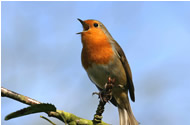 |
Probable breeding
| Code | Description | Example | |
|---|---|---|---|
| P | Pair observed in suitable nesting habitat in breeding season | Pair of House Sparrows in suitable nesting habitat |  |
| T | Permanent Territory presumed through registration of territorial behaviour (song etc) on at least two different days a week or more apart at the same place or many individuals on one day | If there are a number of Robins singing at the same time in the same area then Permanent Territory can be used, or territorial behaviour (song etc) on at least two different days a week or more at the same place. | 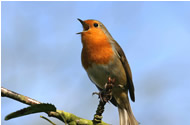 |
| D | Courtship and Display (judged to be in or near potential breeding habitat; be cautious with wildfowl) | Great Crested Grebes displaying is a good sign of probable breeding. | 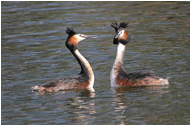 |
| N | Visiting probable Nest site | House Sparrow visiting probable nest site. | 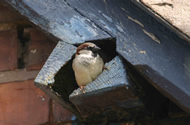 |
| A | Agitated behaviour or anxiety calls from adults, suggesting probable presence of nest or young nearby | ||
| I | Brood patch on adult examined in the hand, suggesting Incubation | Bird ringers can record the presence of brood patches on birds when trapped for ringing. This is a Reed Warbler. | 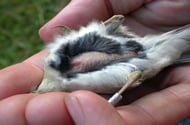 |
| B | Nest Building or excavating nest-hole | Song Thrush collecting nesting material is another sign of probable breeding. | 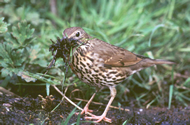 |
Confirmed breeding
| Code | Description | Example | |
|---|---|---|---|
| DD | Distraction-Display or injury feigning | Little Ringed Plover feigning a wing injury as part of a distraction display. | 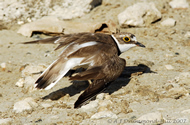 |
| UN | Used Nest or eggshells found (occupied or laid within period of survey) | ||
| FL | Recently FLedged young (nidicolous species) or downy young (nidifugous species). Careful consideration should be given to the likely provenance of any fledged juvenile capable of significant geographical movement. Evidence of dependency on adults (e.g. feeding) is helpful. Be cautious, even if the record comes from suitable habitat. | Recently fledged Robins still showing dependency on an adult. | 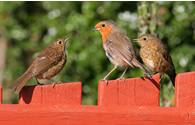 |
| ON | Adults entering or leaving nest-site in circumstances indicating Occupied Nest (including high nests or nest holes, the contents of which can not be seen) or adults seen incubating | Coot on a nest. | 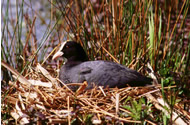 |
| FF | Adult carrying Faecal sac or Food for young | Willow Warbler carrying food for young. This code also includes carrying faecal sac away from the nest. |  |
| NE | Nest containing Eggs | Song Thrush nest with eggs. You have to be lucky to find a nest. For species such as Mute Swan and Canada Goose the nests are more obvious. | 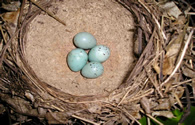 |
| NY | Nest with Young seen or heard | Spotted Flycatcher nest with young. | 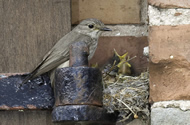 |
Two-letter species codes
This list comprises the names and two-letter species codes of species likely to be recorded in the United Kingdom, and more. It typically features on BTO survey recording forms and is a useful shorthand for fieldwork. Whilst surveyors in local projects may use any coding system of their choosing, BTO recommend the use of the above codes, particular when sharing data. Five-letter codes also exist for ringing.
- Sesarch our database of BTO two-letter species codes.
- Download the two-letter species codes PDF
- Search BirdFacts to find the code if a species is not on the list.
- See the BirdFacts Species information page to learn more about species codes and names.