Blackcap

Introduction
This melodic warbler is widely distributed across Britain & Ireland through the breeding season, and increasingly in winter too.
Blackcap breeding numbers have steadily increased in the UK since the late-1970s, and have also expanded their breeding range throughout northern Scotland and the island of Ireland during this time. They are now absent only on the highest Scottish peaks and farthest flung islands.
In autumn, these breeding birds depart for southern Europe and are replaced by Blackcaps from central Europe. BTO research has helped show how garden bird feeding led to the evolution of this new migratory route and wintering strategy. Although widespread in winter, Blackcaps tend to be absent from the uplands at this time of year.
Blackcaps have a greyish overall appearance. The eponymous black cap is only found in the males; females and juveniles have a brown cap instead. The song is very similar to that of the Garden Warbler, but can be distinguished with practice. Blackcaps are found in parks, deciduous woodland and scrub, as well as at garden feeding stations.
- Our Trends Explorer gives you the latest insight into how this species' population is changing.
Key Stats









Identification
ID Videos
This section features BTO training videos headlining this species, or featuring it as a potential confusion species.
Warbler Identification Workshop Part 2: Blackcap & Garden Warbler
#BirdSongBasics: Blackcap and Garden Warbler
Songs and Calls
Song:
Call:
Status and Trends
Conservation Status
Population Change
Blackcap abundance in the UK has increased consistently since the late 1970s, a trend common to all habitats and evident from both the CBC/BBS and the CES indices. An extraordinary acceleration of the upward trend occurred from 2008 to 2013. Overall increase has occurred despite a reduction in habitat quality for Blackcap, and other species dependent on the understorey, brought about by deer browsing in young woodland (Holt et al. 2012d). The BBS map of change in relative density between 1994-96 and 2007-09 indicates that increase occurred widely throughout the UK range over that period. An even more rapid increase in Northern Ireland and in Scotland, where much new ground has been colonised (Balmer et al. 2013), is indicated by the most recent BBS trends. There has been an increase across Europe since 1980 (PECBMS: PECBMS 2020a>).
Distribution
Breeding Blackcaps are widely distributed throughout Britain and Ireland, with highest densities in lowland areas in southern Britain and in pockets throughout Ireland. Wintering numbers have increased steeply since the 1990s, with numbers peaking in gardens in late January or February.
Occupied 10-km squares in UK
2007/08–10/11
or view it on Bird Atlas Mapstore.
2008–11
or view it on Bird Atlas Mapstore.
European Distribution Map
Distribution Change
There have been extensive gains in the Blackcap's breeding range since the 1968–72 Breeding Atlas; the range has expanded in Ireland by a staggering 241%, and in Britain by 51%, with most of the British gains being in Scotland.
Change in occupied 10-km squares in the UK
from 1981–84 to 2007–11
or view it on Bird Atlas Mapstore.
from 1968–72 to 2008–11
or view it on Bird Atlas Mapstore.
Seasonality
Blackcap is a scarce winter visitor and common summer visitor, with a rapid arrival of birds in April when Blackcap song can be heard in many wooded habitats.
Weekly pattern of occurrence
The graph shows when the species is present in the UK, with taller bars indicating a higher likelihood of encountering the species in appropriate regions and habitats.

Habitats
Breeding season habitats
Relative frequency by habitat
The graph shows the habitats occupied in the breeding season, with the most utilised habitats shown at the top. Bars of similar size indicate the species is equally likely to be recorded in those habitats.

Movement
Britain & Ireland movement
Foreign locations of birds ringed or recovered in Britain & Ireland
Dots show the foreign destinations of birds ringed in Britain & Ireland, and the origins of birds ringed overseas that were subsequently recaptured, resighted or found dead in Britain & Ireland. Dot colours indicate the time of year that the species was present at the location.
- Winter (Nov-Feb)
- Spring (Mar-Apr)
- Summer (May-Jul)
- Autumn (Aug-Oct)

European movements
EuroBirdPortal uses birdwatcher's records, such as those logged in BirdTrack to map the flows of birds as they arrive and depart Europe. See maps for this species here.
The Eurasian-African Migration Atlas shows movements of individual birds ringed or recovered in Europe. See maps for this species here.
Biology
Productivity and Nesting
Nesting timing
Egg measurements
Clutch Size
Incubation
Fledging
Survival and Longevity
Survival is shown as the proportion of birds surviving from one year to the next and is derived from bird ringing data. It can also be used to estimate how long birds typically live.
View number ringed each year in the Online Ringing Report.
Lifespan
Survival of adults
Survival of juveniles
Biometrics
Wing length and body weights are from live birds (source).
Wing length
Body weight
Ring Size
Classification, names and codes
Classification and Codes
- Order: Passeriformes
- Family: Sylviidae
- Scientific name: Sylvia atricapilla
- Authority: Linnaeus, 1758
- BTO 2-letter code: BC
- BTO 5-letter code: BLACA
- Euring code number: 12770
Alternate species names
- Catalan: tallarol de casquet
- Czech: penice cernohlavá
- Danish: Munk
- Dutch: Zwartkop
- Estonian: mustpea-põõsalind
- Finnish: mustapääkerttu
- French: Fauvette à tête noire
- Gaelic: Ceann-dubh
- German: Mönchsgrasmücke
- Hungarian: barátposzáta
- Icelandic: Hettusöngvari
- Irish: Caipín Dubh
- Italian: Capinera
- Latvian: melngalvas kaukis
- Lithuanian: juodagalve devynbalse
- Norwegian: Munk
- Polish: kapturka
- Portuguese: toutinegra-de-barrete
- Slovak: penica ciernohlavá
- Slovenian: crnoglavka
- Spanish: Curruca capirotada
- Swedish: svarthätta
- Welsh: Telor Penddu
- English folkname(s): Haychat, Mock Nightingale
Research
Causes of Change and Solutions
Causes of change
The causes of the increase in this species remain unknown.
Further information on causes of change
According to CES, productivity has fluctuated markedly, obscuring any long-term trend in CES or NRS data. Survival rates have been stable. Using data from France, Julliard (2004) found that population growth rate was under the additive influence of survival and recruitment.
Analysis of phenological data has found that this species advanced its arrival date in the UK, between the 1960s and 2000s, by 18 days ( Newson et al. 2016). This is in line with the trend towards earlier laying, amounting to an advance of almost two weeks since 1968, which may be a response to recent climate change (Crick & Sparks 1999, Croxton et al. 2006). The more rapid increase in Scotland indicated by BBS suggests that climatic warming may be allowing this species to extend its range northwards (Hewson et al. 2007).
Information about conservation actions
The population of this species has increased consistently since the 1970s, hence it is not a species of concern and no conservation actions are currently required.
Conservation actions benefiting other woodland species may also help Blackcap further, particularly those which enhance understorey vegetation and in particular the scrub layer, for example the control of deer numbers to reduce grazing.
Publications (5)
Spatial variation in spring arrival patterns of Afro-Palearctic bird migration across Europe
Author:
Published: 2024
The timing of migrant birds’ arrival on the breeding grounds, or spring arrival, can affect their survival and breeding success. The optimal time for spring arrival involves trade-offs between various factors, including the availability of food and suitable breeding habitat, and the risks of severe weather. Due to climate change, the timing of spring emergence has advanced for many plants and insects which affects the timing of maximum food availability for migratory birds in turn. The degree to which different bird species can adapt to this varies. Understanding the factors that influence spring arrival in different species can help us to predict how they may respond to future changes in climate. This study looked at the variation across space in spring arrival time to Europe for 30 species of birds which winter in Africa. It used citizen science data from EuroBirdPortal, which collates casual birdwatching observations from 31 different European countries, including those submitted via BirdTrack. Using these data, the start, end and duration of spring migration was calculated at a 400 km resolution. The research identified patterns in arrival timing between groups of species, and tested whether these were linked to species traits: foraging strategy, weight, wintering location and length of breeding season. Lastly, it investigated how arrival timing was linked to temperature. The results showed that it takes 1.6 days on average for the leading migratory front to move northwards by 100 km (range: 0.6–2.5 days). The birds’ movements broadly tracked vegetation emergence in spring. Arrival timing could be split into two major groupings; species that arrived earlier and least synchronously, in colder temperatures and progressed slowly northward, and species that arrived later, most synchronously and in warmer temperatures, and advanced quickly through Europe. The slow progress of the early-arriving species suggests that temperature limits their northward advance. This group included aerial Insectivores (e.g. Swallow and Swift) and species that winter north of the Sahel (e.g. Chiffchaff and Blackcap). For the late-arriving species, which included species wintering further south, and heavier species (e.g. Red-backed shrike and Golden Oriole), they may need to wait until the wet season in Africa progresses enough for food to be available to them south of the Sahara before they can make the desert crossing. The research demonstrates that thanks to advances in citizen science, it is now possible to study arrival timing at a relatively fine scale across continents for a wide range of species, enabling a much fuller understanding of year-round variation between and within species, the associated trade-offs, and the pressures that species face. This knowledge can help mitigate threats to migrant species. For example, the dates of the start of spring migration could by used by each European country to inform hunting legislation. The approaches used in this work could be applied to other taxa where data are sufficient.
02.05.24
Papers

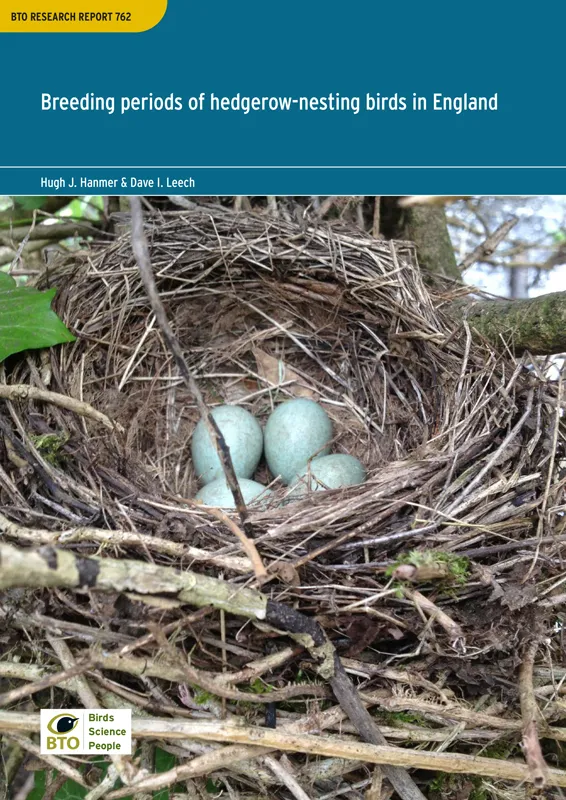
Breeding periods of hedgerow-nesting birds in England
Author:
Published: Spring 2024
Hedgerows form an important semi-natural habitat for birds and other wildlife in English farmland landscapes, in addition to providing other benefits to farming. Hedgerows are currently maintained through annual or multi-annual cutting cycles, the timing of which could have consequences for hedgerow-breeding birds. The aim of this report is to assess the impacts on nesting birds should the duration of the management period be changed, by quantifying the length of the current breeding season for 15 species of songbird likely to nest in farmland hedges. These species are Blackbird, Blackcap, Bullfinch, Chaffinch, Dunnock, Garden Warbler, Goldfinch, Greenfinch, Linnet, Long-tailed Tit, Robin, Song Thrush, Whitethroat, Wren and Yellowhammer.
05.03.24
BTO Research Reports
Human activity shapes the wintering ecology of a migratory bird
Author:
Published: 2021
Research involving BTO provides further evidence of how humans are shaping the natural world through simple changes in our own back gardens.
14.04.21
Papers
Individual variability and versatility in an eco-evolutionary model of avian migration
Author:
Published: 2020
Collaborative research, involving BTO, used tiny tracking devices to investigate unanswered questions about Blackcap migration.
04.11.20
Papers
Is supplementary feeding in gardens a driver of evolutionary change in a migratory bird species?
Author:
Published: 2015
New research using data from Garden BirdWatch has revealed that bird food provided in British gardens has helped Blackcaps to rapidly evolve a successful new migration route. This is the first time that garden bird feeding has been shown to affect large-scale bird distributions. The research uses data from volunteer Garden BirdWatchers. Contemporary evolution of migratory behaviour in the Blackcap Since the 1950s, Blackcaps breeding in southern Germany and Austria have increasingly migrated in a north-westerly direction, heading towards Britain for the winter rather than taking the traditional south-westerly route to wintering grounds in southern Spain. Research has revealed that this new migration strategy is genetically encoded and is maintained through reproductive isolation and fitness benefits on the breeding grounds. The result has been a rapid increase in the number of Blackcaps wintering in Britain over the past 60 years, such that the species is now a familiar visitor to garden feeding stations across the country. Have conditions in Britain helped to drive this evolutionary change? Early observations of wintering Blackcaps in British gardens coincided with the wider introduction of commercial wild bird foods, so it is conceivable garden bird feeding introduced a selection pressure for the evolution of the new migration strategy. However, it is unlikely that this will have been the only factor driving the change. Winter conditions in Britain have become milder and this may have led to improved overwinter survival rates for the Blackcaps choosing to winter here. But which is the more important? Unravelling the underlying mechanisms driving the evolution of this change in migration route requires long-term monitoring data, collected at a landscape scale. Fortunately, BTO's weekly Garden BirdWatch survey provides data of just the right form and scale to explore the spatial distribution and between year variation in Blackcap wintering behaviour, additionally allowing examination of both of these components in relation to the availability of supplementary food and local climate. If the provision of supplementary food has influenced Blackcap migration, we might predict that Blackcaps would be observed more frequently where there is a reliable source of garden bird food and that there may be evidence of an increased association with food over time. If climate has limited the Blackcap’s winter range, we might predict that Blackcaps would be observed more often at sites where the winter climate is warmer. How were the data analysed? Kate Plummer and colleagues extracted data for Blackcap presence and absence per site for 12 winters (1999/2000 to 2010/2011), capturing the period when these central European birds are most strongly associated with garden habitats. The final data set included 3,806 Garden BirdWatch sites and was based on those sites from which at least 16 weekly submissions in a minimum of nine winters had been received. Garden BirdWatch participants record the food provided at their sites each week, but not which species were feed on which foods. To capture this information, and use it to inform which foods to include in the analyses, a questionnaire survey was circulated across participants who had recently had Blackcaps using their gardens. This revealed that fats and sunflower hearts were the preferred foods for visiting Blackcaps. The analyses also included a measure of local habitat, derived from the CEH Land Cover Map and used to test for any potential ‘heat island effect’ – urban areas are warmer than rural areas because of the waste heat escaping from buildings and shops. Also included were mean monthly temperature data extracted from the Met Office UK Climate Projections dataset, latitude/longitude and year. Generalized linear mixed models were then used to examine the predictors of variation in Blackcap wintering behaviour. The patterns revealed Blackcaps showed greater occupancy of sites in the south and west of Britain, where wintering conditions are milder. The authors found strong evidence that Blackcap occupancy rates are influenced by both supplementary food and climatic temperature; Blackcaps were recorded more often at sites that provisioned food more frequently and, most interestingly, Blackcap occurrence has become more strongly associated with supplementary feeding over time. The birds showed a preference for wintering sites that had a warmer local climate, with the use of GBW sites reduced in those years when the winter weather was milder. What does this all mean? This work provides the first direct evidence of the underlying mechanisms that have influenced the contemporary evolution of migratory behaviour in Blackcap. Over a 12-year period, Blackcaps have become increasingly associated with the provision of supplementary foods in British gardens and the reliability of that provisioning is influencing their distribution at the national scale. The findings suggest that climate amelioration is also likely to have enabled Blackcaps to expand their wintering range into Britain. The increasing association with supplementary food over time suggests that Blackcaps are adapting their feeding habits to exploit human-provisioned foods, complementing recent evidence that those Blackcaps migrating to Britain in winter are diverging phenotypically, as well as genetically, from those that winter in Spain. Blackcaps wintering in Britain have relatively narrower and longer beaks than those wintering in Spain, suggesting that British migrants have adapted to a more generalist diet. The study provides new and timely evidence of the role that human activities can play in shaping the evolutionary trajectories of wild bird populations.
24.09.15
Papers

More Evidence
More evidence from Conservation Evidence.com
Partners




Citing BirdFacts
If you wish to cite particular content in this page (e.g. a specific value) it is best to use the original sources as linked in the page. For a more general citation of the whole page please use: BTO (20XX) BirdFacts Species: profiles of birds occurring in the United Kingdom. BTO, Thetford (www.bto.org/birdfacts, accessed on xx/xx/xxxx).