Breeding Birds in the Wider Countryside:
their conservation status 2007
Trends
in numbers and breeding performance for UK birds
|
|
 |
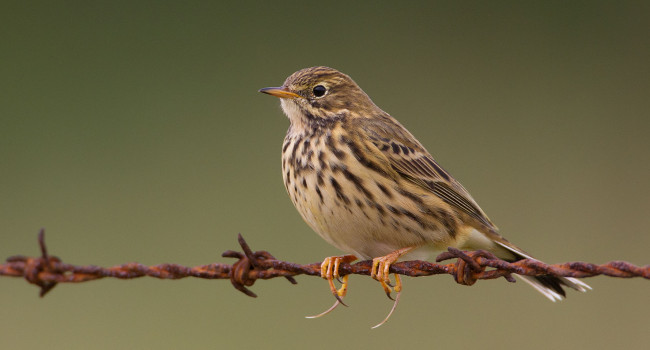
| Tree
Pipits – one of a group of long-distance
migrants that are of conservation concern – have declined
by 82% over the past
25 years |
Using
this website
This website is a "one-stop shop" for
information about the population status of our common terrestrial
birds. It is based on data gathered by many thousands of volunteers
who contribute to BTO-led surveys. With one page per species,
users can quickly find all the key information about trends in
population size and breeding performance over the period 1967–2006,
as measured by BTO monitoring schemes.
The summary of key findings
provides a brief overview of our main findings this year. For
each species, we provide:
-
General information concerning species' conservation
listings and UK population sizes
-
A brief summary of observed changes in the
size of the population and information concerning the possible
causes of these changes
-
A series of graphs and tables showing the
trends and changes in population size and breeding performance
over the past 38 years
-
Trends calculated from BTO/JNCC/RSPB Breeding
Bird Survey (BBS) data, not only for the UK as a whole but
also for each of its constituent countries (England, Scotland,
Wales and Northern Ireland)
-
A system of Alerts that highlight population
declines in any census scheme of greater than 25% or greater
than 50% that have occurred over the past 5 years, 10 years,
25 years and 38 years.
The website also provides details of the field and
analytical methods that were used
to produce the results for each species and of the methods used
to identify alerts. We discuss
overall patterns of trends in abundance and breeding success,
and compare the latest trend information and alerts with the Population
Status of Birds list (Gregory
et al. 2002). Four appendices
list alerts and population changes by scheme, and there is also
a facility to select and display your own tables
of population change.
You can navigate your way around the site using
links from the contents page and between
sections. Alternatively use the drop-down menus accessible from
the menu bar at the top of each page. The top right menu provides
a drop-down list with quick access to the species accounts. To
find out about other online survey results and how you can participate,
visit BirdWeb by clicking on
the BirdWeb logo in the page footers.
The website covers the majority of British breeding
birds, over 100 species in total, but excludes (with a few exceptions)
colonial seabirds, which are well covered by the JNCC's Seabird
Monitoring Programme (Mavor
et al. 2006), and rare species that are included
in the reports of the Rare
Breeding Birds Panel (e.g. Holling
& RBBP 2007a, 2007b).
We value your comments on this report and particularly
any suggestions on how it can be improved.

Authors
This report was written by Stephen Baillie, John
Marchant, Humphrey Crick, David Noble, Dawn Balmer, Carl Barimore,
Rachel Coombes, Iain Downie, Steve Freeman, Andrew Joys, David
Leech, Mike Raven, Rob Robinson and Richard Thewlis. The formal
citation for the report is given in the page footer.
Next page –
Key findings