



Field methods
Fieldwork spanned 4 winters and 4 breeding seasons, starting in November 2007, during which we cumulatively surveyed the whole of Britain and Ireland. To fulfil these objectives there were two complementary fieldwork methods which offered something for everyone.
Roving Records - whatever you see, whenever, wherever
For distribution maps to be comprehensive we needed species lists that were as complete as possible for every 10-km square in Britain and Ireland in the winter and the breeding season. Roving Records aimed to capture all kinds of distribution records; from species lists for grid squares to one-off records of hard to find species, and anything in-between. They were also a means of accumulating evidence of breeding and for providing records of nocturnal species. Everyone could take part by supplying Roving Records. Forms were available for download from August each year, ready for the beginning of fieldwork in November.
Timed Tetrad Visits - dedicated counts in specified tetrads
Timed Tetrad Visits (TTVs) were principally concerned with discovering the broad patterns of relative abundance. Basically, a TTV involved walking around a tetrad, birdwatching for 1 or 2 hours and recording everything you saw and heard.
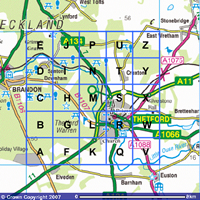
Tetrads are 2km × 2km squares and labelled A to Z within each 10-km square (see image, right). TTVs did not aim to produce a complete species list for the tetrad, but a sample of what one could find during a pair of visits in winter and/or summer. We aimed to cumulatively cover at least 8 tetrads in every 10-km square in Britain and Ireland during winter and summer. You could take on one or as many tetrads as you wish. This was a great opportunity to visit those hidden corners of the landscape and find new birds. If you were interested in taking on a tetrad, you contacted your Atlas Regional Organiser.
(Image produced from the Ordnance Survey Get-a-map service. Image reproduced with kind permission of Ordnance Survey.)
Timed Tetrad Visit field methods
comprehensive instructions
You needed to make two visits in a season, one early and one late. In winter this meant the first visit in November/December and the second in January/February. In the breeding season this meant the first in April/May and the second in June/July. Once you had made two visits in the winter and two visits in the breeding season, then that tetrad was done. A tetrad should not be covered in all four years of the Atlas.
Each visit had to last a minimum of 1 hour, or optionally 2 hours. Whether you spend 1 hour or 2 hours, during this timed part of the visit you aimed to survey all the major habitat types present in the tetrad and count all the adults of all species you see or hear. Counts from the first hour and second hour should be kept seperate. We asked surveyors to exclude juveniles (birds of the year) where possible, although this can become more difficult as the breeding season progresses. The term 'adults' includes all birds in immature plumage that you may encounter e.g. gulls, Cormorants, raptors. You could briefly 'stop the clock' if you encountered large flocks or especially dense concentrations of birds that slow your progress. Surveyors were asked to record any evidence of breeding they notice whilst surveying. The code 'T' (territorial birds) could be applied to several birds singing against each other on one day. At the end of your 1 or 2 hours you could opt to continue listing (i.e. just ticking off) additional species, or return to particular areas to search for missed species, or to try and confirm breeding. You could change the route around your tetrad between the early visit and the late visit.
After your two visits you could optionally produce your own estimate of how many individuals (adults) of each species was present in the whole tetrad. This 'Tetrad Population Estimate' refered to the number of birds you think may be present in the tetrad and not the number you think may be breeding. So bearing in mind how much of the square you visited you might be able to very approximately extrapolate the numbers you encountered on your route to the number in the whole tetrad. We were only looking for very approximate numbers, to the nearest 1 for numbers less than 10, to the nearest 10 for numbers less than 100, to the nearest 100 for numbers less than 1000 etc. For some species and habitats this was very easy but for others much more difficult. If you visited the only lake in the square and saw 6 Tufted Ducks your tetrad estimate would be just 6. If on the other hand you reckon you visited half of the woodland and encountered 14 Blue Tits, your extrapolated tetrad estimate might have been 30. Though these numbers are by definition pretty crude, other studies have found them to be very useful when taken with everyone else's across the whole country. But they are optional, so if you don't feel confident giving them don't worry.
Read a more comprehensive document about Tetrad Population Estimates.

Share this page